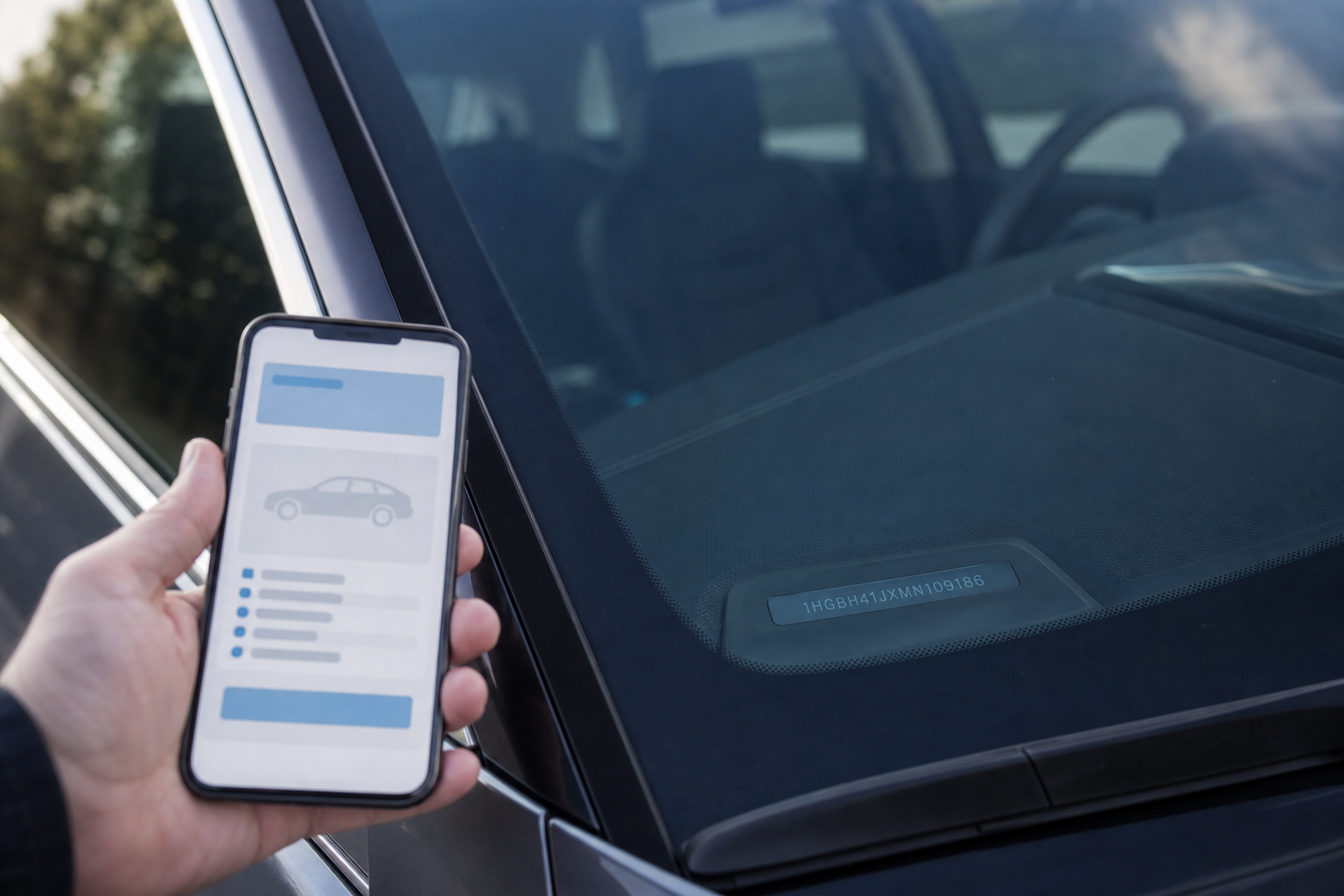
You’re standing in a grocery store parking lot, phone in one hand, meeting a seller who swears the 2016 Honda Accord has a clean title and no accidents. The VIN plate is right there at the base of the windshield. That 17-character string can confirm or contradict almost everything this person just told you, theft flags, title brands, open recalls, even whether the trim matches what’s advertised, in minutes, for free. What it can’t do alone is guarantee a complete accident or service history. Knowing that boundary is what separates a smart buyer from a hopeful one.
A vehicle VIN check is the single fastest screening tool you have before handing over cash. Here’s how to use it properly.
The Two-Minute VIN Routine
Before you test-drive anything, check the VIN in two locations on the vehicle itself. The metal plate visible through the lower driver-side windshield is the most accessible, but always cross-reference it against the label on the driver door jamb. On most vehicles, you’ll also find the VIN on insurance documents and the title. If any of those don’t match, stop. Mismatched VINs suggest tampering, cloning, or a parts car rebuild, none of which you want to inherit.
The 17 characters aren’t random. The first three, the World Manufacturer Identifier, tell you who built it and where. Characters four through eight, the Vehicle Descriptor Section, encode the model, engine, and body type. The remaining digits pin down the model year, assembly plant, and production sequence. On a 2014 Ford F-150, for example, the eighth character identifies which engine the truck left the factory with, useful when a seller claims a specific powertrain upgrade or trim level.
You don’t need to memorize the code chart. You need a free VIN decoder, which any smartphone browser can reach. Plug the number in, confirm the output matches what you’re looking at in the driveway, and you’ve already eliminated the most common misrepresentation: a car that isn’t what the listing says it is. Do this before you even start the engine. If the decoded trim, engine, or model year contradicts the ad, you’ve saved yourself an unnecessary test drive. Always check a VIN before buying a used car, this two-minute habit catches problems that a walk-around never will.
Free VIN and Theft Screening
Not every free VIN check delivers the same data, and some “free” tools are really just teasers designed to sell a full report. Knowing which sources are genuinely useful matters.
The National Highway Traffic Safety Administration (NHTSA) offers a free recall lookup by VIN, no account required, no paywall. The National Insurance Crime Bureau (NICB) provides a free VINCheck tool that screens for theft records and salvage or flood branding reported to participating insurers. These two cover the highest-stakes questions at zero cost.
For a stolen vehicle VIN check specifically, the NICB tool is your starting point, but understand its limits: it searches records from participating insurance companies, not every police report nationwide. If you’re buying in a state that offers its own DMV title lookup, some do, some don’t, run the VIN there too. States vary widely. A few let you pull basic title status online for free; others require an in-person records request. When your state doesn’t offer an online option, the NICB screen plus a request for the seller’s physical title remain your best free tools.
A free VIN check is screening, not certification. Running a free auto vehicle check through the NICB and NHTSA databases covers the most critical flags, but if anything looks off, if the NICB flags a record, if the seller can’t produce a title, if the VIN comes back with a brand you didn’t expect, your next step is the local police non-emergency line or your state’s DMV, not a second free website. Treat free databases as a first filter, not a final verdict.
Title Brands and Mileage Flags
A VIN history report becomes useful only when you know what the entries mean. Title brands, salvage, rebuilt, flood, junk, are applied by the state where the event was processed, and this is where things get inconsistent. A vehicle totaled in one state might carry a salvage brand there but be re-titled as rebuilt in another state with looser thresholds. This practice, sometimes called title washing, is why you should always check what brand a title carries in the state where the damage occurred, not just the current registration state.
Flood branding deserves special attention. Water damage causes long-term electrical and corrosion problems that may not surface for months. If you see a flood brand in the history followed by a clean title in a different state, that’s a red flag worth walking away from.
Mileage inconsistencies show up when reported odometer readings at inspections or title transfers don’t increase at a plausible rate. A VIN number lookup that shows a vehicle at 80,000 miles during one registration period and then 60,000 at a later transfer is a rollback signal. Some gaps are data-entry errors, but consistent downward trends are not.
Short-flip ownership chains, where a vehicle changes hands multiple times in a year or two, often indicate undisclosed problems that each owner discovered and passed along. A single quick resale could be benign. Three in eighteen months rarely is.
Recalls, Paid Reports, Limits
The NHTSA recall lookup is the most underused free tool in a buyer’s kit. Plug in the VIN and you’ll see every open recall tied to that specific vehicle, not just the model line. Sellers sometimes claim “all recalls done” without documentation. The NHTSA database confirms or denies this in seconds.
Beyond recalls, a free VIN number check online free of charge typically confirms build specs, basic title status, and theft screening, but it usually won’t show you a detailed accident timeline, service records from dealerships, or auction photos from a salvage sale. That’s where paid reports from providers like Carfax or AutoCheck enter the picture.
The question of a VIN check vs Carfax isn’t really “which is better”, it’s “what do you still need to know?” If the free sources come back clean, the title matches, the seller has maintenance receipts, and a pre-purchase inspection by an independent mechanic checks out, you may not need to spend on a paid report. But if you’re buying a higher-value vehicle, if the ownership history seems choppy, or if anything in the free data raised a question you can’t resolve, a paid report can fill gaps that free tools structurally can’t. Neither replaces a physical inspection. Both together still don’t equal certainty, they reduce risk.
AI-Powered VIN Analysis
Running a VIN through three or four free sources leaves you with disconnected fragments: a recall list here, a title status there, decoded build specs on another tab. A Free Vehicle VIN Check With AI pulls those fragments into a single, readable narrative instead of forcing you to cross-reference tabs yourself.
Instead of cross-referencing tabs yourself, an AI VIN check synthesizes the data into conclusions a buyer can act on: the vehicle’s likely maintenance posture based on ownership length and recall completion, whether the build specs match the listing claims, and where the risk profile sits relative to what you’d expect for the model and age. It translates what a VIN decoder outputs into plain-English automotive insights, flagging, for instance, that a vehicle with three owners in four years and an open airbag recall represents a different risk profile than a single-owner example with all recalls addressed.
This doesn’t replace mechanical inspection or professional title verification. It does replace the mental gymnastics of holding five browser tabs in your head while a seller watches you in a parking lot. Think of it as a free expert vehicle history report that organizes what you already have access to, faster and more coherently than you’d manage on your phone at the point of sale.
Pre-Purchase VIN Workflow
Every used-car meet-up should follow the same sequence. First, locate the VIN on the windshield and door jamb. Confirm they match. Run the number through a free decoder to verify year, make, model, engine, and trim against the listing. Then screen the VIN through the NICB for theft and salvage flags, the NHTSA for open recalls, and your state’s DMV lookup if one exists.
If everything aligns, build specs match the ad, no theft or salvage flags, recalls completed, title in hand with consistent branding, you’re in a reasonable position to proceed to a test drive and a pre-purchase inspection by an independent mechanic. If anything conflicts, mismatched VINs, a title brand the seller didn’t mention, mileage that doesn’t add up, open safety recalls, pause. Ask the seller to explain. If the explanation doesn’t hold, walk. There are always more cars.
When the free data leaves a gap you can’t close through conversation or visual inspection, a paid report or a trip to the DMV for a full title history is worth the time and money. When the free data is clean and the physical inspection confirms it, you’ve done your due diligence without spending a dollar on reports.
Check a VIN before buying a used car every single time. Not because every seller is dishonest, most aren’t, but because the ones who are count on you skipping this step. The whole process takes five minutes. The regret of not doing it lasts much longer.