On-Site Versus Shop Repair
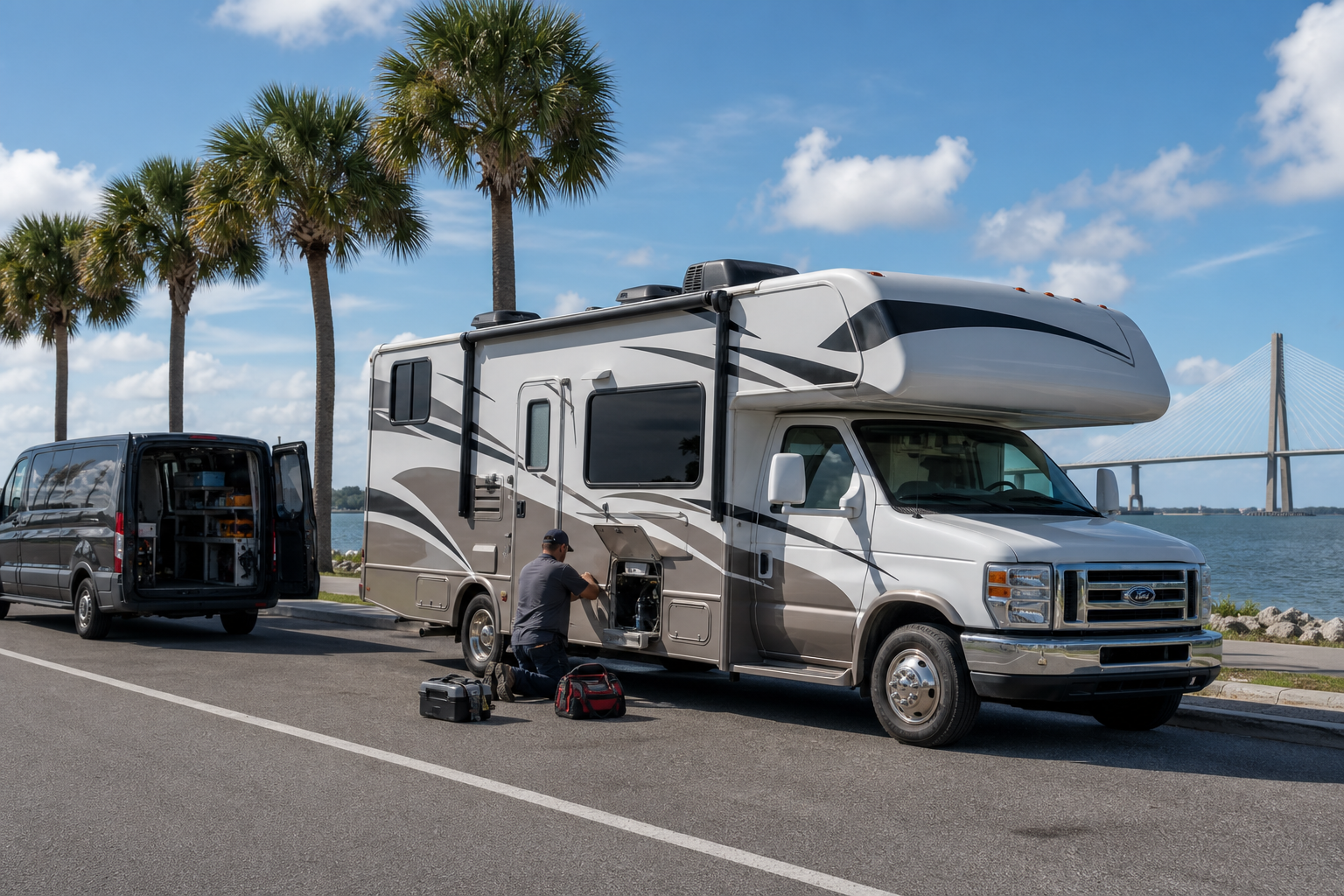
It’s mid-July in Pinellas County, your Class A is parked at a campground off the Bayway, and the rooftop AC just died. The interior temperature is climbing past ninety. You could call a tow service, but maneuvering a forty-foot rig through St. Petersburg traffic to the nearest fixed shop, assuming one has bay space today, sounds like its own emergency. This is the scenario where mobile RV repair in St. Petersburg, FL exists as a practical alternative: a technician drives to the rig with diagnostic tools, a parts inventory, and the ability to resolve many failures on the spot.
The distinction from a fixed shop matters. A mobile tech works without a lift, a paint booth, or major fabrication equipment. That limits scope but eliminates transit. For a stuck rig, whether it’s in a driveway, an RV park, or a storage lot, eliminating transit can mean hours or even days saved.
St. Petersburg’s coastal environment shapes the failure profile. Persistent humidity accelerates corrosion on electrical connections, chassis hardware, and exterior trim. Salt air attacks anything ferrous that isn’t sealed. UV exposure in Florida’s latitude degrades roof caulk, rubber seals, and exterior plastics faster than in northern climates. And the sustained summer heat loads AC systems harder and longer than they’d run in most other markets. A qualified mobile RV repair provider staffed by techs who understand these regional stressors will look for the damage patterns that out-of-state shops wouldn’t prioritize.
Common Failures and On-Site Fixes
Most mobile RV calls fall into a handful of categories: air conditioning, generators, plumbing, roof leaks, and electrical faults. Understanding which ones a mobile tech can typically handle, and which ones need a shop, saves time and money.
AC Systems. When someone searches for RV AC repair in St. Petersburg, FL, the underlying issue is often a failed capacitor, a seized compressor, or a thermostat fault. Capacitor replacements and thermostat swaps are straightforward rooftop work a mobile tech handles routinely. A seized compressor usually means swapping the entire rooftop unit, which a mobile crew can do if they stock or source the replacement. Refrigerant recharges are possible on-site, but if the system has a slow leak in the evaporator coil, a shop with vacuum equipment may be the better call. Generators. Starting failures are the most common generator complaint. Fuel delivery problems, clogged filters, failed fuel pumps, stale fuel, are almost always resolved on-site. So are dead start batteries and faulty control boards. RV generator repair in St. Petersburg often traces back to ethanol-blended fuel degrading in Florida’s heat. A mobile tech can usually get a generator running again in under two hours if parts are available.
Plumbing. Leaking fittings, failed water pumps, cracked holding-tank valves, and water-heater failures are bread-and-butter mobile work. PEX fittings and common valve assemblies are small, inexpensive, and easy to carry on a service truck. RV plumbing repair in St. Petersburg, FL becomes a shop job mainly when the issue is buried behind cabinetry that requires significant disassembly. Roof and Seals. UV-degraded lap sealant around vents, antennas, and AC shrouds is a leading cause of water intrusion in Florida-based RVs. A mobile tech can reseal joints and patch membrane damage on-site. Full roof replacements or large-section EPDM work typically require a controlled shop environment. RV roof repair in St. Petersburg, FL is preventive as much as reactive, annual resealing is one of the most cost-effective maintenance items a mobile tech can perform.
Propane (LP Gas) Safety. Propane work deserves its own discussion because not every mobile RV mechanic is qualified to perform it. A fully LP-gas-licensed technician has specific training in leak detection, regulator replacement, line pressure testing, and appliance commissioning. If you smell propane inside the coach, that is not a wait and see situation, it’s a safety emergency covered in the next section. When hiring any mobile RV tech near you, confirm LP gas licensing separately from general mechanical certification. The two are not the same credential.
RV Emergency First 30 Minutes
Some failures are inconvenient. Others are dangerous. Knowing the difference matters before you pick up the phone.
If you smell propane or rotten eggs inside the RV, act immediately. Extinguish all flames. Do not flip any electrical switch, on or off, because a spark can ignite accumulated gas. Open doors and windows only if you can do so without operating electric steps or slides. Turn off the LP gas supply at the tank valve if you can reach it safely from outside. Move everyone, including pets, away from the rig. Call 911 if the smell is strong or persistent. Only after the area is ventilated and confirmed safe should you contact a mobile tech.
For non-propane emergencies, a dead generator before a scheduled departure, a water leak flooding a compartment, a complete electrical failure, the first thirty minutes are about gathering information. Note which systems are and aren’t working. Check the breaker panel and fuse block. Look at the converter and transfer switch for visible damage or tripped resets. If there’s a fault code on a display panel, photograph it. These details let a mobile tech arrive with the right parts and a working theory, which reduces both diagnosis time and cost. Emergency RV repair in St. Petersburg is faster when the dispatcher knows whether it’s a single dead circuit or a total power loss. Have your RV’s year, make, model, and length ready. Know whether you’re on shore power, generator, or battery only. If you’re in a campground, confirm that the tech can access your site with a service vehicle.
Mobile RV Repair Pricing Breakdown
Mobile RV repair cost in St. Petersburg varies, but the billing structure is fairly consistent across the market. Understanding the components helps you estimate a total before authorizing work.
Most mobile techs charge a diagnostic or trip fee that covers driving to the rig and performing an initial assessment. This fee often applies whether or not you proceed with the repair. It accounts for the tech’s transit time, fuel, and the opportunity cost of being unavailable for other calls.
Labor is typically billed hourly, with the rate depending on the tech’s certifications and the complexity of the work. Expect the hourly rate for a certified, insured RV mechanic in St. Petersburg, FL to be comparable to what a fixed shop charges, sometimes slightly higher to offset mobile overhead, sometimes lower because the tech has no facility lease. Parts are usually marked up from wholesale cost, which is standard across the repair industry. Some mobile techs carry common components, capacitors, water pumps, filters, fuses, sealant, and can complete a repair in one visit. Specialty or model-specific parts may require a second trip, which can mean an additional service call fee.
After-hours and weekend calls typically carry a premium. If your failure can safely wait until a weekday morning, you’ll likely save a meaningful percentage of the total bill. Conversely, if you’re stuck with a propane leak or a dead coach in August heat, the premium buys real value.
Vetting Your Mobile RV Tech
Choosing a mobile RV mechanic in Pinellas County is a vetting exercise, not a price-shopping exercise. The cheapest call-out means nothing if the tech misdiagnoses a leak or lacks the license to safely service your propane system.
Start with certification. RVDA/RVIA and ASE credentials indicate formal training and tested competency. Ask whether the tech holds current certification, not just that they once completed a course. LP gas licensing is a separate credential and a non-negotiable for any propane-related work. A fully LP-gas-licensed technician has been trained and tested on gas system integrity, leak detection protocols, and appliance safety. If a mobile service advertises propane repair but can’t produce an LP gas license, move on. Insurance is the third pillar. A mobile tech is working on or inside your RV, an asset that can be worth six figures. Verify that the service carries liability coverage and, ideally, a policy that covers damage to the customer’s vehicle during service.
Beyond credentials, ask about scope and limitations. A good mobile tech will tell you clearly what they won’t do on-site, transmission work, frame repairs, major body damage, rather than overpromise. Ask how they source parts, whether they warranty their labor, and whether they document work in writing.
For snowbirds, full-timers, and small fleet operators who winter in the St. Petersburg area, the concept of a personal RV pit crew is worth considering. Rather than calling a random mobile RV mechanic near you each time something breaks, establishing a recurring maintenance relationship with a qualified tech means someone who already knows your rig’s history, its quirks, and the preventive schedule it needs to survive Florida’s coastal climate. That rhythm, seasonal inspections, annual roof resealing, generator servicing, appliance checks, prevents most of the emergency calls this post describes.
Mobile Repair or Tow Decision
Bringing it back to the core question: when does mobile RV repair in St. Petersburg, FL make sense, and when should you tow to a shop?
Mobile repair fits when the rig can’t move safely, when the failure is isolated to a single system, when the repair doesn’t require a lift or specialized shop equipment, and when a certified, insured, LP-gas-licensed tech is available to come to you. Most AC, generator, plumbing, electrical, and roof-seal issues land in this category.
Towing fits when the drivetrain, transmission, frame, or braking system is compromised. It also fits when the failure involves multiple interrelated systems that require extensive disassembly, or when on-site diagnosis reveals a problem bigger than what mobile tools can handle.
Before you call anyone, gather the basics: your RV’s year, make, model, and length; the specific symptoms, including any fault codes or error messages; whether you’re on shore power, generator, or battery; your location and site access constraints; and whether propane is involved. If propane is involved and you smell gas, handle safety first, ventilate, shut off the tank, evacuate, before making any service call. The goal isn’t to avoid shops entirely. It’s to match the right service format to the right failure, minimize downtime, and make sure the person working on your rig has the credentials, the coastal experience, and the insurance to back up the repair. That’s what separates a productive service call from an expensive guess.