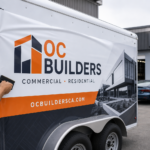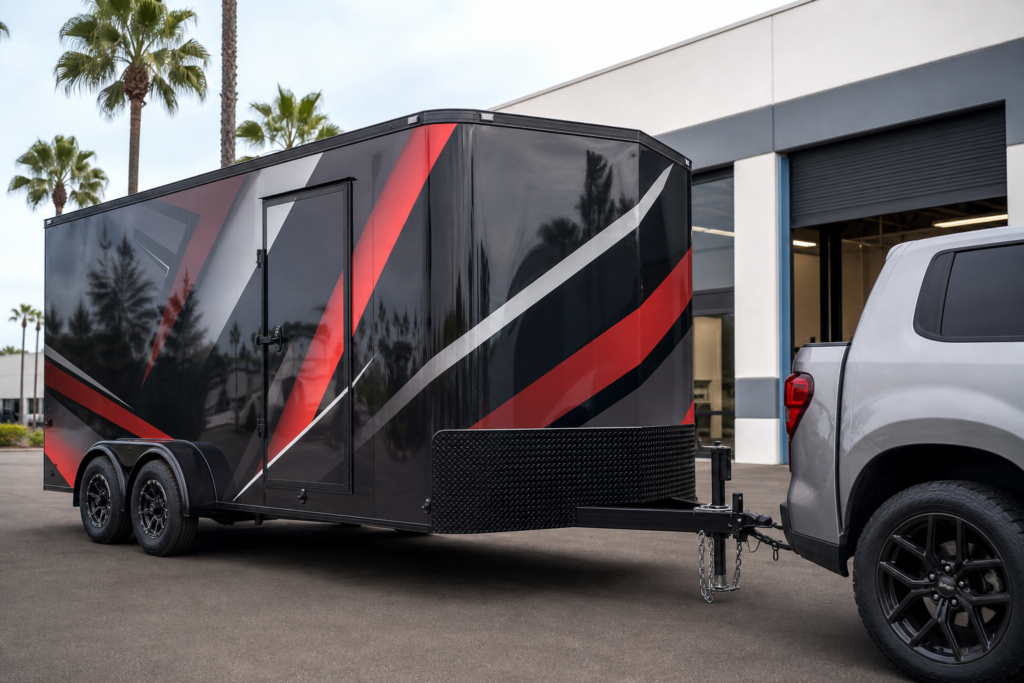
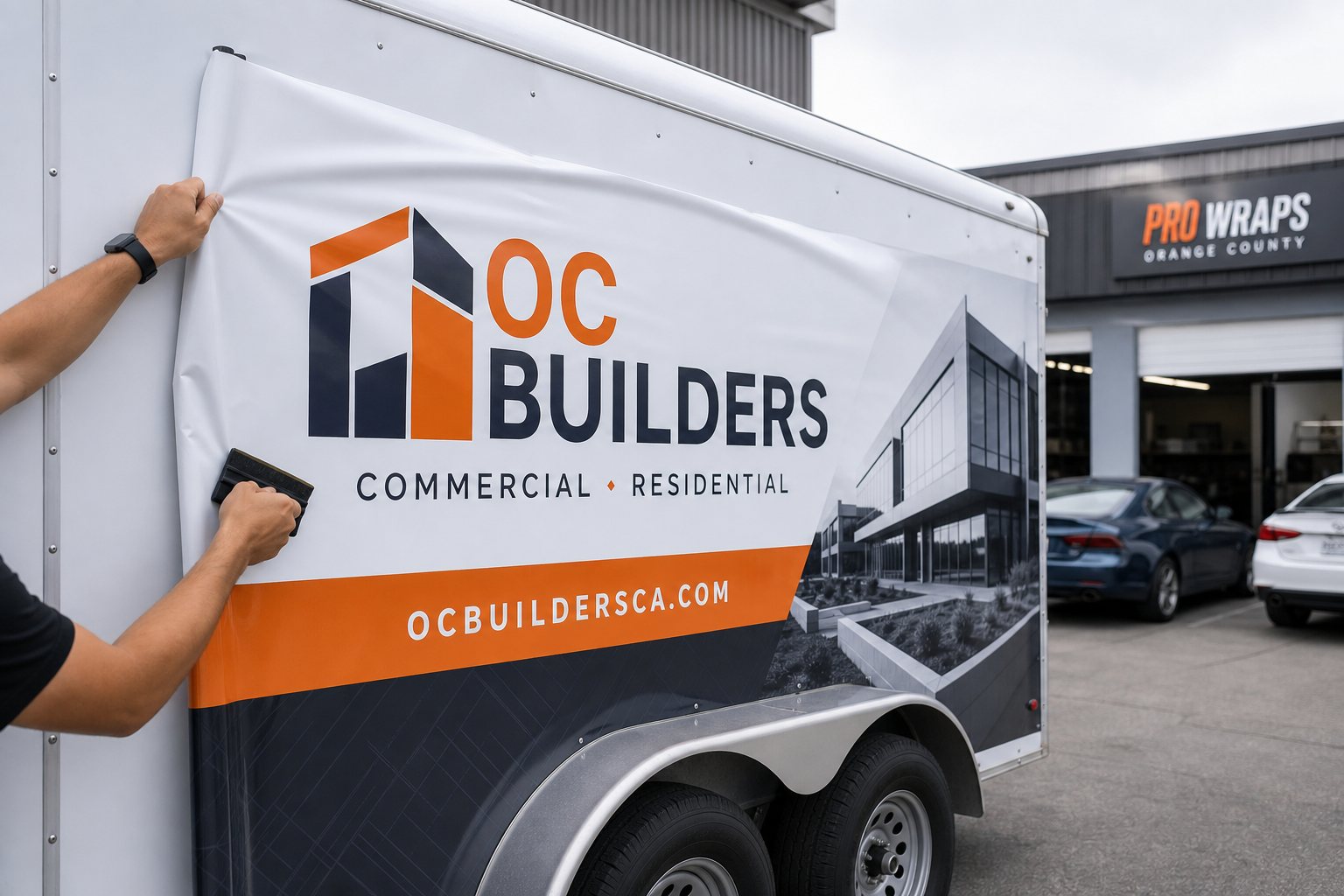
A fully wrapped cargo trailer rolling south on the 405 through Irvine at 5:15 p.m. is doing something no other ad format can do at that moment, sitting in bumper-to-bumper traffic, visible to hundreds of drivers who have nothing to look at but the vehicle in front of them. Park that same trailer outside a job site in Costa Mesa or a commercial lot in Anaheim, and it keeps working overnight, on weekends, through holidays. Understanding trailer wrap pricing in Orange County starts with recognizing what you’re actually buying: a marketing machine that works 24/7, priced according to a handful of concrete variables.
So how much does a trailer wrap cost? The honest answer is that it depends, but OC-area projects generally fall into recognizable range buckets. Starter-level partial graphics, a logo, phone number, and basic color band on one or both sides, land at the low end. A full wrap covering every visible panel with designed artwork, laminated film, and professional installation pushes the price significantly higher. Between those poles sit partial wraps with moderate coverage, often covering the rear doors and one full side.
Quotes typically arrive in one of two formats: per square foot or per project. Per-square-foot pricing gives an apples-to-apples comparison across different trailer sizes but can obscure design and prep costs. Per-project quotes bundle everything, design, print, materials, labor, surface prep, into a single number, which is easier to budget against but harder to compare between shops. Either way, the line items are the same: creative design time, vinyl printing, lamination, surface preparation, and installation labor.
For context, a box truck wrap cost in Orange County tends to run higher than a comparably sized trailer wrap because box trucks have more complex geometry. Van wraps sit in a similar range. Trailer panels are often flatter and more uniform, which can work in your favor. None of this is a provider recommendation, it’s a framework for understanding why the number you’re quoted is what it is.
Biggest Pricing Levers
Trailer category matters more than most people expect. A small utility trailer with two flat side panels is a fundamentally different project than a 7×16 enclosed cargo trailer with double rear doors, fender flares, and exterior rivets. A cargo trailer wrap cost in California reflects not just square footage but complexity: every seam, rivet line, door handle cutout, and corrugated surface adds labor time.
Measuring isn’t as simple as length times height. Recessed rivets require extra tucking. Corrugated panels demand more film and slower application. A 6×12 trailer isn’t half the price of a 7×16 because the prep, design, and mobilization costs don’t scale linearly, they’re partially fixed.
Coverage level is the second major lever. A full wrap delivers maximum visual impact and protects the most surface area, but a well-designed partial wrap can outperform it in certain contexts. A landscaping company running a high-contrast logo with a clear phone number on a clean background can be more readable at freeway speed than a photo-heavy full wrap with too much visual noise. On OC surface streets and beach routes like PCH, where traffic moves slower, more detailed designs get a longer look. On the 55 or 91, simplicity wins.
The decision between full and partial should be driven by how and where the trailer moves, not just budget. A commercial trailer wrap in Orange County earns its keep through legibility, and legibility depends on contrast, type size, and message hierarchy, not how much of the trailer is covered.
Materials, Installation, and Durability
Film choice is where durability lives. Cast vinyl conforms better to curves and complex surfaces and resists shrinking over time. Calendared vinyl costs less but is more prone to edge lifting and degradation, especially under sustained UV exposure. In Orange County, that UV factor is not trivial, trailers parked outdoors in Tustin or Lake Forest bake in direct sun most of the year. Coastal rigs near Huntington Beach or Dana Point add salt air to the equation, which accelerates adhesive breakdown if edges aren’t properly sealed.
Lamination protects the printed surface from UV fade, abrasion, and chemical exposure. Skipping it saves money upfront and costs more over two or three summers when colors wash out. A quality laminate extends usable life meaningfully.
Trailer wrap installation in Orange County varies in cost based on environment and surface condition. An indoor bay with climate control produces better adhesion than an outdoor install on a hot afternoon. Prep steps, degreasing, removing old adhesive, addressing minor rust or paint issues, take time and directly affect how well the wrap bonds and how long it lasts.
Design time is a cost driver that surprises many first-time buyers. If a business supplies clean vector logos, brand colors, and a clear layout direction, design hours stay low. If the designer needs to recreate assets from a blurry JPEG, manage multiple revision rounds, or integrate photography, the creative portion of the bill climbs. The goal is a design that reads clearly in OC traffic reality: short attention windows, multiple lanes, and fast passes at varying distances.
Impressions, ROI, and Long-Term Value
A trailer that drives regular routes through Orange County, commuting between a yard and job sites, parked at commercial locations, running errands on weekends, accumulates impressions passively. The math framework is straightforward: estimate weekly miles driven, multiply by average traffic density on those routes, factor in parked visibility hours, and project across the wrap’s expected lifespan.
Compare that to recurring costs for local advertising. A PPC campaign requires monthly spend that stops producing the moment the budget pauses. Direct mailers go in the trash. A trailer vinyl wrap in Orange County keeps showing up on the 405, in parking lots, and outside client homes for years on a single investment. The cost, amortized over a multi-year lifespan, often drops below what the same business spends monthly on digital ads.
That said, honesty matters here. Not every wrapped trailer generates trackable leads. A general contractor whose trailer sits in a residential neighborhood during a remodel builds familiarity with that specific neighborhood, and landscaping, HVAC, mobile detailing, and event rental companies report the same pattern. The phrase business owners hear most often is some version of “I see your trailer everywhere.” That recognition compounds into trust, and trust shortens the sales cycle when a prospect finally needs the service. But if the trailer rarely leaves a gated yard or the design is unreadable, the impressions don’t materialize. ROI depends on route, brand clarity, and service area alignment.
Hidden Costs and Avoidable Mistakes
The cheapest trailer graphics pricing in Orange County often isn’t cheap once reality sets in. Bargain film that shrinks after two summers means a full redo, not just a touch-up. Skipping lamination means faded colors and a wrap that looks neglected, the opposite of the brand impression intended. Installing over rust or old adhesive without proper prep leads to bubbling and edge failure within months.
Other costs catch buyers off guard: removal of an existing wrap before the new one goes on, potential paint damage on older trailers where the clear coat has deteriorated, downtime while the trailer is in the shop, and reprints caused by approving a proof without checking it at actual scale. Each of these is avoidable with preparation.
Before requesting quotes, gather specifics: accurate trailer dimensions, photos of all sides including close-ups of rivets, seams, and any surface damage, desired coverage level, brand assets in usable formats, your timeline, where the trailer parks when not in use and how much sun it gets, how long you expect the wrap to last, and whether you’ll want clean removal later. A shop that asks for all of this upfront is doing the job right.
One sanity check worth running: if the trailer itself is near end-of-life, rusted panels, structural issues, paint too far gone for proper adhesion, the wrap investment may not make sense. Wrapping a trailer you’ll replace in a year is throwing money at a temporary surface. Vehicle wrap prices in Orange County reflect professional-grade work, and that work deserves a surface that will hold it.
Price It as Long-Term Advertising
Trailer wrap cost comes down to a short list of real variables: trailer size and surface complexity, coverage level, material grade, design effort, and installation conditions. Each one moves the number in a predictable direction. OC-specific factors, intense sun, coastal air, heat cycling, make material and prep quality more important here than in milder climates, though businesses researching trailer wrap pricing boston will find that harsh winters and road salt create a parallel set of durability concerns in colder markets.
The decision rule is practical. Match coverage and materials to how and where the trailer actually lives. A rig that runs daily routes on Orange County freeways and parks in visible locations justifies premium film and full coverage because it will earn impressions for years. A trailer that mostly sits in a shaded yard might warrant a simpler partial wrap. Either way, price it as what it is: a long-term local advertising asset, not a one-time decorating expense.