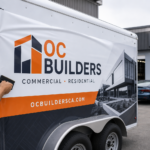
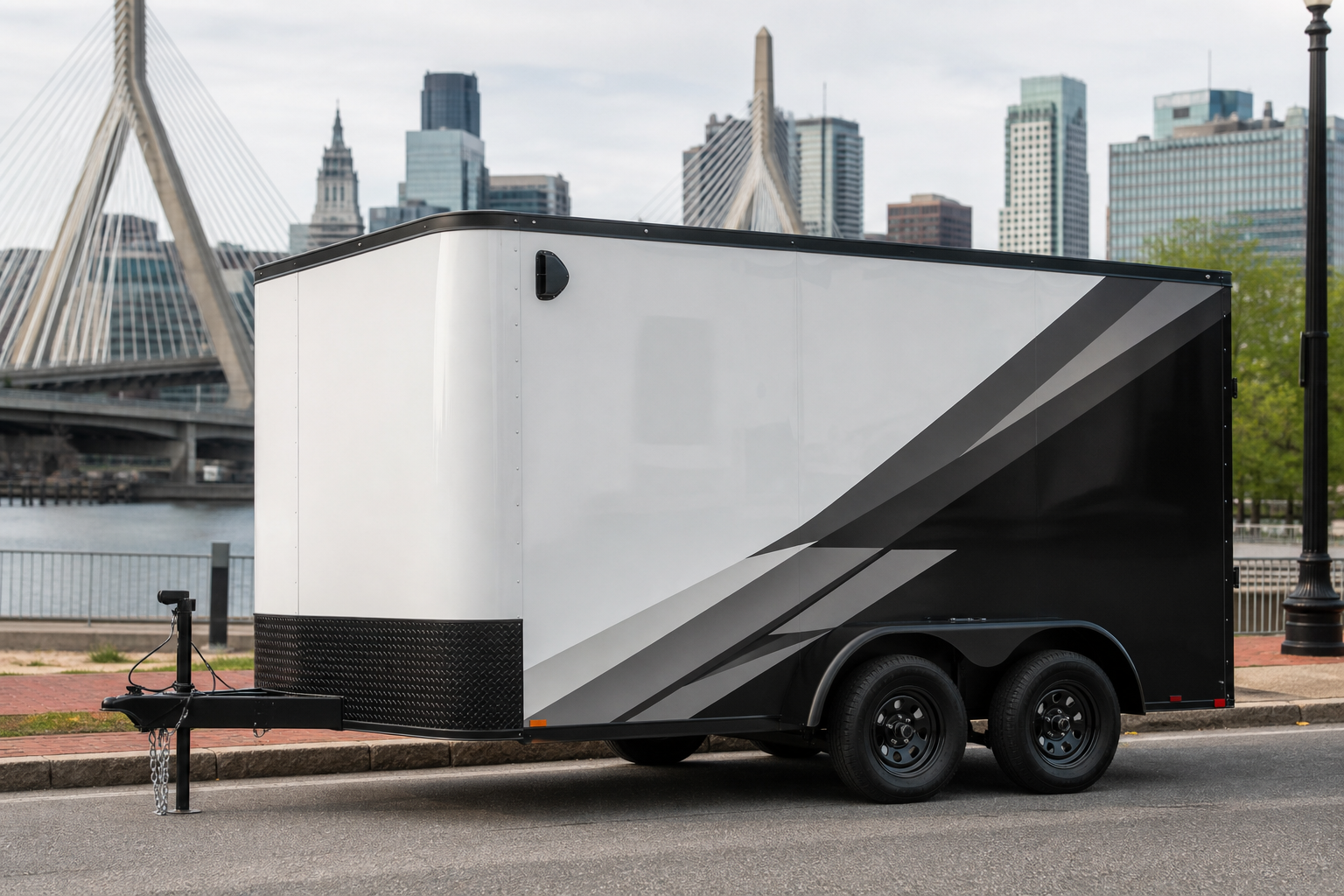
A landscaping trailer sits curbside in Dorchester through January, panels glazed with salt spray and frozen slush, then bakes in the same spot come July. Whatever vinyl is on that trailer has to stay stuck, stay vivid, and keep advertising through every season in between. If you’re pricing a trailer wrap in Boston right now, you need more than a ballpark number, you need to understand the handful of factors that make one quote half the price of another and whether the cheaper option will still look right twelve months from now.
What Your Quote Includes
Most operators start by searching “how much does a trailer wrap cost” and find ranges so wide they’re barely useful. That’s because a trailer wrap quote isn’t one line item, it bundles design, materials, printing, prep, and labor into a single price, and each piece scales independently.
A partial wrap, logo, phone number, a few brand panels on the sides, costs considerably less than a full wrap covering every square inch of a trailer’s exterior. In the Greater Boston area, partial wraps for a standard single-axle utility trailer tend to land in a lower tier, while full wraps on larger enclosed trailers climb significantly higher. The exact numbers depend on who’s quoting and what they’re including, which is precisely why two shops can look at the same trailer and come back with figures that don’t resemble each other.
One quote may include custom design work; another assumes you’re handing over print-ready files. One may spec premium cast vinyl with a protective laminate; another defaults to a cheaper calendared film. One may factor in removing old decals and correcting oxidation; another prices the wrap as though the surface is already clean and smooth. Until you know what’s inside each quote, comparing trailer wrap costs is like comparing hotel rates without checking whether breakfast is included.
Factors That Move the Price
Surface area is the most obvious cost driver. A small open utility trailer has a fraction of the wrappable space of a twenty-foot enclosed cargo trailer, and material is sold by the square foot. But surface area alone doesn’t explain pricing gaps.
Design and branding work before anything gets printed can represent a meaningful share of the total. A simple one-color logo placement requires far less studio time than a full illustrative brand wrap with color matching across multiple panels. If you’re commissioning original design, not just reformatting an existing logo, expect that cost to show up in the quote.
Material grade matters everywhere, but it matters more in Boston. A vinyl trailer wrap in Boston faces freeze-thaw cycles that stress adhesive bonds, road salt that accelerates edge lifting, coastal humidity that tests laminate integrity, and summer heat that softens cheaper films. Cast vinyl, thinner, more conformable, and engineered for long-term outdoor use, handles these swings better than calendared vinyl, which is stiffer, more affordable, and more prone to shrinking over time. The laminate layer printed over the graphic protects against UV fade and abrasion; skipping it or using a thinner laminate saves money upfront but shortens the wrap’s useful life, sometimes dramatically in New England conditions.
Prep is where many operators get surprised. Removing old decals or partial wraps, cleaning adhesive residue, addressing surface oxidation on aluminum panels, and working around rivets, corrugated surfaces, and multiple doors all add labor hours. A trailer with clean, flat panels wraps faster and cheaper than one with dents, ghosting from old graphics, or textured corrugation that demands careful heat work.
Installation Quality and Durability
Trailer wrap installation in Boston isn’t just about sticking film to metal. It’s detail work, stretching vinyl into rivet lines without trapping air, wrapping door edges so they don’t peel back after a few hundred open-close cycles, and heat-sealing every border so salt-laden moisture can’t creep underneath.
Budget installations tend to skip or rush these steps. The wrap looks fine on day one. Three months into a Boston winter, edges along the bottom rail start curling. Rivets become visible bumps where the vinyl has tented. Door seams lift. By spring, the trailer looks worse than bare metal would have.
Downtime matters too. A professional installer can typically turn around a full trailer wrap within a few days, but rushed timelines lead to rushed work. For operators who depend on their trailer daily, contractors, movers, mobile food vendors, scheduling the install during a slower period and allowing adequate cure time is worth the minor inconvenience.
This is where working with an experienced, reputable installer pays off in harsh-climate markets like Boston. Shops with real New England experience understand how the region’s specific conditions stress vinyl, and they prep, apply, and finish accordingly. The difference isn’t always visible at pickup, it shows up six, twelve, eighteen months later when the wrap still looks the way it did on install day.
Trailers vs. Other Vehicle Wraps
Operators running mixed fleets sometimes wonder how trailer pricing stacks up against their other vehicles. Box truck wrap pricing in Boston tends to run higher than most trailer wraps simply because box trucks have more surface area, curved cab panels, and windows that require cutouts or perforated film. A twenty-six-foot box truck is a bigger, more complex job than a sixteen-foot enclosed trailer, even though they might look similar parked side by side.
Fleet wrap pricing in Boston often comes with volume logic, wrapping three or five trailers at once can bring the per-unit cost down because design work is done once, materials are ordered in bulk, and the installer can batch production. If you’re wrapping a single trailer, you won’t see those economies, but it’s worth asking whether a shop offers fleet rates if you plan to add vehicles later.
Broadly, vehicle wrap prices in Boston reflect the region’s higher cost of doing business, shop rents, labor rates, and material sourcing all run above the national average. That context is useful when comparing a local quote against pricing guides written for markets with lower overhead.
Getting a Trustworthy Quote
Walking into a shop, or filling out an online form, with the right information speeds up the process and produces a more accurate number. Bring exterior photos of every panel you want wrapped, including close-ups of rivets, doors, vents, and any existing graphics or damage. Know your trailer’s dimensions: length, height of the side panels, and whether the front and rear are wrappable. Note the substrate, aluminum, steel, fiberglass, or corrugated, because each material preps and accepts vinyl differently.
Ask what vinyl brand and grade the quote assumes, and whether laminate is included. Ask whether design is part of the price or billed separately. Ask what the warranty covers, material only, or material and labor, and for how long. Ask what happens if the trailer has surface issues discovered during prep that weren’t visible in photos.
The quotes that should raise concern are the ones that don’t ask you anything back. A shop that quotes a flat rate without seeing the trailer, asking about its condition, or clarifying the scope of the wrap is estimating blind. In a market like Boston, MA, where climate punishes every shortcut, a vague quote often means vague execution.
Smart Pricing for Boston Operators
Understanding trailer wrap pricing boston operators actually face comes down to a simple tradeoff: pay less now and risk rewrapping sooner, or invest in premium materials and skilled installation that holds up through the full cycle of New England weather.
Cheaper vinyl and cut-rate installation can work in mild, dry climates where the film never faces salt brine, sub-zero adhesive stress, or ninety-degree summer softening. Boston isn’t that market. Operators here who choose quality film, proper prep, and experienced installation routinely get years of clean, professional appearance from a single wrap, which, spread over that lifespan, often costs less per year than the budget option that needs replacing in half the time.
The framework is straightforward. Know your trailer’s real dimensions and condition. Understand what’s in each quote. Prioritize material grade and installation quality over the lowest sticker price. And factor Boston’s climate into the equation, because the weather will test the wrap whether the budget accounted for it or not.