Introduction
- Why Commercial Wraps Are the Smartest Marketing Spend on Your Balance Sheet
- Six Tiers of Commercial Wrap Coverage
- Your Wrap Strategy Should Reflect Your Industry’s Unique Goals
- The Technology Stack That Separates Leaders from Followers
- The Business Case for Commercial Wraps, Built on Real Numbers
- The 2.5-Second Rule: Design Hierarchy That Actually Converts
- Wrapping Leased Vehicles: What Your Fleet Manager Needs to Know
- Protecting Your Investment: Maintenance That Extends Wrap Life to 7 Years
- Commercial Wraps Are Not a Cost; They’re a Compounding Asset
- Ready to Wrap Your Fleet?
- Summary
Why Commercial Wraps Are the Smartest Marketing Spend on Your Balance Sheet
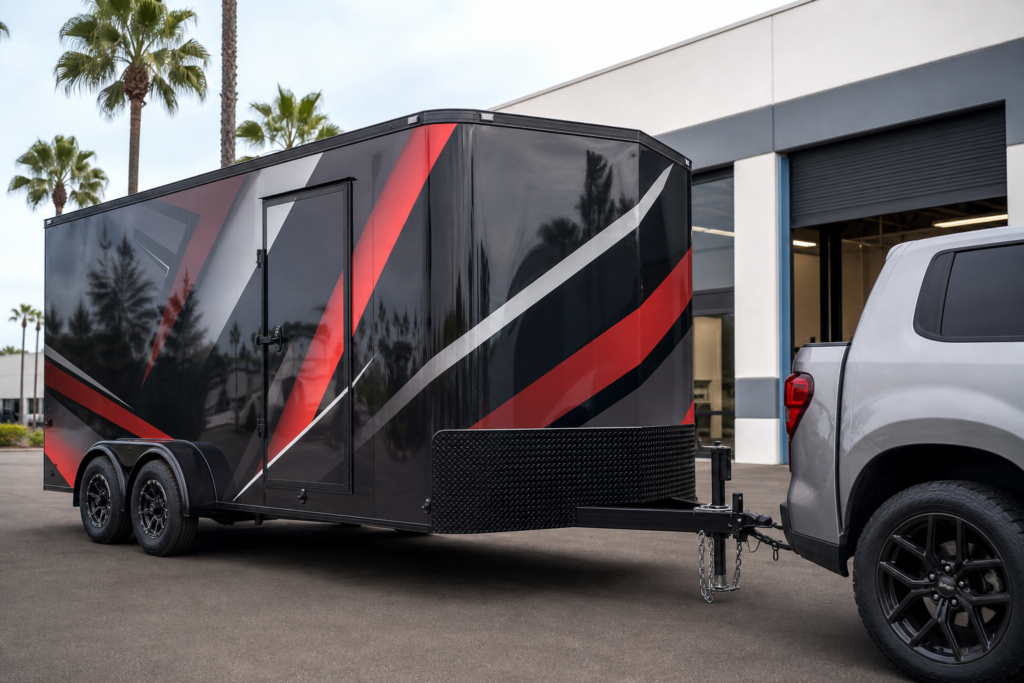
Every morning your service van pulls out of the driveway, a billboard worth thousands of dollars in advertising value hits the road; and you paid for it once. Commercial wraps transform ordinary work vehicles into high-impact mobile advertising assets that generate impressions around the clock, in every neighborhood your drivers service. Unlike a Facebook ad that disappears when the budget runs out, or a billboard lease that expires in 30 days, a professionally installed commercial wrap keeps working, keeps branding, and keeps converting for up to seven years.
But “slap your logo on a van” is not a strategy; it’s a missed opportunity. This guide breaks down every layer of the commercial wraps ecosystem: service tiers, industry-specific approaches, 2026 technology trends, and the ROI math that makes the business case undeniable. Whether you’re a solo plumber looking for your first decal set or a national logistics company standardizing 200 vehicles, this is your roadmap.
Six Tiers of Commercial Wrap Coverage
Full Commercial Wraps
A bumper-to-bumper transformation that completely replaces the vehicle’s visible surface with your brand. Full wraps deliver the highest possible impression impact and carry a secondary financial benefit: the 3M or Avery Dennison film acts as a sacrificial layer that preserves the factory paint underneath, protecting resale value for lease returns or future sale. When brand equity is the goal, full wraps are the gold standard.
Partial Wraps (⅓ to ½ Coverage)
The sweet spot between cost and visibility. A skilled designer integrates your vehicle’s factory color as part of the composition; think a white cargo van with bold blue and green graphics that flow organically around the rear panels. You get a professional, eye-catching result at roughly 40 to 60% of a full wrap’s cost. Partial wraps are ideal for growing businesses that want a polished presence without the full-fleet price tag.
Spot Graphics & Decals
The most targeted application: logo, phone number, website URL, and any required DOT registration numbers. Cut-vinyl decals or digitally printed spot graphics are ideal for service-only vehicles that rarely park in high-traffic areas, or for small businesses testing vehicle marketing before committing to a full program. Simple, clean, and completely removable without paint damage.
Reflective Safety Wraps
Retroreflective vinyl; most commonly 3M™ Scotchlite™; is engineered to return light directly toward its source at night. For roadside service fleets, utility companies, or emergency responders, this isn’t decoration, it’s worker protection. The bonus: headlights from passing vehicles effectively illuminate your brand messaging after dark, extending your advertising hours to 24/7 without additional spend.
Fleet Branding
Unified visual identity applied consistently across every vehicle type in your operation; compact cars for sales reps, full-size vans for installers, and box trucks for delivery. The challenge with fleet work is maintaining design cohesion across radically different panel shapes and sizes. Experienced wrap studios create master design templates that adapt proportionally, so your brand looks equally authoritative on a Ford Transit and a 26-foot box truck.
Perforated Window Film
One-way perforated vinyl allows full-color graphics to span rear and side glass surfaces while maintaining the driver’s outward visibility. Viewed from outside at normal distances, the design appears as a continuous, solid graphic. Viewed from inside, the perforations allow light transmission similar to a fine mesh screen. Window film can dramatically expand the canvas of a partial wrap and create visually seamless designs that wrap around corners.
Your Wrap Strategy Should Reflect Your Industry’s Unique Goals
Home Services
Bold logos, large-format phone numbers in high-contrast color, “Licensed & Insured” badges prominently placed. High legibility from driveways at 20 feet.
Build instant trust with homeowners. A clean, professional wrap signals that the person entering their home is a legitimate, established business; not a handyman.
Food & Beverage
High-resolution “appetite appeal” photography of the product, vibrant color palettes, prominent Instagram or TikTok handles, and QR codes linking to daily specials menus.
Create Instagrammable moments. A stunning food truck wrap is a marketing asset in every photo a customer takes; user-generated content you never paid for.
Delivery & Logistics
High-contrast QR codes, prominent “Now Hiring” messaging, URL callouts, and simplified brand marks optimized for recognition at highway speeds.
Turn every route into a recruitment campaign. City-center delivery fleets see the same drivers every day; that frequency creates recall and drives applications.
Real Estate
Professional headshot photography, luxury finish options (satin or matte vinyl for a premium feel), clean typography, and personal website URL.
“Local Expert” positioning. A luxury-finish wrap on a well-maintained vehicle signals success, taste, and community presence; exactly what sellers want in their agent.
Design tip across all sectors
Always design for your vehicle’s most common context. A home-services van spends most of its working hours parked on residential streets. A delivery truck is primarily seen moving in traffic. Your dominant graphic element should be legible in the context where it gets the most eyes.
The Technology Stack That Separates Leaders from Followers
Smart Wraps (QR & NFC)
Oversized, high-contrast QR codes are no longer an afterthought; they’re a primary call-to-action. The key is designing them large enough to be captured on a smartphone camera from 10 to 15 feet and linking to a mobile-optimized landing page with a single, high-value conversion action (book now, get a quote, see today’s menu). NFC chips embedded beneath the film take this further: a tap from a smartphone launches the same destination instantly; no camera required.
Commercial PPF Hybrid Films
New hybrid films merge commercial-grade print quality with the self-healing topcoat technology borrowed from automotive paint protection film (PPF). Minor surface scratches; the inevitable result of backing into loading docks, tight alleys, and brush contact; literally disappear in direct sunlight or warm water. For high-activity fleet vehicles, this innovation meaningfully extends the wrap’s visual lifespan, protecting the investment over a 5 to 7 year service life.
PVC-Free & Recycled-Content Vinyl
As ESG (Environmental, Social, and Governance) commitments move from marketing language to procurement policy, enterprise clients increasingly specify eco-compliant vinyl. PVC-free films and wraps produced from recycled-content materials now offer print quality and durability comparable to traditional films, eliminating the greenwashing concern. For businesses with published sustainability goals, this spec change also becomes a PR talking point and differentiator in RFP responses.
Fleet Telematics Integration
The newest frontier in wrap ROI measurement. GPS fleet telematics data, overlaid with population density maps, generates visual heat maps showing precisely where each vehicle generates the highest impression volume over any given period. Forward-thinking wrap studios now offer this as a quarterly report to fleet clients; turning what was always a “soft metric” into hard data. It also informs route planning, timing high-impression routes during peak commuter traffic to maximize CPM efficiency.
The Business Case for Commercial Wraps, Built on Real Numbers
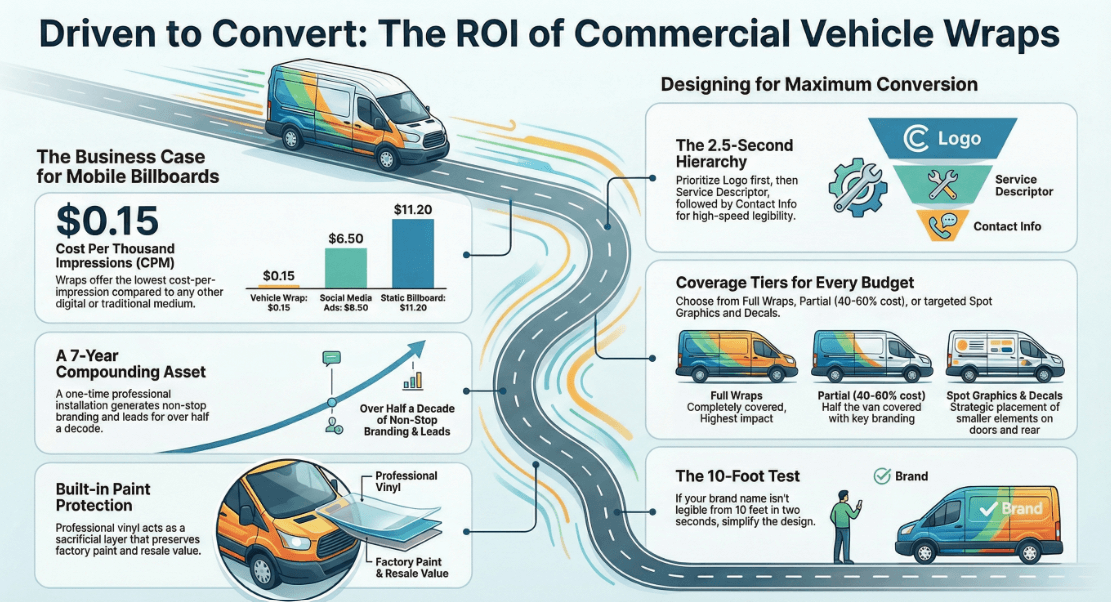
A professional full wrap on a cargo van typically runs $3,000 to $5,000 installed. Amortized over a 5-year lifespan and divided by the estimated impressions generated (studies put it at 30,000 to 80,000 impressions per day in urban markets), the CPM lands at roughly $0.15; a fraction of any digital or traditional alternative.
More importantly, unlike digital campaigns, the wrap doesn’t require ongoing budget allocation. A $4,000 install in 2026 is still generating impressions in 2031; with zero recurring cost.
Cost Per 1,000 Impressions
- Vehicle Wrap: $0.15
- Social Media Ads: $6.50
- Google Display: $7.80
- Static Billboard: $11.20
The Math That Changes Minds
CPM = Cost Per Thousand Impressions. Wrap CPM calculated over a 5-year amortization of total installation cost.
The 2.5-Second Rule: Design Hierarchy That Actually Converts
Priority Hierarchy
- Priority 1: Brand mark / Logo
- Priority 2: Tagline / Service descriptor
- Priority 3: Phone / URL / QR code
Brand recognition first. Your logo is the anchor. A viewer who remembers your brand name can Google you, even if they didn’t catch the phone number. A viewer who saw a phone number but doesn’t know the brand has a string of digits and no context. Build the brand mark large, legible, and dominant; everything else exists in its orbit.
Contact information should be reserved for stationary viewing contexts: the side panel when the van is parked, or the rear panel at a stoplight. Design for the “drive-by” first, and let the parked view close the conversion.
The 10-foot test
Print a scaled proof of your design and tape it to a wall. Walk 10 feet away. If you can’t immediately read the brand name in under two seconds, the design needs revision before installation. This simple exercise saves thousands of dollars in remakes.
Wrapping Leased Vehicles: What Your Fleet Manager Needs to Know
One of the most persistent objections to commercial wraps is the lease concern: “We can’t modify the vehicles.” This is a common misunderstanding that deserves a direct answer.
Professional-grade wraps installed with 3M 1080 series or Avery Dennison Supreme Wrapping Film; applied over factory paint that is free of rust, chips, and prior repairs; can be removed cleanly without paint damage after 3 to 5 years when done by a trained installer. The vinyl’s pressure-sensitive adhesive is engineered for reversibility. The film, not the paint, absorbs any minor abrasion from road debris, UV fading, and micro-scratches during the lease period. At return time, removal leaves the factory paint in the same or better condition than an unwrapped equivalent vehicle.
Key caveat
The cleanest removals happen when paint is factory-original and cure-hardened (minimum 30 to 90 days for newer vehicles). Aftermarket paint jobs, repaired panels, or paint with pre-existing chips may not survive removal without some touch-up. Always disclose any prior bodywork to your installer before the project begins.
Protecting Your Investment: Maintenance That Extends Wrap Life to 7 Years
Maintenance Practices
- Avoid Automated Tunnel Washes: High-pressure brushes and harsh chemical detergents in tunnel washes are the leading cause of premature edge lifting and surface micro-abrasion. Hand washing with a pH-neutral soap and a soft microfiber mitt is the preferred method. If a touchless automatic wash is the only option, use it on low pressure settings only.
- UV-Protectant Spray Every 3 Months: UV radiation is the primary aging mechanism for print graphics; it breaks down the inks and degrades the vinyl’s plasticizers over time. Applying a dedicated wrap-safe UV-protectant spray every 3 months significantly slows this process, especially for vehicles parked outdoors year-round in high-sun climates.
- Address Edge Lifting Immediately: Small lifted edges; especially around door handles, mirrors, and bumper corners; allow moisture and dirt to penetrate beneath the film. Left unaddressed, they grow into large delaminated sections. Most wrap studios can re-adhere minor edge lifts quickly and inexpensively. Catching them early saves a partial re-wrap later.
- Covered Parking When Available: If operational logistics allow it, covered overnight parking extends wrap life measurably by reducing the total UV hours and thermal cycling the vinyl endures. Even a basic carport makes a meaningful difference over a 5-year lifespan in a sun-intensive climate.
Commercial Wraps Are Not a Cost. They’re a Compounding Asset
Every other advertising channel you pay for requires continuous investment to generate continuous results. Stop paying, stop showing up. Commercial wraps break that model entirely. A single investment in professional vehicle graphics creates a durable brand presence that operates during business hours, after hours, in traffic, at job sites, and in every parking lot across your service territory; for years.
In 2026, the question for most businesses isn’t whether to wrap their vehicles. It’s which tier of wrap, which vinyl technology, and which design strategy will generate the highest return for their specific industry, market, and growth objectives. The businesses that treat their fleet as a media channel; not just a transportation cost; are accumulating brand equity with every mile driven.
Get the design right. Specify professional-grade materials. Partner with a certified installer. And then calculate the cost of not wrapping the vehicles that are already driving your brand; blank; through thousands of potential customers every single day.
Ready to Wrap Your Fleet?
Talk to a commercial wrap specialist and get a custom quote for your vehicle count, coverage level, and timeline.