- Introduction
- Part 1: The Big Three; Understanding Your Options
- The 2026 Gold Standard: Hybrid Protection
- Quick Reference Comparison
- Part 2: The Science Behind the Marketing
- Part 3: Which Protection Package Is Right for You?
- Part 4: The Buyer’s Guide; Logistics, Costs, and Red Flags
- Part 5: Aesthetic Trends in 2026; Protection That Makes a Statement
- Summary
Introduction
From budget wax to bulletproof PPF, everything you need to know before spending a single dollar.
Your car’s paint is under constant attack. Every highway mile pelts the hood with sand and gravel. Every morning brings UV radiation and acidic bird droppings. Every winter covers your rocker panels in corrosive road salt. And yet, most car owners do nothing more than run their vehicle through a $12 automatic car wash and call it maintained.
That’s about to change.
Automotive paint protection has evolved dramatically. In 2026, you’re no longer choosing between a Saturday afternoon with a can of Turtle Wax and a $7,000 professional installation; you’re choosing from an entire ecosystem of technologies, each engineered to solve a specific problem. This guide walks you through all of it: the science, the costs, the red flags, and the right solution for your specific situation.
Part 1: The Big Three: Understanding Your Options
Traditional Wax & Sealants; The Entry Point
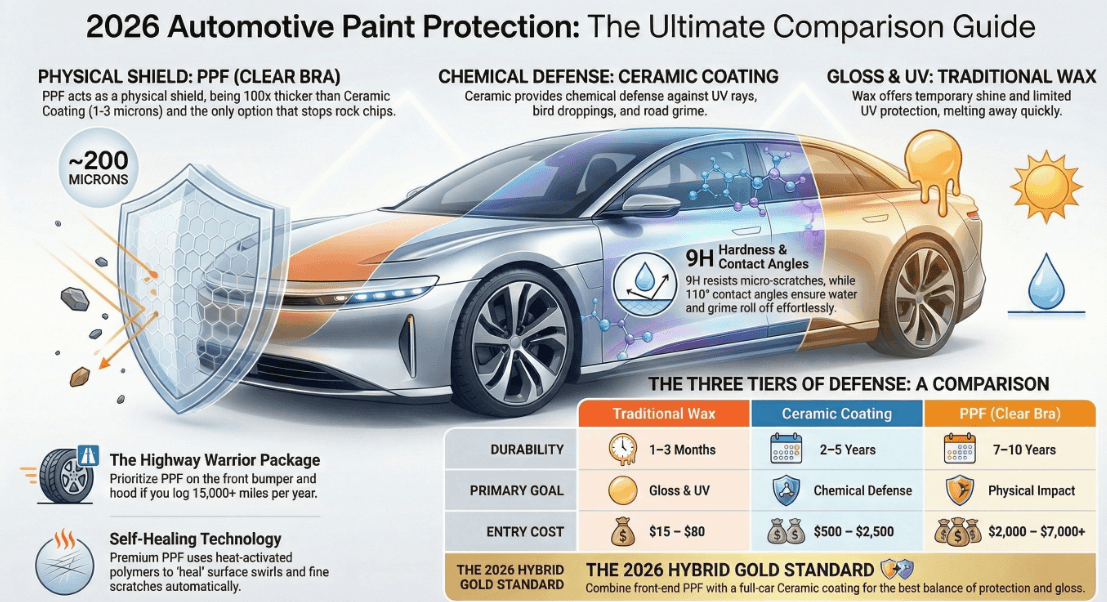
Wax has been protecting car paint since the 1940s, and it remains the most accessible option on the market. Carnauba waxes and synthetic polymer sealants work by depositing a thin sacrificial layer, less than 1 micron thick, on top of your clear coat. That layer takes the abuse of UV rays, minor environmental contaminants, and water sheeting, buying your underlying paint some time before it needs to be replaced.
The ceiling on wax is low. A quality application lasts 1 to 3 months. It offers no meaningful impact resistance. It will not stop a rock chip. But for the DIY enthusiast who enjoys a weekend detail session, or for a daily driver where the budget simply doesn’t allow for more advanced solutions, a good synthetic sealant applied every few months is vastly better than nothing. Entry-level products run $15 to $50 and require no professional installation.
The realistic expectation: enhanced gloss, minor water beading, and a few months of light environmental protection.
Ceramic Coatings; The Chemical Defense Layer
Ceramic coatings represent the first major technological leap. These liquid polymer solutions, typically Silicon Dioxide (SiO₂) or Titanium Dioxide (TiO₂), chemically bond to your paint’s clear coat at a molecular level. Once cured, they form a glass-like shell 1 to 3 microns thick that is semi-permanent, hydrophobic, and chemically resistant.
The defining property of a quality ceramic coating is hydrophobicity. Water literally cannot stick to the surface; it beads up and rolls off, taking road grime and contaminants with it. This is why ceramic-coated cars stay cleaner longer and are dramatically easier to wash. The coating also resists chemical etching, meaning bird droppings, tree sap, and acid rain, all of which are slightly acidic, won’t penetrate and stain the paint underneath.
A professional-grade ceramic coating lasts 2 to 5 years, with premium formulations pushing toward 7 to 10 years. Professionally installed, expect to pay $500 to $2,000 depending on the product tier, vehicle size, and the amount of paint correction work required beforehand. Ceramic coatings amplify everything underneath, including swirl marks, so the surface must be flawless before application.
The realistic expectation: easier maintenance, superior gloss and depth, long-lasting chemical and UV resistance, but zero protection against physical impacts.
Paint Protection Film (PPF); The Physical Shield
PPF, often called clear bra, is a thermoplastic polyurethane (TPU) film typically 8 to 12 mils thick (approximately 200 microns). Compared to a ceramic coating’s 1 to 3 microns, PPF is roughly 100 times thicker. That mass is the entire point; it absorbs kinetic energy from road debris so your paint doesn’t have to.
PPF is the only solution that physically stops rock chips. When a piece of gravel traveling at highway speed strikes a PPF-covered hood, the film absorbs the impact and distributes the energy, leaving your paint untouched. Without film, that same impact leaves a chip straight to bare metal.
Modern PPF goes further than basic impact absorption. Today’s premium films include self-healing technology, UV-blocking layers, and hydrophobic topcoats. High-quality installations last 7 to 10 years before needing replacement. Costs range from $2,000 for a partial front-end wrap to $5,000 to $7,000 for a full vehicle installation.
The realistic expectation: genuine physical protection from road debris, rock chips, scratches, and abrasion; the only technology that prevents permanent damage before it happens.
The 2026 Gold Standard: Hybrid Protection
The industry consensus in 2026 is clear: the optimal protection strategy is not a single technology but a combination. Apply PPF to the high-impact zones, the front bumper, hood, front fenders, and side mirrors, and ceramic coat the entire vehicle over the top. PPF handles physical impacts where they occur most, the leading surfaces facing oncoming traffic and road debris, while the ceramic coating over everything else delivers hydrophobicity, UV resistance, chemical defense, and uniform gloss across the entire car.
For many owners, this hybrid approach delivers the best real-world results at a more manageable price than a full PPF wrap; typically $3,000 to $5,000 combined.
Quick Reference Comparison
Primary Goal | Temporary Shine | Chemical/UV Defense | Physical Impact Defense
Durability | 1 to 3 Months | 2 to 5 Years | 7 to 10 Years
Thickness | < 1 μm | 1 to 3 μm | 8 to 12 mil (~200 μm)
Self-Healing | No | No | Yes (heat-activated)
Rock Chip Protection | No | No | Yes
Hydrophobicity | Moderate | Excellent | Good
Ease of Cleaning | Moderate | Excellent | Good
DIY Friendly | Yes | Advanced | Professional Only
Entry Cost | $15 to $50 | $500 to $2,000 | $2,000 to $7,000
Part 2: The Science Behind the Marketing
Self-Healing Technology; How Films Repair Themselves
Modern premium PPF films use a TPU formulation with an elastic polymer memory. The top coat contains molecules that are in a state of tension when deformed (from a light scratch or swirl mark). When heat is applied, either from direct sunlight over 30 to 60 minutes, or from pouring warm water over the surface, those molecules regain their mobility and flow back to their original flat configuration. The scratch literally disappears.
This works reliably for light surface swirls, fine scratches from improper washing, and minor marring. It does not work for deep cuts that penetrate through the film’s top coat, nor does it heal rock chips that have already transferred into the vehicle’s paint beneath the film. Think of it as the film healing itself, not healing damage to your paint.
Hydrophobicity and Contact Angles; Why 110° Matters
Water beading on a car surface is not just aesthetically pleasing; it directly correlates with how easily contaminants slide off. The contact angle is the angle measured between a water droplet and the surface it sits on. A flat surface like bare glass has a contact angle around 20 to 30°. Traditional wax achieves roughly 70 to 80°. Quality ceramic coatings push 100 to 115°.
At contact angles above approximately 100°, water enters what’s called a superhydrophobic regime; the droplets are almost perfectly spherical, have minimal adhesion to the surface, and roll off at very low tilt angles. When rain or spray hits the surface at highway speeds, it doesn’t form sheets (which trap mineral deposits and dry into water spots). It beads and rolls away, taking dissolved road grime with it. A coating advertised at 110° is not marketing fluff; it’s a measurable physical property that directly reduces the frequency and effort of washing.
The 9H Hardness Rating; Managing Expectations
Walk into any detailing shop and you’ll see ceramic coatings advertised as 9H hardness. This claim is real but commonly misunderstood in a way that leads to disappointment.
The H refers to the pencil hardness scale, which measures resistance to scratching by graphite pencils ranging from 6B (very soft) to 9H (very hard). A 9H ceramic coating can resist being scratched by the hardest graphite pencil. What it cannot do is resist keys, sand particles, or metal objects, which operate on an entirely different hardness scale (the Mohs scale). A ceramic coating rated 9H on the pencil scale is still only about 7 on the Mohs scale, meaning it will scratch if you drag a key across it intentionally. The coating resists fine environmental abrasion and reduces swirl marks from washing, not deliberate mechanical scratching.
The correct expectation: a 9H coating makes your car significantly more resistant to the micro-scratches caused by dust, washing sponges, and light contact. It does not make the paint scratch-proof.
Graphene Coatings and Thermal Management
The newest evolution in ceramic technology is graphene-infused coatings. Graphene, a single-atom-thick layer of carbon, has exceptional thermal conductivity. When added to a ceramic coating formulation, it helps dissipate heat across the surface more evenly, reducing localized hot spots where the paint surface gets particularly warm.
Why does this matter for paint protection? Water spots form when mineral-laden water droplets evaporate on a hot surface, leaving the mineral deposits behind as hard, crystallized spots. A cooler, more thermally uniform surface reduces the rate of evaporation, giving the water more time to roll off rather than bake on. In practice, graphene-enhanced coatings show measurably reduced water spotting in hot climates and during summer months.
Part 3: Which Protection Package Is Right for You?
The Highway Warrior Package
Best for: Daily commuters logging 15,000+ miles per year on highways and rural roads.
The front of your car is a ballistic target. Every truck ahead of you kicks up gravel. Every construction zone sprays debris. If you commute more than 30 miles each way, the leading surfaces of your vehicle are accumulating dozens of micro-impacts per month. The Highway Warrior approach prioritizes front-end PPF coverage, hood, front bumper, front fenders, and headlights, with a ceramic coating applied over the rest of the vehicle. This configuration protects exactly where the damage concentrates, at a price point ($2,500 to $4,000) that most commuters can justify against the cost of paint correction or repainting.
The Track Day Shield
Best for: Enthusiasts who participate in track days, autocross events, or canyon runs.
Standard 8-mil PPF is engineered for highway speeds and normal road debris. Track environments involve much higher impact velocities and greater debris density from other cars. For track use, premium 10 to 12 mil films are available and provide meaningfully greater energy absorption. These thicker films are stiffer and slightly more visible under certain lighting, but for a car that sees occasional serious performance driving, the trade-off is well worth it. Full front-end coverage in 12-mil film, professionally installed, typically runs $4,000 to $7,000.
The Resale Value Play
Best for: Anyone who plans to sell or trade within 3 to 7 years.
The data on this is compelling. Multiple independent market analyses of used vehicle transactions have found that cars with documented, professionally installed paint protection sell for 5 to 10% more than unprotected equivalents in the same condition, and sell faster. At an average used vehicle price of $28,000, a 7% premium is $1,960. Full front-end PPF plus a ceramic coating might cost $3,500. The math doesn’t favor the protection on resale value alone, but factoring in avoided paint correction ($500 to $1,500), touch-up work, and the reduced psychological friction of owning a car that still looks new at year 5, the investment has tangible financial merit.
When selling, keep your documentation: the installer’s warranty paperwork, the product brand and film/coating type, and any maintenance records. Buyers in the enthusiast market specifically look for this.
New Car Day One Protection
Best for: Anyone taking delivery of a new vehicle.
The optimal moment to apply paint protection is the moment the car arrives at the dealership, ideally before it’s ever driven. The paint is in factory-perfect condition: no swirl marks from drive-arounds, no rock chips from transit, no contamination from dealer washing procedures. Applying PPF and/or ceramic coating to a brand-new car means you’re locking in the original factory finish permanently. Every mile you drive before protecting the car is a mile during which irreversible damage can accumulate. If you’re spending $40,000 or more on a new vehicle, adding $3,000 to $5,000 in protection at purchase, often financeable as part of the deal, is simply rational asset preservation.
Be cautious of dealer-installed paint protection packages. Many dealerships upsell protection packages that consist of little more than a spray sealant applied in 10 minutes. Ask specifically what product is being used, the installer’s certifications, and the warranty terms before agreeing.
The Winter Shield
Best for: Owners in northern climates dealing with ice, snow, and road treatment chemicals.
Road salt is steel’s enemy, but it’s no friend to paint either. More problematically, modern municipalities increasingly use magnesium chloride as a deicer, a liquid that bonds to surfaces more aggressively than dry salt and penetrates into microscopic paint imperfections. Calcium chloride used in extreme cold is similarly damaging. A quality ceramic coating provides meaningful resistance to these chloride compounds, preventing them from etching the clear coat over repeated winter seasons. For vehicles with lower rocker panels and wheel wells, PPF provides a physical barrier against the stone chips and salt spray thrown by your own tires.
The winter shield strategy: full ceramic coating on all painted surfaces, PPF on rocker panels and lower portions of front and rear bumpers, and ceramic-coated wheel faces to prevent brake dust and road grime adhesion.
Part 4: The Buyer’s Guide; Logistics, Costs, and Red Flags
Cost Breakdown
Traditional Wax/Sealant
- DIY consumer products: $15 to $80
- Professional application: $100 to $300
Ceramic Coating
- Consumer-grade DIY kits: $50 to $150 (significantly lower durability than professional products, requires careful application)
- Professional entry-level (2 to 3 year): $500 to $900
- Professional mid-grade (5 year): $900 to $1,500
- Professional premium (7 to 10 year, graphene-enhanced): $1,500 to $2,500
Note: Price includes paint decontamination and often 1-step polishing. Significant paint correction (multiple polishing stages) adds $300 to $800 and is sometimes necessary.
Paint Protection Film
- Partial front-end package (bumper + hood): $1,200 to $2,500
- Extended front-end (bumper + hood + fenders + mirrors): $2,000 to $4,000
- Full vehicle wrap: $5,000 to $8,000+
- Premium 12-mil or specialty finish film: add 20 to 30%
Hybrid PPF + Ceramic
- Front-end PPF + full car ceramic: $3,000 to $5,500
- Full car PPF + ceramic over top: $6,000 to $10,000+
Installation Red Flags; What to Watch For
Finding the right installer matters as much as choosing the right product. The installation environment and the installer’s technique will determine whether your investment lasts 7 years or starts peeling at year 2.
Environment: PPF installation must take place in a clean, climate-controlled space, ideally a dedicated paint protection bay with positive air pressure to prevent dust settling on the film during application. A shop that installs film in a standard garage bay with open doors is a red flag. Even a small dust particle trapped under a film edge will cause premature lifting.
Installer certification: Ask whether the installer is certified by the film manufacturer. 3M, XPEL, SunTek, and other major brands offer official training and certification programs. Certified installers have demonstrated proficiency with the specific film chemistry, stretching techniques, and edge-wrapping procedures.
Edge wrapping: This is a critical differentiator between amateur and professional installations. Inferior installs terminate the film at panel edges, bumpers, hood edges, and door edges, leaving a visible seam and an adhesive edge exposed to lifting. Professional installations wrap the film around panel edges and tuck it underneath, creating an invisible termination point. Ask specifically to see examples of edge wrapping on completed vehicles.
Testimonials and portfolio: Any reputable shop should have a portfolio of completed vehicles and customer reviews. Be wary of shops that cannot show recent completed work.
Warranty documentation: The warranty paperwork should be provided at installation, not after you ask for it. If a shop is reluctant to discuss warranty terms upfront, walk away.
Understanding Warranties: Two Very Different Things
Automotive paint protection comes with two distinct types of warranty, and most consumers conflate them.
Manufacturer’s Warranty: This warranty is issued by the film or coating manufacturer (e.g., XPEL, SunTek, 3M, Ceramic Pro) and covers product defects, yellowing, cracking, bubbling from manufacturing issues, or failure of the product’s advertised properties. This warranty typically runs 5 to 10 years for premium PPF and 2 to 5 years for ceramic coatings. It is transferable if you sell the vehicle. Crucially, it does not cover installation errors; only defects in the product itself.
Installation Warranty: This warranty is issued by the installing shop and covers workmanship, lifting edges, bubbles from improper application, delamination caused by the installer’s technique. Quality shops offer 1 to 3 years of installation warranty. This warranty stays with the original vehicle owner and does not transfer on resale.
Before signing anything, read both warranties. Key things to confirm: what voids the manufacturer’s warranty (many require pH-neutral wash soaps and prohibit pressure washing at close range), what the installer’s warranty covers specifically, and the claims process for each.
Maintenance Aftercare; Do’s and Don’ts
Do:
- Wash with pH-neutral soaps specifically formulated for coated vehicles
- Hand wash or use a touchless automatic wash (no brushes)
- Apply a maintenance spray (ceramic booster or quick detailer) every 3 to 6 months
- Clean bird droppings and tree sap promptly, within a few hours if possible
- Use a high-quality microfiber wash mitt and two-bucket wash method
- Inspect film edges every 6 months for any early lifting
Don’t:
- Use automatic car washes with rotating brushes; they will scratch ceramic coatings and abrade PPF edges
- Use acidic or alkaline cleaners, degreasers, or solvent-based products on coated surfaces
- Pressure wash closer than 12 inches to panel edges or film termination points
- Apply traditional wax over a ceramic coating (it interferes with the coating’s performance)
- Allow contaminants to bake on in direct sun for extended periods
- Use clay bars on PPF without a proper lubricant; clay will grab the film surface
Part 5: Aesthetic Trends in 2026; Protection That Makes a Statement
Stealth Matte Conversions
Colored and Tinted PPF
Texture Films; Carbon Fiber, Brushed Metal, and Forged Carbon
Summary
Automotive paint protection in 2026 is not a luxury reserved for exotic car owners. It is a rational, scalable investment that protects the largest depreciating asset most people own.
Start with what your budget allows. Even a professional ceramic coating at $800 is dramatically better than bare paint. If you’re buying a new car or have a vehicle you intend to keep for many years, the hybrid PPF-plus-ceramic approach delivers comprehensive protection that pays dividends in both preservation and resale value. And if you drive hard, commute long distances, or live in a climate that punishes cars with extreme cold or heat, the case for front-end PPF is practically beyond debate.
Whatever you choose, choose intentionally. The cost of good protection is always less than the cost of fixing the damage that protection would have prevented.
Have questions about which protection package fits your vehicle, climate, or budget? Drop them in the comments below.
Tags: Paint Protection Film, PPF, Ceramic Coating, Clear Bra, Car Detailing, Paint Protection, Auto Detailing, Car Care, Self-Healing Film, Graphene Coating, Vehicle Protection, Resale Value, PPF vs Ceramic Coating