Introduction
If your truck rolls through Boston; whether you are hauling equipment to a South Boston job site, running deliveries through the Seaport District, or navigating the legendary gridlock of Storrow Drive; your vehicle is broadcasting a message whether you want it to or not. The question is: what is it saying?
Truck lettering in Boston is far more than a branding exercise. It is a legal obligation for most commercial operators, a first impression for every potential customer who spots you on the Pike, and a competitive advantage for businesses willing to invest in it properly. With nearly 400,000 registered commercial vehicles in Massachusetts, the trucks that stand out; and stay compliant; are the ones that win the work.
This guide covers every angle: DOT compliance requirements under Massachusetts law, design strategies for Boston’s unique street landscape, vinyl materials that survive a New England winter, and logistical solutions for busy fleet operators. Let’s get into it.
- Regulatory & Compliance; The Must-Haves
- Design & Branding; The Look
- Practical & Environmental; The Durability
- Local Service & Logistics; The Where & How
- Lettering vs. Full Wraps; Side by Side Comparison
- Summary
Regulatory & Compliance
In Massachusetts, truck lettering isn’t optional for most commercial operators; it is the law. Before you think about fonts or colors, you need to know what must appear on your vehicle. Failure to comply can mean roadside fines, failed inspections, and insurance complications that cost far more than the lettering itself.
Massachusetts Law
540 CMR 2:22; Know It Before You Letter
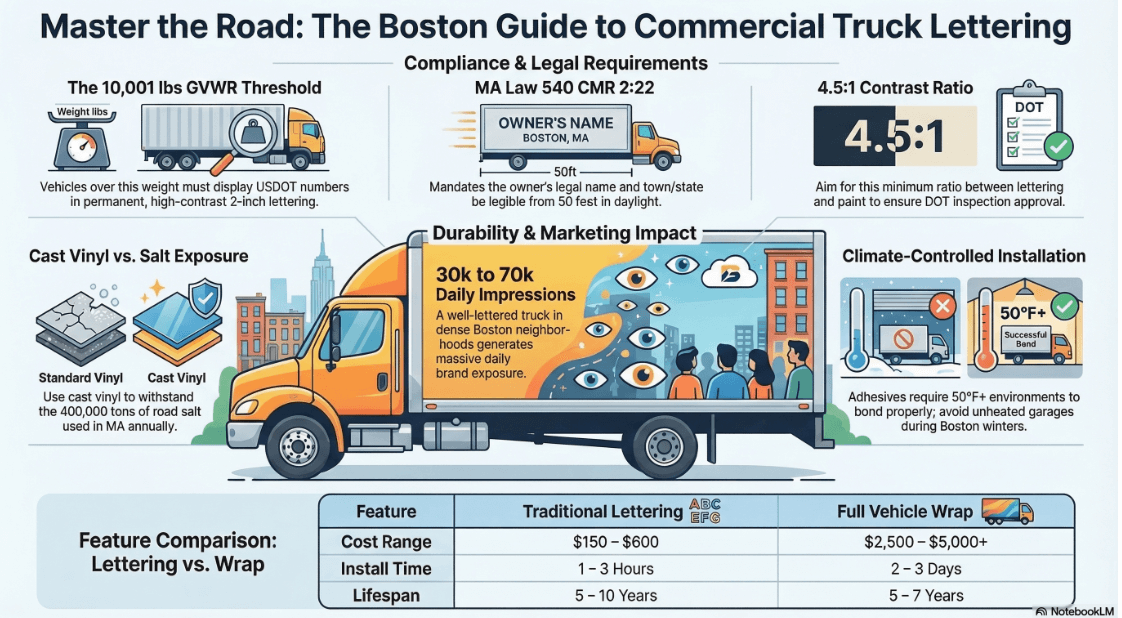
The Massachusetts Registry of Motor Vehicles enforces 540 CMR 2:22, which mandates that commercial motor vehicles over 10,001 lbs GVWR display specific identification information in a legible, permanent format. Non-compliance can result in out-of-service orders during roadside inspections; a costly disruption for any Boston-area operator.
USDOT Number Compliance
If your vehicle exceeds 10,001 lbs GVWR, your USDOT number is not optional; it is a federal requirement enforced at the state level. Under MA RMV 540 CMR 2:22, this number must appear in permanent, high-contrast lettering on both sides of the cab. Minimum letter height is typically 2 inches, with a contrasting color to the vehicle body. Use cast vinyl (not calendered) for permanence. Many Boston shops offer pre-cut USDOT number kits that install in under 30 minutes and satisfy both FMCSA and MA RMV standards. Always verify your active USDOT status at the FMCSA portal before installation.
Company Identification Requirements
Massachusetts commercial plates require that your vehicle display the owner’s legal name and Town/City, State on the door or cab. This isn’t just for DOT-regulated carriers; it applies broadly to commercial plate holders. Layout matters: the name and location must be legible from at least 50 feet in daylight conditions. A professional shop will design a layout that satisfies this requirement while still looking sharp; stacking the company name in a bold condensed font above a smaller city/state line is a proven, clean solution that Boston operators rely on.
GVW (Gross Vehicle Weight) Displays
For heavy-duty trucks operating in the Boston metro; especially on restricted routes through Cambridge, Brookline, or downtown; displaying your Gross Vehicle Weight rating is often required and always smart. Bridge weight restrictions are strictly enforced in Massachusetts, and visible GVW lettering on the door or rear demonstrates compliance at a glance. Professional placement typically puts the GVW rating below the company name block in a smaller but clearly legible point size. Use the same vinyl stock as your primary lettering for a cohesive, permanent look.
Contrasting Color Solutions
Regulations require legibility, which means contrast is mandatory; not just aesthetic. White trucks need dark lettering (navy, black, or dark red). Black trucks demand white, silver, or yellow. For metallic, fleet blue, or custom-painted vehicles common in Boston construction fleets, a professional letterer will fan-deck test vinyl swatches against your truck’s exact paint before commitment. 3M Series 180 and Avery MPI 1005 both offer contrast-certified options. For DOT compliance, avoid light-on-light or dark-on-dark combinations; inspectors will flag them. A good rule of thumb: aim for a contrast ratio of at least 4.5:1 between letter color and vehicle body color.
- Quick Compliance Checklist for Boston Commercial Operators USDOT number (both sides, min. 2″ high); required for vehicles over 10,001 lbs GVWR
- Owner/Operator Name Legal business name displayed in permanent lettering on door panels
- Town, State Home base city and state; legible from 50+ feet in daylight
- GVW Rating Required for many heavy-duty and oversize loads; recommended for all commercial operators navigating restricted Boston routes
- Contrasting Colors Verified contrast ratio between lettering and vehicle paint; photograph your truck in overcast daylight to double-check visibility
Design & Branding
Once compliance is handled, the real opportunity begins. Your truck is a moving billboard that reaches thousands of potential customers every single day; during commutes on I-93, at job sites across Dorchester and Jamaica Plain, and parked in front of every property you service. The design choices you make directly impact how many calls you get.
“A well-lettered work truck in Boston gets seen by an estimated 30,000 to 70,000 people per day in dense urban areas. That’s more impressions per dollar than most digital ad formats.”
Industry Estimate, Outdoor Advertising Association of America
“Mobile Billboard” Box Truck Layouts
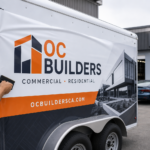
Box trucks offer the largest blank canvas in commercial vehicle advertising. The sides of a standard 16 to 26 ft box truck can be treated as a full-panel billboard, featuring your logo large, a core service statement, a phone number in a font large enough to read at highway speed, and a website. Boston companies using this format; especially in high-traffic corridors like Route 9, the Mass Pike, or the Southeast Expressway; report significantly stronger brand recognition in their service areas. The key is hierarchy: one dominant visual, one dominant message. Don’t try to say everything. Say the one thing that makes you memorable.
Minimalist Door Decals for Tight Streets
Boston’s historic neighborhoods; the North End, Beacon Hill, Charlestown; were built for horses, not trucks. Pickup trucks and SUVs navigating these streets benefit from a clean, professional less-is-more approach: a well-kerned company name, a phone number, and a minimal logo mark. Two-color vinyl in 3 to 4″ cap heights strikes the right balance between visibility and sophistication. Tradespeople who service high-end residential clients in Back Bay or the South End consistently find that clean, minimal lettering projects professionalism and discretion; both traits their clients value.
Gold Leaf Lettering
Boston has a long tradition of gold leaf signage; from the State House dome to the storefronts of Newbury Street. Applied gold leaf lettering (or high-quality gold metallic vinyl that mimics it) is a hallmark of established, prestigious businesses. Fire departments, funeral homes, law firms with corporate vehicles, and historic Boston businesses regularly choose gold leaf-style lettering to signal longevity and authority. Done by a skilled hand-lettering artist, this treatment is visually unmistakable and photographically striking; the kind of truck that stops people mid-scroll when they see it on Instagram.
QR Code Integration
Boston traffic creates opportunity. When your truck is sitting in I-93 congestion or parked at a job site, the tailgate becomes prime advertising real estate. A large-format, high-contrast QR code printed on the tailgate or rear door; linking to your Google Business profile, a quote form, or a portfolio page; turns wait time into lead generation. For best results, pair the QR code with a concise call to action like “Get a Free Quote” and test the scan distance before installation. QR codes should be at least 4″ × 4″ to be reliably scannable from 8 to 10 feet. Use a URL shortener with tracking to measure scan volume.
Reflective Safety Lettering
For towing companies, utility contractors, road crews, and any operator working night shifts on Boston’s highways, reflective vinyl lettering isn’t just a branding upgrade; it is a safety imperative. Reflective cast vinyl (3M Diamond Grade or equivalent) returns light to its source, making your vehicle dramatically more visible to oncoming drivers. FHWA guidelines recommend reflective conspicuity treatments for large commercial vehicles. In Boston’s fog-prone coastal climate and dark winter mornings, reflective lettering on the cab doors, rear panels, and running boards can make the difference that matters most.
- Pro Tip Before You Order Verify USDOT status at FMCSA.dot.gov first
- Pro Tip Before You Order Check letter height minimums with your lettering shop
- Pro Tip Before You Order Bring a paint chip or code for exact contrast matching
- Pro Tip Before You Order Photograph existing lettering for re-lettering accuracy
Practical & Environmental
Boston doesn’t do gentle. Winters here bring road salt by the ton, freeze-thaw cycles that stress every surface, and slush spray that coats everything from axle to antenna. Summers bring punishing UV radiation amplified by the heat-island effect in urban neighborhoods. Your truck lettering needs to be engineered for this environment; not just designed for it.
Boston Climate Reality Check
Why Material Choice Matters Here More Than Anywhere
Massachusetts roads consume over 400,000 tons of road salt per winter season. Chloride penetration degrades adhesives, lifts edges, and accelerates fading in cheap calendered vinyl. Investing in proper materials upfront isn’t a luxury; it is the difference between lettering that lasts 7+ years and lettering that starts peeling by the second winter. Always ask your shop what grade of vinyl they’re using before you sign off.
Salt-Resistant Cast Vinyl
Not all vinyl is created equal. Calendered vinyl; the budget option; uses a simplified manufacturing process that leaves internal stresses in the film. It shrinks over time, lifts at edges, and degrades quickly when exposed to road salt and temperature cycling. Cast vinyl, like 3M Series 180C or Avery Dennison MPI 1005 SC, is manufactured without those stresses and conforms better to complex vehicle contours. It’s the material of choice for any Boston operator expecting 5 to 10 years of service life. Yes, it costs 15 to 25% more per roll; but when re-lettering a fleet means 2 to 3 days of downtime per vehicle, the math strongly favors the upgrade.
UV-Protected Over-Laminates
New England summers may be shorter than Florida’s, but they deliver intense UV exposure; especially on south- and west-facing truck panels. Over-laminates (a clear vinyl film applied over the printed graphic) add UV inhibitors that block the radiation spectrum responsible for color fading. For any lettering that includes full-color printing; logos, gradients, photographs; an over-laminate is non-negotiable. Gloss laminates intensify color vibrancy; matte laminates give a sophisticated, low-glare finish increasingly popular with premium service brands. Expect a laminated graphic to outlast an unprotected one by 2 to 4 years in Boston’s conditions.
Perforated Window Graphics
Every inch of your truck’s surface area is advertising space; including the rear windows. One-Way Vision vinyl (also called perforated window film) features a micro-perforated pattern that displays a full-color graphic when viewed from outside, while preserving the driver’s sightlines from the inside. This is particularly effective on the rear window of box trucks and cargo vans, where it maximizes visual impact without compromising safety. In Massachusetts, ensure your perforated film maintains adequate visibility to comply with state window tint and visibility regulations; a reputable Boston shop will advise on compliant perforation ratios (typically 50/50 or 60/40 print-to-hole ratio).
Magnetic Lettering for Subcontractors
Subcontractors, gig economy tradespeople, and part-time operators face a unique challenge: they need to display a general contractor’s or employer’s branding on a personal vehicle at a job site, then remove it when the workday ends. High-quality magnetic vehicle signs offer a practical solution. Modern magnetic signs use a composite flexible magnet material thick enough to hold securely at highway speeds and resist wind lift. Key best practices for Boston conditions: remove magnetics before car washes (where they can shift and scratch), store them flat on a non-ferrous surface, and never leave them on during heavy rain to prevent water intrusion under the magnet.
Local Service & Logistics
Finding a great lettering shop in the Boston metro means more than Googling the nearest sign company. It means understanding who can handle your fleet size, who installs in the right conditions, who knows the local regulatory landscape, and who won’t leave your truck sitting in a parking lot for a week during your busiest season.
Mobile Installation Services
For fleet operators who can’t afford vehicle downtime, mobile installation teams come directly to your warehouse, depot, or active job site. A trained mobile installer can letter a standard cab door in 45 to 90 minutes, meaning a 10-vehicle fleet can be lettered in a single day without moving a single truck. This service is especially valuable for Boston-area logistics companies, HVAC contractors, and plumbing fleets where every vehicle off the road means lost revenue. When evaluating mobile services, confirm the installer uses a portable heat gun and squeegee kit for proper vinyl activation; cold installations without heat can fail within weeks.
Climate-Controlled Facility Installations
Vinyl adhesive chemistry is temperature-sensitive. Below 50°F, most vinyl adhesives become sluggish and fail to achieve proper initial bond; a common failure point for shops that install in unheated garages during Boston winters. Climate-controlled installation bays (maintained at 65 to 75°F) ensure proper adhesive activation and eliminate the risk of premature edge lifting. When choosing a lettering shop between November and April, ask directly: “Is your installation bay heated?” If they hesitate, keep looking. A properly bonded installation will outlast a cold-applied one by years, especially when road salt enters the equation.
Fleet Changeover Strategies
Growing Boston service businesses; from landscaping companies to electrical contractors; eventually face the challenge of re-lettering an entire fleet when they rebrand or update their look. Efficient fleet changeover requires pre-cut kit preparation: all vinyl panels designed, printed, cut, and kitted per vehicle before the first truck arrives. A well-organized shop can process 3 to 5 vehicles per day with a two-person installation team. For fleets of 10+, stagger the vehicles across 3 to 4 days to keep operations running. Negotiate a fleet rate (typically 10 to 20% below per-vehicle pricing) and provide vehicle measurements in advance to accelerate turnaround. Some Boston shops offer after-hours fleet slots to minimize disruption.
Permit Assistance & BPDA Compliance
Boston’s commercial signage regulations extend beyond moving vehicles. The Boston Planning & Development Agency (BPDA) has jurisdiction over signage on parked commercial vehicles in certain zones; particularly in landmark districts, near historic properties, or in neighborhoods with active development agreements. Some businesses park branded vehicles as semi-permanent advertising fixtures, which can trigger BPDA review. Knowledgeable lettering shops familiar with Boston’s regulatory environment can advise on what constitutes a moving vehicle versus a parked sign, and which neighborhoods require additional permits. This is especially relevant for food trucks, mobile retail units, and service companies with fixed parking agreements near sensitive zones.
Lettering vs. Full Vehicle Wraps
Not sure which approach fits your needs and budget? Here’s a direct side-by-side breakdown for Boston commercial operators.
Cost Range
- Traditional Lettering Budget-Friendly; $150 to $600 per vehicle
- Full Vehicle Wrap Premium Investment; $2,500 to $5,000+ per vehicle
Coverage
- Traditional Lettering Name, USDOT number, logo, phone; compliance essentials
- Full Vehicle Wrap Full color change, photographic graphics, complete vehicle transformation
Installation Time
- Traditional Lettering 1 to 3 hours per vehicle
- Full Vehicle Wrap 2 to 3 days per vehicle (surface prep + application + cure)
DOT Compliance
- Traditional Lettering Purpose-built for compliance lettering
- Full Vehicle Wrap Compliance elements added to wrap design
Fleet Scalability
- Traditional Lettering Highly scalable; 10+ vehicles in 1 to 2 days
- Full Vehicle Wrap Slower; 3 to 5 vehicles per week maximum
Paint Protection
- Traditional Lettering Minimal; partial coverage only
- Full Vehicle Wrap Excellent; full film protects original paint
Visual Impact
- Traditional Lettering Professional, clean, trusted
- Full Vehicle Wrap Maximum; head-turning, high-impression brand statement
Removal / Update
- Traditional Lettering Easy; individual elements removable in minutes
- Full Vehicle Wrap Professional removal recommended; 4 to 8 hours per vehicle
Expected Lifespan
- Traditional Lettering 5 to 10 years (cast vinyl, laminated)
- Full Vehicle Wrap 5 to 7 years (cast vinyl, garage-kept)
Best For
- Traditional Lettering Compliance-first, clean branding, fleet operators, subcontractors
- Full Vehicle Wrap Maximum visual impact, paint protection, premium brand positioning
The Hybrid Approach: Lettering + Partial Wrap
Many Boston fleet operators use a hybrid strategy: traditional lettering for compliance elements (DOT number, company name) combined with a partial wrap on hood, tailgate, or box truck panels for visual impact. This approach delivers 70 to 80% of the visual punch of a full wrap at roughly 40 to 50% of the cost; and keeps fleet changeover fast and affordable.
Summary
Truck lettering in Boston is where legal obligation meets business opportunity. Every mile your commercial vehicle travels through the metro; on the Pike, through Dorchester, across the Zakim; is a chance to build brand recognition, demonstrate credibility, and generate leads without paying for another ad impression.
The businesses that treat their trucks as moving billboards, invest in durable materials built for New England winters, and stay current with Massachusetts compliance requirements are the ones that keep their phones ringing year-round. It doesn’t require a massive budget; it requires the right strategy and the right shop.
Use this guide as your starting point: confirm your compliance obligations, define your branding goals, choose materials suited to Boston’s climate, and find a local installer with a climate-controlled bay and a solid fleet track record. Your truck is already on the road. It’s time to make every mile count.
Conclusion: Truck lettering done right helps you stay compliant, look professional, and get more calls from the same miles you already drive. If you focus on clear identification, strong contrast, winter-ready materials, and an installer who understands Boston conditions, your trucks can become one of your most reliable marketing tools year after year.