- Introduction
- The Boston Factor: Why Your Paint Has It Harder Here Than Almost Anywhere Else
- Understanding Your Options: Ceramic Coating Packages Explained
- Is It Worth It? Ceramic Coating vs. Wax vs. PPF
- The Step Everyone Skips: Why Paint Correction Comes First
- Boston-Area Cost Guide (2025 Market Rates)
- Maintenance & Aftercare: How to Keep Your Coating Performing Through Boston Winters
- Frequently Asked Questions: Boston Edition
- Summary
Introduction
Your car battles one of the harshest urban environments in America every single day. Here’s how to fight back.
If you’ve lived in Boston for more than one winter, you already know the score. By February, your car looks like it spent a week at the bottom of Massachusetts Bay. The salt-caked wheel wells, the paint that’s lost its depth, the film of urban grime baked on by Logan’s jet exhaust; it’s not just cosmetic. It’s corrosion, and it compounds every year you don’t address it.
Ceramic coating has become the go-to solution for Boston-area car owners who want lasting protection without the weekly waxing ritual. But with prices ranging from $900 to $2,500+, this isn’t an impulse purchase. This guide will walk you through everything a Greater Boston driver needs to know; from why our climate specifically destroys paint, to which package makes sense for your situation, to what questions to ask any detailer before handing over your keys.
The Boston Factor: Why Your Paint Has It Harder Here Than Almost Anywhere Else
Road Salt & Liquid Brine: The Invisible Enemy
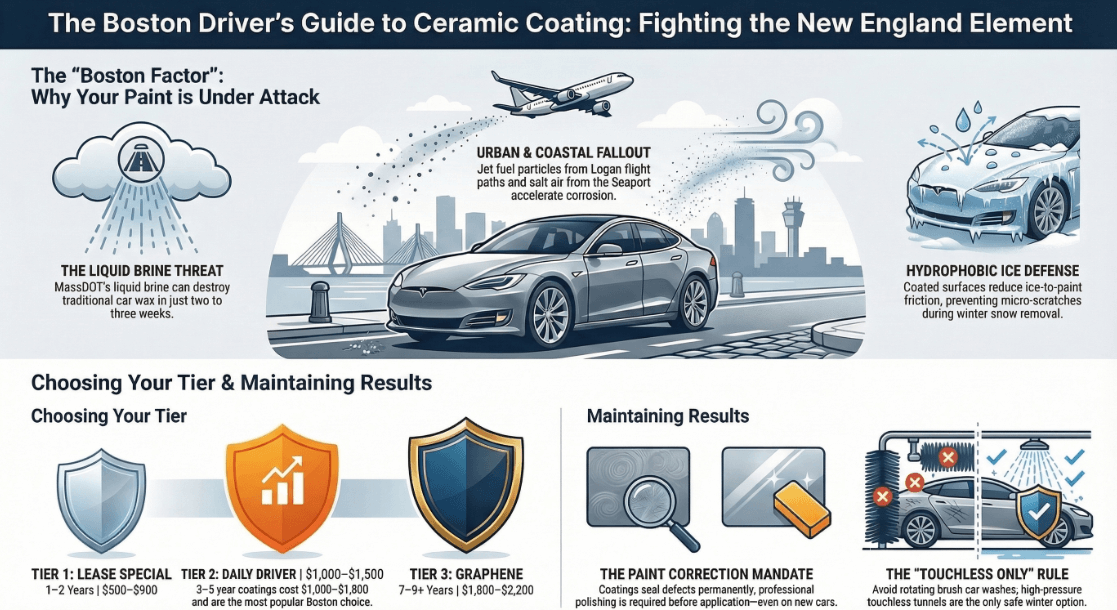
MassDOT doesn’t just scatter rock salt anymore. The state has aggressively shifted toward liquid brine pre-treatment; a magnesium chloride and sodium chloride solution sprayed directly onto roads before storms hit. This liquid brine is corrosive by design, and it does its job on your car’s paint just as effectively as it does on ice.
Traditional car wax; even a premium carnauba; breaks down under repeated brine exposure in as little as two to three weeks during a heavy winter. You’d need to wax your car every month from November through March just to maintain baseline protection. Ceramic coating, by contrast, chemically bonds to your clear coat at the molecular level and creates a barrier that brine cannot easily penetrate over its full lifespan.
Winter Ice & Snow Repellency
A ceramic coating’s hydrophobic surface does something wax simply cannot replicate; it dramatically reduces the friction between ice and paint. When a wet snowstorm dumps six inches of heavy, wet New England snow on your car, that snow bonds tightly to unprotected or lightly waxed paint. Scraping it off; even with a soft brush; drags tiny ice crystals and road grit across your clear coat, leaving behind a web of micro-scratches that dull your paint’s depth over years.
On a properly coated vehicle, water; and the snow that comes with it; beads and sheds instead of bonding. You’ll spend less time clearing your car, and more importantly, the process is dramatically less abrasive on your finish.
Coastal Corrosion: Southie, Seaport, and the North Shore Problem
If you park within a few miles of the ocean; South Boston, the Seaport District, East Boston, Revere, Swampscott, Gloucester; your car is also dealing with airborne salt particulates year-round. This isn’t a seasonal issue. Coastal salty air settles on paint, glass, and metal surfaces 365 days a year, slowly oxidizing clear coat and promoting rust in unprotected areas.
Residents in these neighborhoods effectively live in a permanent salt-spray environment. For them, ceramic coating isn’t a luxury upgrade; it’s basic due diligence for anyone who plans to own their vehicle for more than two or three years.
Acid Rain & Urban Fallout from Logan Flight Paths
Here’s one that most Boston car owners don’t think about: Logan Airport’s flight paths run directly over large swaths of the metro area; East Boston, parts of Revere, Chelsea, Winthrop, and beyond. Jet fuel combustion deposits microscopic hydrocarbon particles that settle on paint and, when mixed with morning dew or light rain, form a mildly acidic film. Left unaddressed, this “environmental fallout” etches into clear coat over time.
Add in the general urban pollution from the Southeast Expressway, Route 1, and the industrial corridor in Chelsea and Everett, and Boston’s air quality creates a slow, cumulative assault on automotive finishes that drivers in rural New England simply don’t face.
Understanding Your Options: Ceramic Coating Packages Explained
Tier 1 The “Lease Special” (1–2 Year Coatings)
Best for: Drivers who swap vehicles every 24–36 months, or anyone on a lease who wants protection without over-investing in a car they won’t keep.
These entry-level ceramic coatings use a single-layer, consumer-grade or entry-professional ceramic formula with a rated durability of 12–24 months. They offer genuine hydrophobic performance and a meaningful step up from wax, but they require more frequent maintenance washes and won’t hold up to severe neglect.
Realistic cost in the Boston market: $500–$900 for a sedan, with minimal paint correction included.
The honest takeaway: For lease drivers, this tier makes sense. You’ll return the car in better cosmetic shape, protect it through two Boston winters, and not over-spend on a vehicle you won’t own.
Tier 2 The “Daily Driver” (3–5 Year Coatings)
Best for: The Boston commuter who owns their vehicle, puts on miles on the Pike or Route 128, and wants a multi-year protection solution with minimal maintenance overhead.
This is by far the most popular tier in the Greater Boston market. Professional-grade coatings in this range; brands like GTECHNIQ, Ceramic Pro, IGL Coatings, or similar; are multi-layer systems applied by trained installers, offering genuine 9H hardness ratings and durable hydrophobic performance through multiple New England winters.
These packages typically include more thorough paint correction work before application, a longer product warranty, and follow-up inspection services from the detailer.
Realistic cost in the Boston market: $1,000–$1,500 for sedans, $1,300–$1,800 for SUVs and trucks.
The honest takeaway: This is the sweet spot for most Boston car owners. The math works out: spread over four years, you’re paying $250–$450 per year for protection that replaces dozens of wax applications, professional details, and potential paint correction down the road.
Tier 3 The “Lifetime / Graphene” (7–9+ Year Coatings)
Best for: Luxury vehicle owners, collectors, enthusiasts, or anyone planning to keep their vehicle for 10+ years and wants the absolute best available protection.
Graphene-enhanced ceramic coatings represent the current pinnacle of the professional detailing market. Graphene’s honeycomb molecular structure offers improved thermal resistance; critical for Boston summers when dark cars bake in parking garages; reduced water-spot susceptibility, and enhanced hardness compared to traditional SiO2-based ceramics.
These installs are time-intensive; expect 2–5 days at the shop; and require extensive paint correction before application. For a daily driver luxury SUV, this is a serious investment.
Realistic cost in the Boston market: $1,800–$3,500+ depending on vehicle size and extent of paint correction.
The honest takeaway: If you’re driving a $90,000 BMW X7, a $2,500 coating that protects it for a decade is trivial relative to the asset. If you’re driving a $28,000 RAV4, the math is harder to justify unless you’re extremely particular about your vehicle’s condition.
Interior Protection Packages: The Overlooked Boston Essential
Boston winters create an interior environment that’s just as brutal as the exterior. The cycle of wet boots, road salt tracked onto carpets, and snow-soaked leather seats causes accelerating deterioration that’s often more visible than paint damage.
Ceramic coating for interior surfaces; including leather, fabric, trim, and cargo areas; creates a hydrophobic, stain-resistant barrier that makes cleaning dramatically easier and prevents salt crystals from embedding in carpet fibers. When combined with a quality all-weather floor liner, interior protection adds meaningful longevity to your cabin.
Typical add-on cost: $300–$600 for a full interior treatment.
Is It Worth It? Ceramic Coating vs. Wax vs. PPF
| Feature | Traditional Wax | Ceramic Coating | Paint Protection Film (PPF) |
|---|---|---|---|
| Lifespan | 2–3 Months | 2–5+ Years | 7–10 Years |
| Hardness | Soft/Organic | 9H (Glass-like) | Self-healing Urethane |
| Salt Resistance | Low | High | Very High |
| Physical Protection | None | Minor (Swirls) | High (Rock Chips) |
| Hydrophobic Effect | Moderate | Excellent | Good |
| Cost | $20–$150 DIY | $900–$2,500 Pro | $2,500–$8,000+ Pro |
| Maintenance Required | Monthly reapplication | Annual decon wash | Annual professional check |
The critical distinction: Ceramic is not PPF.
This comes up constantly and it matters for Boston drivers specifically. On I-93 North through downtown, on Route 1 through Saugus, on Route 3 through Braintree; you are taking rock chip hits. Ceramic coating provides no meaningful protection against a piece of highway debris at 65 mph. It will prevent swirl marks in a car wash and resist chemical attack, but it will not stop a chip.
If rock chip protection is your primary concern, you need Paint Protection Film (PPF), either as a standalone solution or in combination with ceramic coating over the PPF. Many Boston shops offer PPF on high-impact zones; hood, front bumper, mirrors, A-pillars; paired with ceramic coating over the entire vehicle; giving you the best of both.
The Step Everyone Skips: Why Paint Correction Comes First
The Glass Box Analogy
Ceramic coating is, functionally, a layer of transparent glass applied over your paint. It is crystal clear and extremely hard. This is exactly why it’s so good at protection; and exactly why what’s underneath it matters so much.
If you apply a ceramic coating over paint that has swirl marks, light scratches, water spot etching, or oxidation, you have just permanently sealed those defects under a glass dome. They will be visible in direct sunlight. They will be visible under artificial light. And because the coating is harder than the paint beneath it, correcting those defects after the fact means removing the coating entirely, polishing the paint, and recoating from scratch; a very expensive mistake.
A reputable Boston detailer will never apply a coating without first discussing paint correction. If they offer to coat your car without evaluating the paint’s condition, walk away.
1-Step vs. 2-Step Paint Correction: What’s the Difference?
1-Step / Gloss Enhancement: A single-stage polish that uses a fine compound or finishing polish to improve gloss and remove the lightest surface contamination. This is appropriate for newer vehicles in good condition or for clients on a tighter budget who understand the limitations. It will not remove deep scratches or significant swirl marks; it will reduce their appearance and improve clarity.
2-Step / Full Defect Removal: A two-stage process that begins with a cutting compound on a more aggressive pad to physically remove a thin layer of clear coat and eliminate defects, followed by a finishing polish to refine the surface. This produces the best possible paint condition before coating and is strongly recommended for any vehicle with visible swirl marks, water spots, or light scratches.
The difference in final appearance under direct sunlight is dramatic. The difference in cost is typically $200–$600 for the additional correction step.
The New Car Myth
“It’s brand new from the dealership; the paint doesn’t need any work.”
This is one of the most persistent and costly misconceptions in the detailing industry. The reality: most new vehicles arrive with some degree of paint imperfection. Here’s why:
- Rail dust: Iron particles from the steel railcars used to transport vehicles embed in soft paint during transit and can cause rust specks within months if not decontaminated.
- Transport scratches: Loading and unloading vehicles, along with protective plastic sheeting that traps grit, often leaves light scratches on new paint.
- Dealer prep damage: Dealership employees using automated car washes, improper wash mitts, or incorrect products during their “prep” process regularly introduce swirl marks before the car ever reaches a customer.
Boston-Area Cost Guide (2025 Market Rates)
Vehicle Size Tiers
- Entry coating (1–2 yr): $600–$900
- Mid-tier coating (3–5 yr): $900–$1,400
- Premium/Graphene (7–9+ yr): $1,500–$2,200
- Entry coating (1–2 yr): $800–$1,100
- Mid-tier coating (3–5 yr): $1,200–$1,800
- Premium/Graphene (7–9+ yr): $2,000–$3,200
- Mid-tier and above: $2,500–$5,000+
Common Add-Ons
| Service | Typical Price Range |
|---|---|
| Windshield / Glass Coating | $150–$250 |
| Wheel Faces (coated in place) | $150–$250 |
| Full Wheel Removal & Coating | $400–$600 |
| Interior Ceramic Treatment | $300–$600 |
| PPF High-Impact Zones (partial hood, bumper) | $800–$1,500 |
| 1-Step Paint Correction Add-On | $150–$350 |
| 2-Step Full Correction Add-On | $400–$800 |
Maintenance & Aftercare: How to Keep Your Coating Performing Through Boston Winters
The 7-Day Rule: Don’t Wash Your Car After Installation
Touchless Washes Only A Boston-Specific Warning
Boston and the North Shore suburbs are home to dozens of automatic car washes; the rotating brush tunnels on Route 1, Commonwealth Ave, and scattered throughout the suburbs. These are incompatible with ceramic coatings. The physical brushes and friction cloths in these tunnels will create swirl marks in your coating, accelerate its wear, and ultimately defeat the purpose of the investment.
For winter washes; which you absolutely should be doing regularly to remove salt accumulation; use only:
- Touchless automatic washes (high-pressure water only, no physical contact)
- High-quality hand washes by professional detailers using proper two-bucket method technique and clean, ceramic-safe soaps
The Spring Decontamination Wash: A Boston Ritual
By the time Boston’s last road salt is washed away in March or April, your coating; even if it looks fine; has accumulated a layer of embedded iron particles from brake dust and road contamination. These iron particles bond to surfaces and, if left, can cause surface rust blooms and compromise the coating’s hydrophobic performance.
Every spring, have your coated vehicle professionally decontaminated with an iron remover; the chemical turns purple on contact with iron; it’s quite a sight; followed by a clay bar treatment. This “spring cleaning” is as essential as winter prep and typically costs $100–$200 at a professional shop. Most reputable coaters include a first-year decon wash as part of their service package.
Top-Up & Inspection
Frequently Asked Questions: Boston Edition
“Can I still go to a car wash in the winter?”
“Does ceramic coating protect against rock chips on I-93?”
“Can I apply ceramic coating myself in my driveway?”
- A climate-controlled environment (50–80°F, low humidity); difficult to guarantee in New England from October through May
- Panel-wipers and proper lighting to catch high spots during application
- Prior paint correction skills and equipment
- Experience with application timing and flash times
“How soon after buying a new car should I get it coated?”
“Will ceramic coating prevent water spots?”
“What should I ask a detailer before committing?”
- What product are you applying, and can you show me the product warranty documentation? Reputable shops use certified professional-grade products that come with manufacturer warranties.
- What paint correction is included, and how do you assess my paint’s condition? A legitimate detailer will inspect your paint under proper lighting before quoting.
- What is your prep process? The answer should include at minimum: wash, decontamination (iron remover + clay), IPA wipe-down, then correction, then coating.
- Do you offer any warranty on your work? Many shops offer a workmanship warranty separate from the product warranty.
- What aftercare products and instructions will you provide? A professional installer should send you home with written aftercare guidelines and recommended maintenance products.
Summary
Ceramic coating isn’t magic, and it isn’t for everyone. But for the Boston driver who owns their vehicle, cares about its appearance, and wants to stop fighting the city’s climate one wax job at a time; a professionally applied, properly prepped ceramic coating is one of the highest-ROI investments you can make in your car.
The math is straightforward: a quality 5-year coating at $1,200 costs $240 per year. Compare that to quarterly professional waxing ($150–$300 per session), the corrosive damage of New England winters on unprotected paint, and the cost of paint correction down the road that a coating would have prevented; and the value proposition becomes clear.
If you’re ready to stop watching Boston winters slowly eat your paint, the first step is finding a certified installer, having your paint honestly assessed, and choosing the package that matches how long you plan to own your vehicle.
Your car gets through the winters. It should look like it.
Looking for ceramic coating services in the Greater Boston area? Make sure any shop you work with is certified by their coating manufacturer, transparent about their products and process, and willing to walk you through a pre-installation paint inspection. The right installer will always be happy to answer every question in this guide.