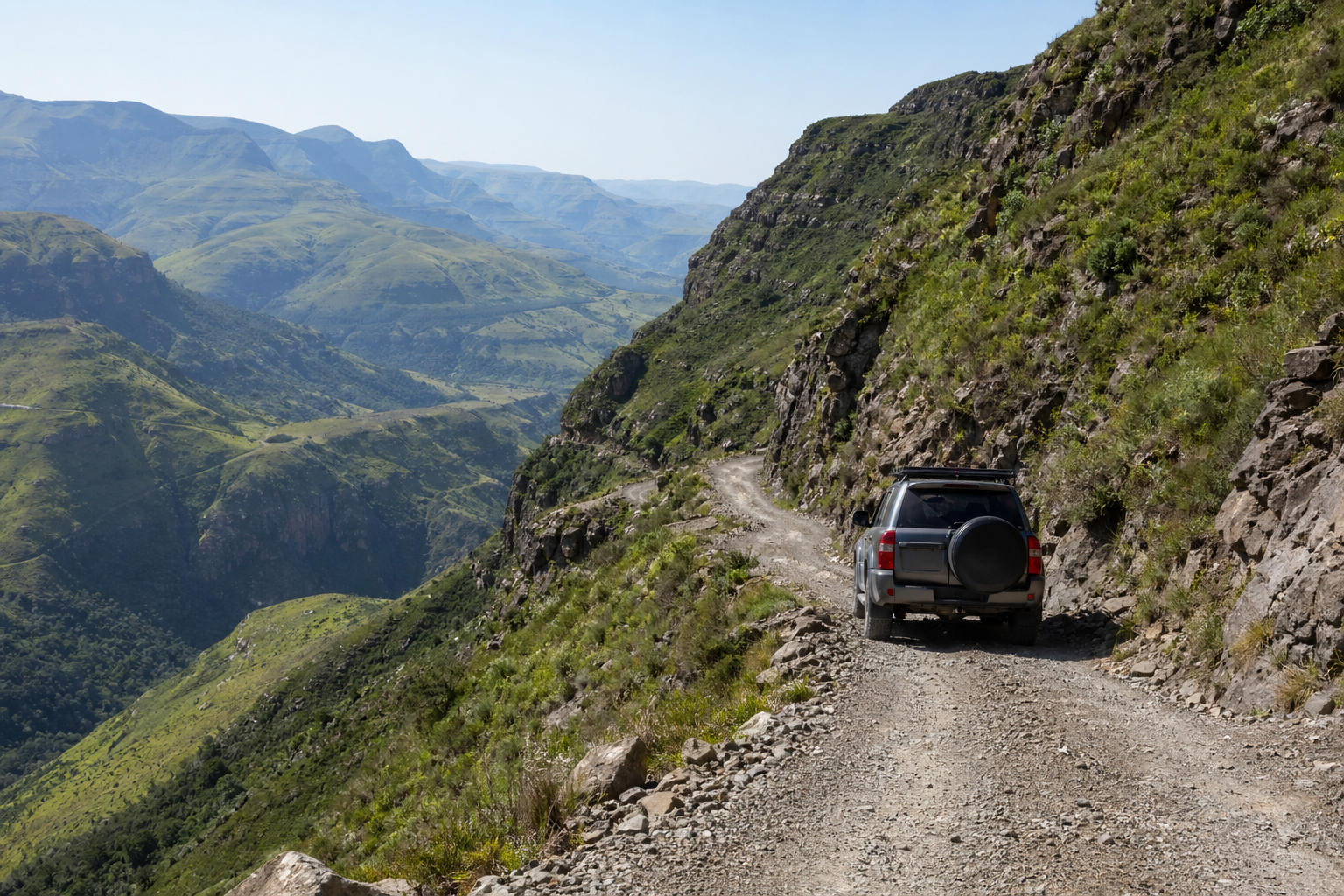
Bulembu Pass outside Barberton, Mpumalanga, climbs steeply out of the lowveld toward the old mining town of Bulembu and the Eswatini (Swaziland) border beyond it.
Getting There From Barberton
The pass connects Barberton on the South African side to Bulembu on the Eswatini side, crossing through some of the oldest exposed geology on the planet. It’s a relatively short mountain pass in terms of distance. You’re not driving for hours, but the elevation change is compressed into tight switchbacks and steep gradients that demand your full attention.
From Barberton, head south toward Bulembu. Signposting exists, but it’s worth checking a recent GPS or satellite map before you go, because signage in rural Mpumalanga can be inconsistent. If you’re navigating by phone, download offline maps in advance; cell signal gets patchy once you start climbing. The turn-off from Barberton is straightforward enough, but once you leave the tar and the road starts winding upward, you’re committed to a single route with very few bail-out options until you either reach Bulembu or turn around.
For drivers looking into the broader network of Barberton mountain passes, Bulembu Pass sits on the more adventurous end of the spectrum. It’s not a highway detour. It’s a deliberate choice, and a rewarding one if you’re prepared.
Road Surface and Conditions
The lower sections out of Barberton can start on tar before transitioning to gravel and dirt. Higher up, the surface quality varies, sometimes compacted and manageable, sometimes loose, rutted, or washed out, depending on when the road was last graded and how much rain has fallen recently.
The hairpins are the defining feature. They’re tight, often on steep gradients, and some have limited visibility around the apex. Expect sections where two vehicles can’t pass comfortably, which means you need to be watching ahead and listening for oncoming traffic. Locals, including trucks and bakkies that know the road well, won’t always slow down the way you’d hope.
Bulembu Pass road conditions deteriorate noticeably after heavy rain. Water channels across the road surface, loose rocks get deposited on the driving line, and sections that were firm gravel can turn into slick mud. Mist and low cloud reduce visibility to very little, and that’s a serious compounding factor on a road with drop-offs and blind corners. During the dry winter months, conditions tend to be more predictable, but dust can still limit your view of what’s coming.
The common “gotchas”: underestimating how steep the descent is (climbing up feels different from coming back down), meeting oncoming vehicles on a narrow hairpin, and misjudging surface grip after overnight rain even on a day that looks clear.
If conditions are bad, turn around. Reaching a summit isn’t worth a damaged vehicle, a stuck wheel, or worse. Reversing your plan on a mountain pass is a sign of good judgment, not a failure. The pass will still be there next weekend.
Vehicle Choice and Difficulty
There’s no official Bulembu Pass difficulty rating published by any road authority, so here’s a practical framework based on what the road actually asks of a vehicle.
A standard low-slung hatchback or sedan is a risk. Ground clearance is the first gatekeeper, ruts, rocks, and uneven surfaces after rain can scrape or damage the underside of anything sitting below roughly 170mm. If you’re in a modern crossover with reasonable clearance and decent tyres, you can manage in dry conditions when the road has been recently graded. But “can manage” and “comfortable” are different things.
When the road is wet, muddy, or hasn’t been maintained in a while, this becomes a Bulembu Pass 4×4 route discussion. A high-clearance bakkie or SUV with proper all-terrain tyres gives you margin, margin for traction on loose surfaces, margin for clearance over rocks, and margin for confidence on steep gradients. Low-range gearing is genuinely useful on the steepest hairpins, both climbing and descending.
Brake management on the descent deserves its own attention. Downshift early. Use second or even first gear in low range if you have it, and let engine braking do most of the work. Riding the brake pedal down a sustained mountain gradient heats your pads and fluid, and brake fade on a steep, winding gravel road is a situation nobody wants. If you smell hot brakes, pull over somewhere safe, let them cool, and reassess your gear selection before continuing. Short, firm brake applications are far better than constant light pressure.
Your honest self-assessment matters as much as the vehicle. If mountain passes make you tense, if you’re not comfortable with steep gravel descents, or if your passengers include small children and you’d rather not add stress, there’s no shame in choosing a different route for the day.
Viewpoints and Makhonjwa Scenery
This is where the effort pays off. The Bulembu Pass scenic drive delivers views that genuinely stop you mid-sentence. As you gain elevation, the landscape opens up into sweeping panoramas of the Makhonjwa Mountains, an ancient greenstone belt that forms some of the oldest mountainous terrain on Earth, and part of the Barberton Makhonjwa Mountains UNESCO World Heritage Site.
What you’re looking at, in practical terms: deeply folded ridgelines covered in dense, lush vegetation during the wet summer months, giving way to subtler browns and golds in the dry season. The lush hills in summer are almost impossibly green, layered in mist that drifts through the valleys in the early morning and late afternoon. In winter, the air clears, the light sharpens, and you can see further, but the landscape trades some of that dramatic green intensity for drier, more muted tones.
For photography, morning light works best if you’re climbing eastward out of Barberton, you’ll have front-lit ridgelines and softer shadows. Late afternoon gives you warmer tones and longer shadows across the valleys, but you’ll be shooting into haze more often. Stop only where there’s space to pull fully off the road and where you have clear sightlines in both directions. Do not stop on blind corners or tight hairpins to grab a photo, no matter how good the view looks. There are several wider spots and natural pull-overs on the route where you can safely park and take your time.
Birdlife in the area can be notable, particularly raptors using the thermals along the ridgeline. Keep expectations modest for large wildlife, this isn’t a game reserve, but the natural environment is rich and relatively undisturbed.
Planning and Logistics
If you intend to cross into Eswatini via the Bulembu border crossing from Barberton, plan for a small, relatively quiet post with limited operating hours. Carry your passport and any required documentation for your vehicle. Check current border hours before you leave, as they can change. This is not a major commercial crossing, and facilities on either side are minimal. If you’re a foreign national, confirm visa requirements for Eswatini in advance.
The best time to drive is during the dry season, roughly May through September, when road surfaces are more stable, visibility is better, and the risk of sudden storms is lower. That said, the wet season (October through March) delivers the most dramatic scenery: thick green vegetation, waterfalls running, mist threading through the mountains. You trade visual spectacle for less predictable road conditions and reduced visibility. If you go in summer, start early, watch the weather, and be ready to turn back if conditions change.
Before you leave Barberton, fuel up, there’s no fuel available on the pass or in Bulembu. Check your tyre pressures and tread depth; consider lowering pressures slightly for better grip on gravel, and carry a compressor to reinflate on tar afterward. Inspect your brakes, top up coolant, and make sure your spare tyre is usable. Carry water, a basic first-aid kit, and a charged phone with offline maps. Let someone know your plan.
For time-limited visitors, an out-and-back drive from Barberton works well as a half-day trip. Drive up to the best viewpoints, spend time with the scenery, and return the same way. You don’t have to cross the border to get the full experience of the pass, the road and the views are the destination.
Who Bulembu Pass Suits
Bulembu Pass suits drivers who enjoy mountain roads, who have a vehicle with reasonable clearance and good tyres, and who want scenery that goes beyond the usual Panorama Route stops. It’s a proper gravel mountain pass with real consequences for poor decisions, but it’s not extreme, prepared drivers in suitable vehicles handle it regularly.
If you’re in a low-clearance car, if you’re not comfortable on steep gravel hairpins, or if conditions are wet and you don’t have 4×4 capability, pick a different day or a different route. The Barberton area has other roads worth looking into that don’t carry the same vehicle and skill requirements.
The Makhonjwa Mountains and their lush hills aren’t going anywhere. Drive the pass when the conditions, the vehicle, and your confidence all line up, and when they do, it’s one of the most rewarding mountain drives in Mpumalanga.