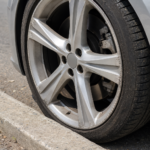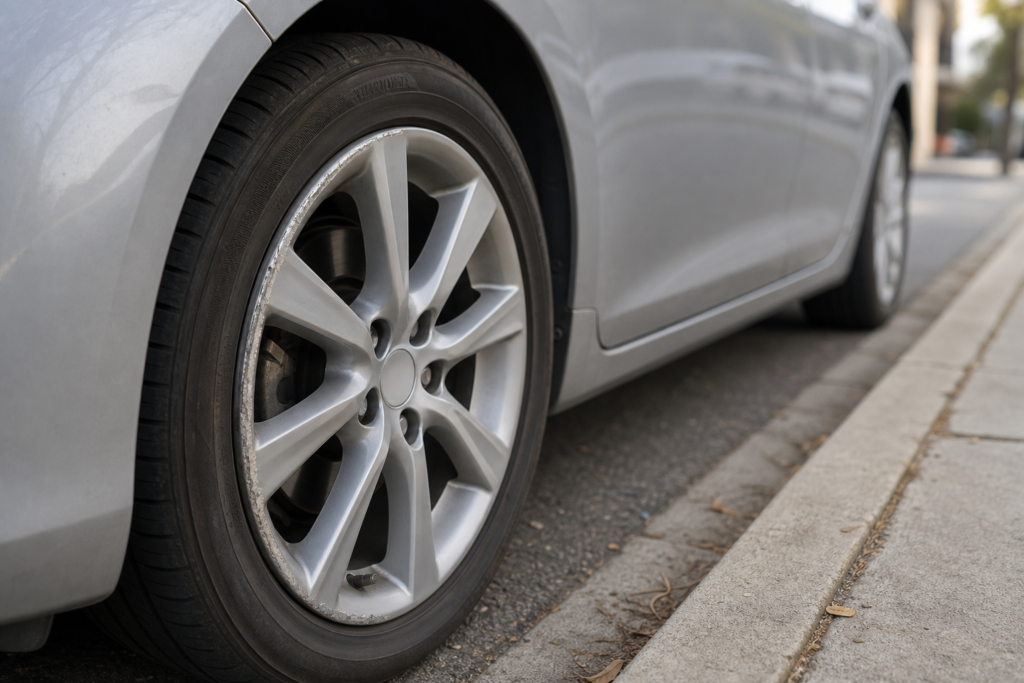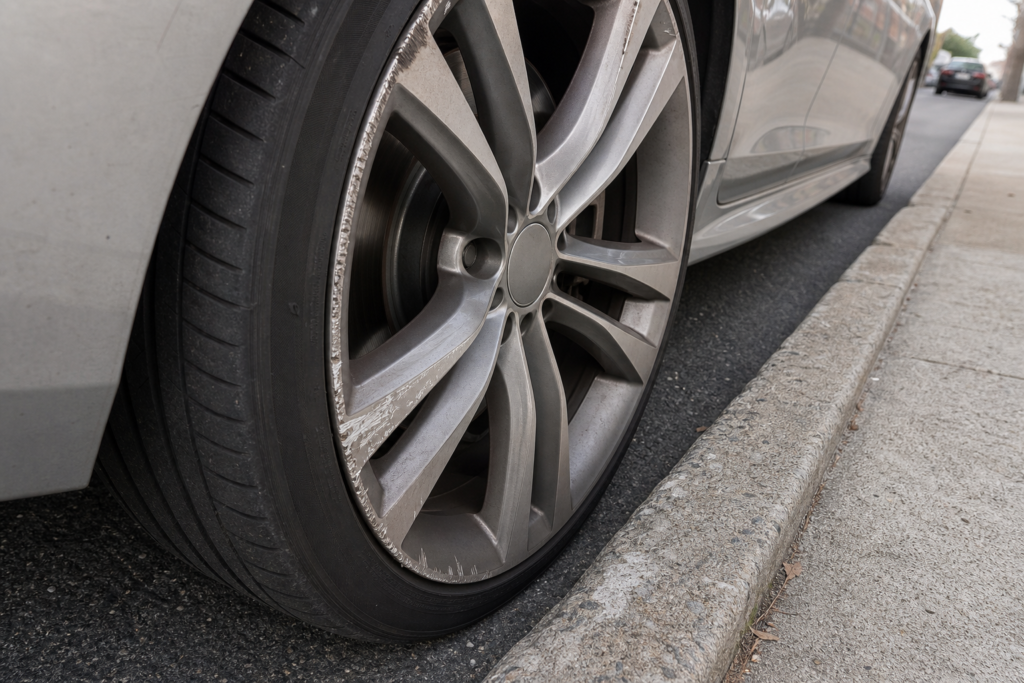
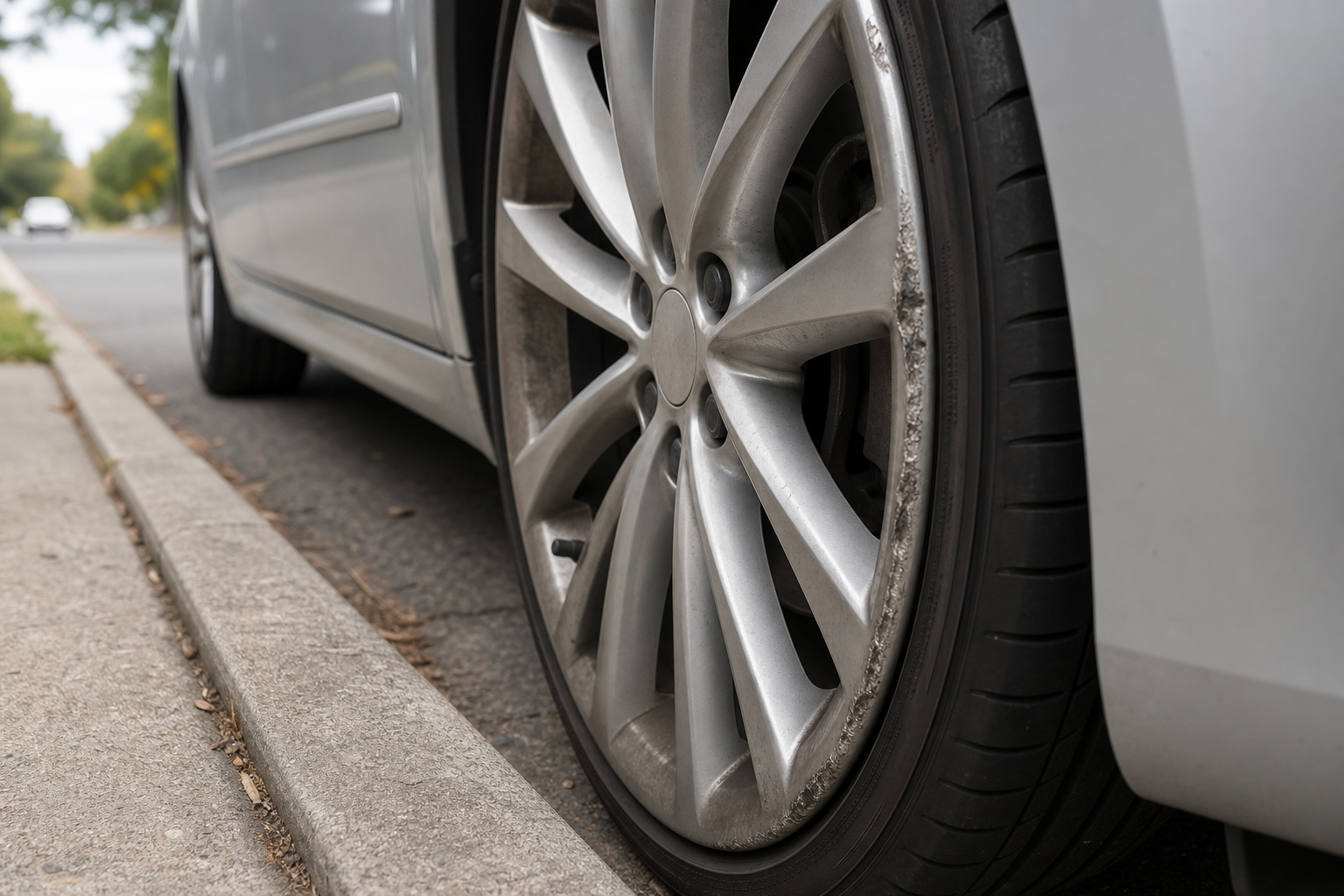
You clip the concrete lip of a parking garage pillar during a tight turn, hear that sickening grind, and pull into your spot already dreading what you’ll find. The scuff is there, silver alloy showing through the paint, and now the real question hits: how much curb rash is too much? Is this a cosmetic blemish you can live with, or has the wheel crossed into territory where air loss, vibration, or outright failure becomes a realistic concern?
That line between “ugly but fine” and “not safe to ignore” depends on depth, location, and what’s happening beneath the surface.
The Practical Safety Threshold
The practical threshold is structural. Curb rash becomes too much the moment the damage moves past the wheel’s surface coating and removes enough material, or bends or cracks enough of it, to compromise the rim’s integrity, its ability to hold an air seal, or its resistance to corrosion over time.
Think of wheel damage on a three-tier spectrum. Minor rash is scuffing through clear coat and paint, exposing bare alloy but not gouging into it. The surface is rough to the touch but essentially flat. Moderate damage means visible gouges that bite into the metal itself, you can catch a fingernail in them, and some material is clearly missing. Severe damage is anything involving cracks, bends, chunks of missing alloy, or deformation near the bead seat where the tire seals against the rim.
Why does depth matter beyond looks? A deep gouge reduces the wheel’s effective cross-section at that point, creating what engineers call a stress riser, a spot where vibration and load forces concentrate instead of distributing evenly. That concentration is how cracks start. Worse, exposed alloy corrodes. Road salt, brake dust, and moisture work into the raw metal over weeks and months, widening what started as a single scrape into a network of pitting that weakens the area further.
Location amplifies severity. Damage on the outer lip is common and usually cosmetic. The same depth of gouge near the bead seat, the machined ledge where your tire forms its air seal, is a different problem entirely. Spoke damage can weaken the wheel’s load path. And rash on the inner barrel, invisible without removing the tire, often hides the worst surprises.
At-Home Inspection Steps
Start with three variables: depth, length, and location. Run your fingertip across the damaged area. If you feel only texture, roughness without a ledge or valley, you’re likely in cosmetic territory. If your fingernail drops into a groove, measure that depth against something familiar. A credit card is roughly 0.75 mm thick. Gouges deeper than that are removing meaningful material. Gouges several times that depth, or ones that span a significant arc of the rim, deserve closer inspection.
Next, check location. Crouch down and look at where the damage sits relative to the tire bead. If the scrape runs across or into the flat sealing surface where rubber meets metal, that’s a curb rash wheel safety risk even if it doesn’t look dramatic. A compromised bead seat can weep air slowly enough that you won’t notice for days, until a cold morning drops pressure just enough to trigger a warning light or, worse, affect handling.
Feel the wheel with both hands, slowly, all the way around. Any spot where the rim edge feels pushed inward or outward, even slightly, indicates a bend. Bends don’t always show visually; sometimes you detect them only by feel or by the wobble they create at speed.
Stop your home assessment if you find any crack visible to the naked eye, any bend you can feel, any gouge deeper than a credit card’s thickness, or any damage touching the bead seat. These are hard triggers, not judgment calls. Also watch for delayed symptoms in the days and weeks after a curb hit, such as a new vibration through the steering wheel, a subtle pull to one side, a tire that keeps losing a pound or two of pressure between fill-ups, or a shop telling you the wheel keeps throwing balance weights. All of these can trace back to a curb strike that also shifted alignment or damaged a suspension component. The wheel is the visible evidence; the geometry underneath might be quietly off too.
Damage Beyond Repair
Every reputable wheel shop has hard lines. Cracks mean replacement. Bends that distort the mounting surface or bead seat mean replacement. Missing chunks of alloy mean replacement. Damage that has already been welded once and cracks again means replacement. These aren’t conservative opinions, they reflect the reality that a wheel spinning at highway speed is under enormous cyclical stress, and a compromised structure doesn’t send warnings before it fails catastrophically.
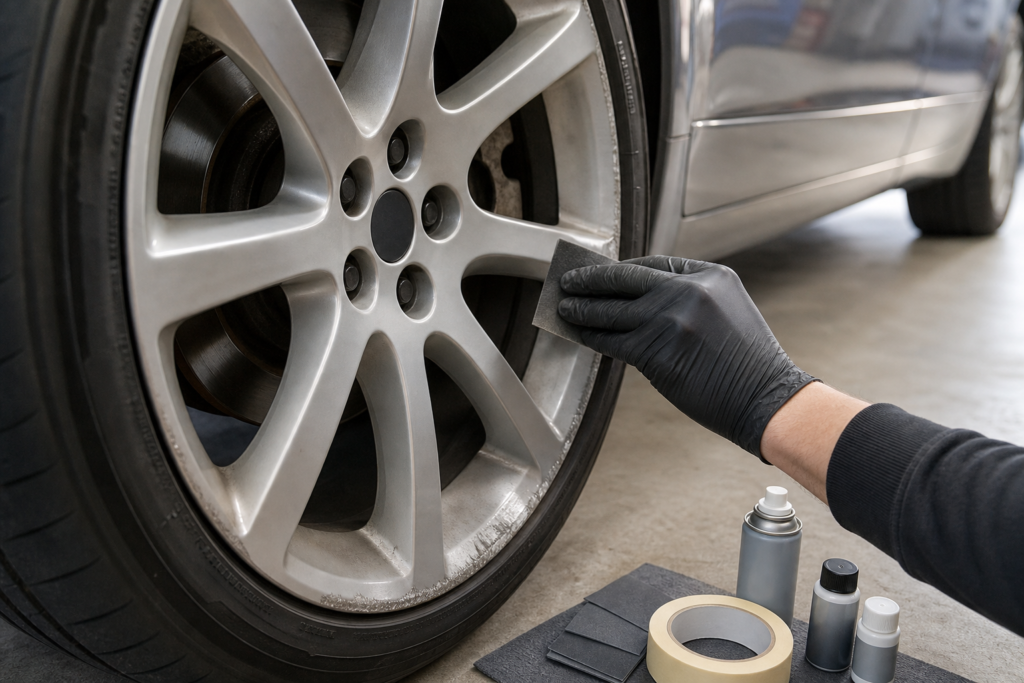
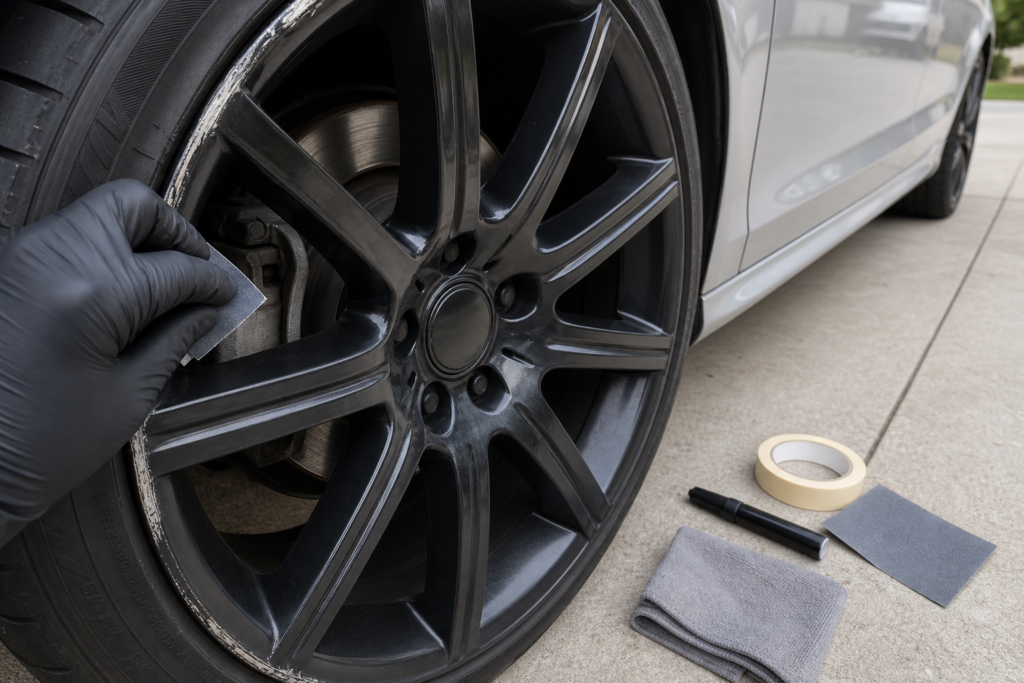
Below those hard lines, there’s a gray zone. Cosmetic refinishing, sanding, filling, repainting, and clear-coating surface scuffs, is well-established and low-risk. The wheel’s structure is untouched; you’re just restoring the protective and visual layers. Structural straightening, where a hydraulic press bends a wheel back into round, is a different conversation. It can work on mild bends in cast alloy, but it introduces its own stress, and not every wheel tolerates it. Forged wheels are more amenable to straightening than cast ones. Welding cracked alloy is possible but carries risk: heat-affected zones around the weld can become the next failure point.
When damage goes past surface scratches and turns into deep gouges, cracks, or a bent rim, you’ve crossed from cosmetic into structural harm. That’s curb rash too deep to fix with confidence. A refinished gouge can still hide a stress riser underneath fresh paint. A straightened bend can re-crack under load. If a shop hesitates or recommends replacement, take that seriously.
Repair and Replacement Costs
How much does it cost to deal with curb rash? Ranges vary widely by market, wheel size, and finish, but broad strokes are useful. A mobile cosmetic touch-up on a standard painted alloy wheel typically runs in the low hundreds and can handle light scuffs right in your driveway. A full strip-and-refinish at a dedicated wheel shop costs more, often two to four times as much, especially for diamond-cut, polished, or multi-tone finishes. Structural straightening, where it’s appropriate, usually falls somewhere between those two.
A brand-new OEM wheel for a mainstream sedan or crossover might cost a few hundred dollars; for a premium or luxury vehicle with large-diameter forged wheels, that number can climb steeply. Aftermarket replacements bring the price down but introduce fitment and finish-matching considerations. Add an alignment check and tire rebalance to any scenario.
How much is it worth spending? That depends on the car. Dropping several hundred dollars to refinish a wheel on a base-model commuter with high mileage rarely makes financial sense unless you’re about to sell it. On a late-model luxury car where buyers expect perfection, the same spend can prevent a disproportionate hit at trade-in.
And curb rash does affect trade-in value, not by a fixed dollar amount, but by shaping perception. Visible wheel damage signals a hard life to any buyer or appraiser. It invites the assumption that if the wheels were neglected, maybe the mechanicals were too. In private sales, chewed-up rims give buyers leverage to negotiate down by more than the repair would have cost. The rule of thumb: if the cosmetic fix costs meaningfully less than the resale discount it prevents, fix it. If the car’s value doesn’t justify the repair, save the money.
Replace, Repair, or Monitor
The decision framework comes down to three outcomes.
Replace when you find cracks, significant bends, missing material, or bead-seat damage. Replace when a shop has already attempted a structural repair and the problem returned. Replace when the wheel is a size or design where quality aftermarket options cost less than a proper refurbishment. Knowing when to replace curb rashed rims is mostly about recognizing that structural compromise doesn’t improve with time, it worsens under every mile of load and vibration.
Repair when the damage is cosmetic, surface scrapes, paint loss, shallow scoring, and the wheel is structurally sound. Repair when the finish matters for resale or personal satisfaction and the cost is proportional to the car’s value. Repair mild bends only at shops experienced with your wheel type, and only after confirming no cracks are present.
Monitor when the rash is minor, the wheel holds air, balance is steady, and no vibration or pull has developed. Many wheels on the road carry light curb rash for years without consequence. Check the damaged area periodically for corrosion spread or new cracking, especially through winter salt seasons. The confidence test is personal but real. If you’re loading your family for a long highway trip or driving through heavy rain, do you trust that wheel? If the answer is anything less than yes, that’s your answer. The threshold for too much curb rash isn’t always a measurement, sometimes it’s the hesitation itself.
The Bottom Line
Classify the damage by depth, location, and symptoms. Surface scuffs through paint are cosmetic. Gouges into the alloy are a watch-and-decide situation. Cracks, bends, or bead-seat damage are replacement triggers, full stop.
Know the red flags: visible cracks, felt bends, slow leaks, new vibrations, and any gouge deep enough to catch more than a fingernail. Understand that a single curb hit can set off a slow chain, exposed metal corrodes, corrosion weakens the structure, and months later a wheel that “seemed fine” starts losing air or developing a crack.
Make a financially honest decision. Don’t overspend fixing wheels on a car that doesn’t warrant it. Don’t underspend ignoring structural damage on a car you depend on daily. Prioritize the safety-critical thresholds over appearance, get a check when you’re uncertain, and drive on the wheels you actually trust.