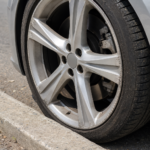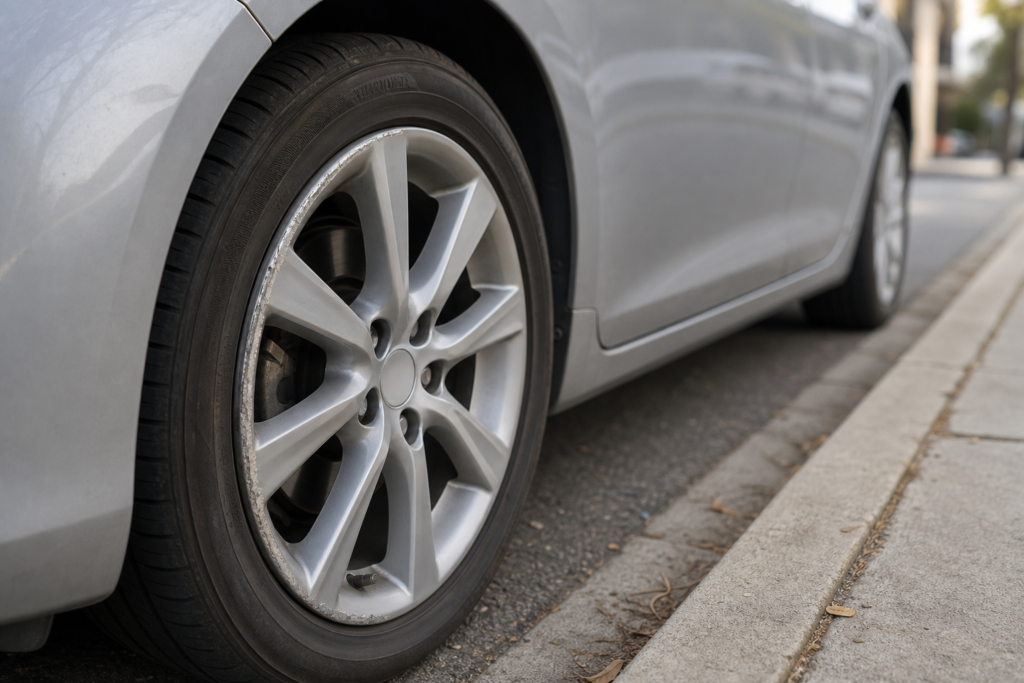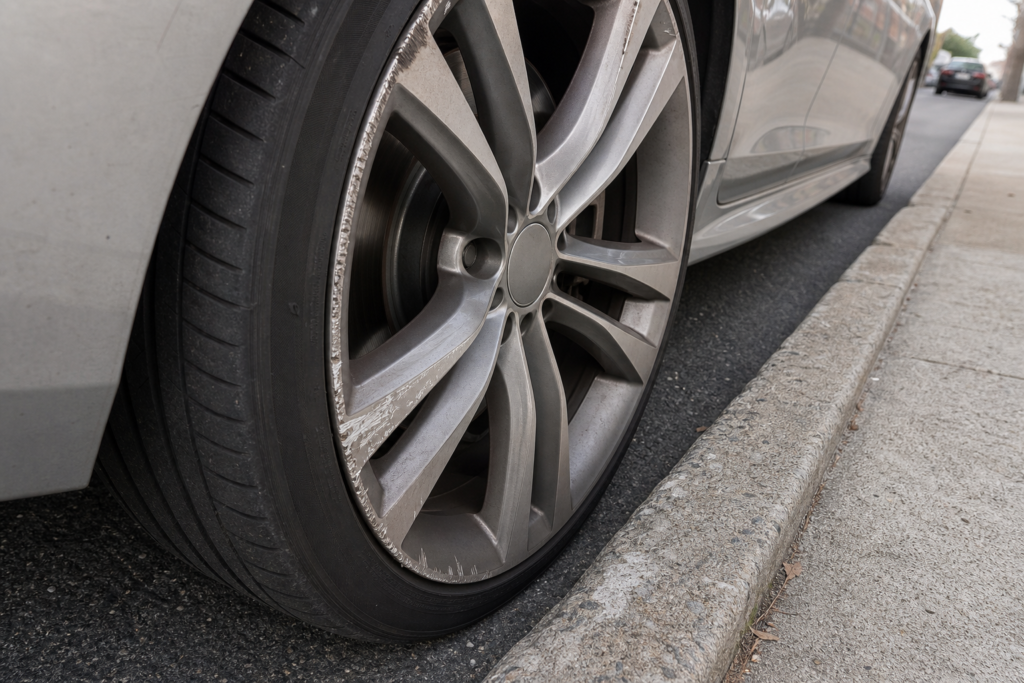
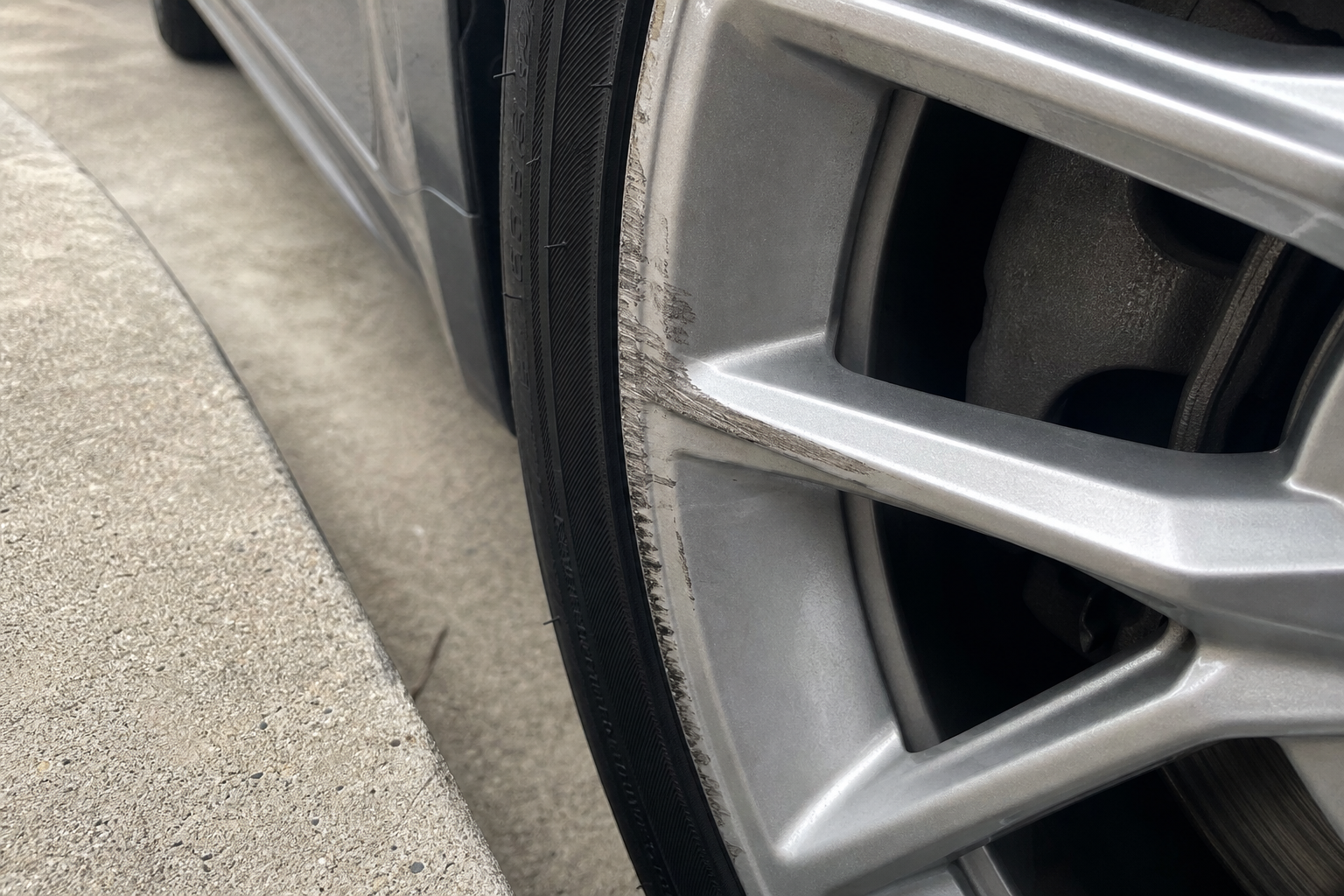
You clip a concrete curb pulling into a tight parking spot, hear that sickening scrape, and step out to find the lip of your alloy wheel chewed up with a raw silver streak across the finish. The first question isn’t about looks, it’s whether you just created a cosmetic problem or a safety one.
The answer depends on where your damage falls on a severity scale, what kind of wheel finish you’re dealing with, and how quickly you act. Most curb rash is fixable. Some isn’t. Here’s how to tell the difference, and what it realistically costs, from an inexpensive DIY kit to a professional refinish per wheel.
Damage Types and Severity
Curb rash is abrasion damage to a wheel’s outer surface caused by contact with a curb or barrier. It ranges from barely noticeable to structurally compromising, and the severity ladder matters more than most drivers realize.
At the lightest level, you’re looking at surface scuffs, clearcoat scratches and minor scrapes that expose a thin layer of bare aluminum or paint underneath. These are cosmetic. The wheel’s structure is untouched, the bead seat where the tire seals is fine, and the lip isn’t deformed.
Move up and you hit gouges, material actually removed from the wheel face or lip. Shallow gouges are still repairable with filler and refinishing. Deeper ones start to test the limits. Can deep curb rash be fixed? Often yes, but conditionally. A gouge that’s removed enough material to thin the lip significantly, or one that sits right on the bead seat, changes the repair conversation from cosmetic to structural.
At the top of the ladder are bends, cracks, and compromised bead seats. A bent lip can sometimes be straightened by a specialist, but a cracked wheel is almost always a replacement situation. Cracks propagate under load. A wheel that’s leaking air because the bead seat is torn up is unsafe to drive on regardless of how the face looks. Finish type matters here too. A standard painted or silver alloy wheel is the most forgiving, easy to sand, fill, and repaint. Machined-face wheels, with their lathe-cut concentric lines, are harder because the finish can only be truly replicated on a CNC lathe. Chrome wheels present their own challenge: curb rash on chrome wheels typically means the plating is breached, and you can’t spot-repair chrome plating the way you can touch up paint. The wheel usually needs full re-chroming or replacement. Fixing curb rash on aluminum wheels is straightforward in most cases, but the finish dictates the method and the realistic outcome.
Realistic Repair Results
Anyone searching for curb rash repair before and after photos online will find dramatic transformations. They’re real, but context matters.
On a painted alloy wheel with light-to-moderate scuffs, a skilled repair can be genuinely invisible from normal viewing distance, five feet or so. Up close, under direct sunlight and at the right angle, you might notice a slight texture difference where filler was used or a faint color variation in the repaint zone. For most drivers, that result is more than good enough.
Deeper gouges produce visible repairs more often. Filler compounds are strong but they’re not metal. A deep fill on a wheel lip might show a slight contour change or a surface that doesn’t quite match the factory sheen. Again, from a few feet away, it’s usually undetectable. Under inspection at a lease return or from a picky buyer, it may be noticeable.
Machined-face wheels are the trickiest. The factory finish is a precision lathe cut that creates a reflective, directional pattern. A paint-based repair on a machined face will never replicate that pattern, it’ll look acceptable but different. The only way to restore the original look is a full CNC re-cut, which removes a thin layer of the wheel face to create new machining marks. Not every shop offers this, and it’s typically at the upper end of repair pricing. Chrome is the least forgiving. A patched chrome wheel will almost always look patched. Full re-chroming is the only path to an invisible result, and it costs significantly more than standard refinishing. The honest summary: most repairs look great at conversational distance. Perfection under a magnifying glass depends on severity, finish type, and the skill of the person doing the work.
DIY Kits vs. Professional Repair
The curb rash repair cost gap between doing it yourself and hiring a professional is significant, and so is the gap in results.
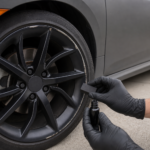
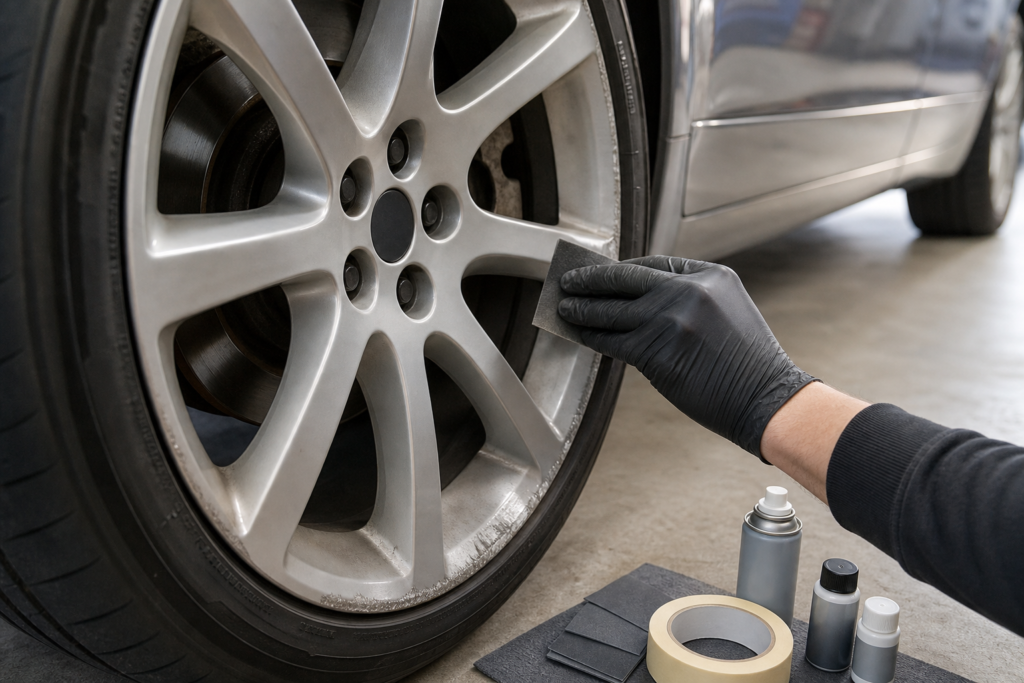
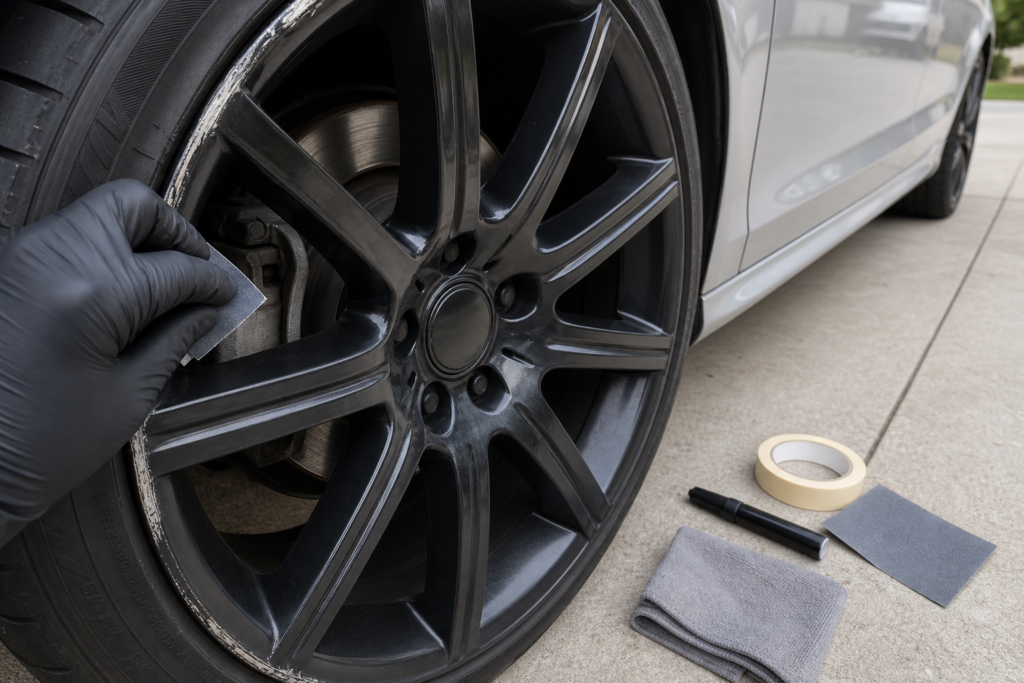
A DIY curb rash repair kit is relatively inexpensive, though prices vary by brand and what’s included. These kits include sandpaper, filler putty, primer, and a color-matched paint or silver wheel paint. For light scuffs and shallow scratches on a standard painted alloy, they work. You sand the damaged area, apply filler if needed, prime it, paint it, and clearcoat it. The process takes a few hours plus drying time. The results are acceptable for a daily driver where “better than it was” is the goal.
Where DIY falls short is color matching on non-standard finishes, filling deep gouges smoothly, and durability. Spray-can clearcoat isn’t as resilient as what a professional applies, so the repair may dull or chip faster. On dark-colored or custom-finished wheels, getting the paint to blend seamlessly is difficult without professional spray equipment.
Professional wheel repair costs significantly more than a DIY kit, with pricing depending on damage severity, finish type, and whether you go to a mobile service or a dedicated shop. A service offering mobile rim repair in orange county or similar metro areas will come to you and work in your driveway, convenient and often adequate for light-to-moderate cosmetic damage. A shop-based repair allows for more controlled conditions, better curing, and access to CNC lathes for machined-face wheels. The dividing line is straightforward: if the damage is light scuffs on a painted silver wheel, a DIY kit is a reasonable first step. Anything beyond that, deep gouges, machined faces, chrome, or structural concerns, belongs with a professional.
Cost of Waiting
Bare aluminum exposed by curb rash starts oxidizing almost immediately. In dry climates, this happens slowly. In regions with road salt, rain, or humidity, corrosion can set in within weeks.
What starts as a cosmetic scuff becomes pitting, small craters in the metal surface that are harder to fill and sand smooth. Pitting that reaches the bead seat area can compromise the tire seal over time, turning a straightforward cosmetic repair into a more involved structural job or a full wheel replacement.
Corrosion also spreads beneath the surrounding clearcoat and paint, lifting the finish from the inside out. A scuff you could have fixed cheaply with a DIY kit in week one can require a much costlier professional refinish by month six because the damage footprint has grown.
For leased vehicles, timing matters even more. Lease-return inspections flag curb rash, and the charges for wheel damage at turn-in are typically higher than what you’d pay for a quality repair beforehand. Waiting until the last month of a lease to address wheels that have been corroding for two years limits your options and raises your costs. The principle is simple: exposed metal wants to be treated. The sooner you seal it, even with a temporary touch-up if a full repair isn’t in the budget yet, the more options you preserve.
Repair, Refinish, or Replace
Deciding what to do with a damaged wheel comes down to five factors: severity, finish, cost, safety, and context.
If the damage is light scuffs with no deformation and the wheel has a standard painted finish, a DIY fix or an affordable mobile repair handles it. This is the most common scenario and the one with the best cost-to-outcome ratio.
Moderate gouges on painted or machined wheels call for professional repair. These repairs cost more than a basic touch-up, especially if CNC re-cutting is involved. The result will be good, though machined faces may not be factory-perfect. A bent lip without cracking can sometimes be straightened by a wheel specialist. This is worth exploring before assuming replacement, but the wheel should be inspected for hairline cracks afterward. Straightening a wheel that’s also cracked is not a repair, it’s a liability.
Cracked wheels get replaced. Full stop. No filler, weld, or refinish makes a cracked wheel safe for road use at speed. The same applies to wheels with severe bead seat damage that can’t hold air reliably. Context shapes the decision too. A daily driver with one scuffed wheel and no plans to sell may be fine with an inexpensive DIY touch-up. A leased vehicle six months from return deserves professional attention to avoid inflated turn-in charges. A car being prepped for sale benefits from clean wheels, fix curb rash on rims before listing, because buyers notice wheels immediately and discount their offers accordingly. How much is it worth spending? That depends on the wheel. If a factory replacement costs significantly more than the repair, refinishing makes sense. If the wheel is an inexpensive steel rim with a plastic cover, skip the repair and replace.
The Simplest Decision Rule
Run your finger across the damage. If you feel a scuff but the lip is straight, the metal isn’t cracked, and the tire holds air, you’re in repair territory, and most of the time, the results will be better than you expect for less than you fear.
How much curb rash can be fixed comes down to one distinction: cosmetic damage has broad, affordable solutions; structural damage has narrow, non-negotiable ones. Most drivers are dealing with the first category. The key is acting before time and weather push you into the second.