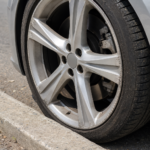
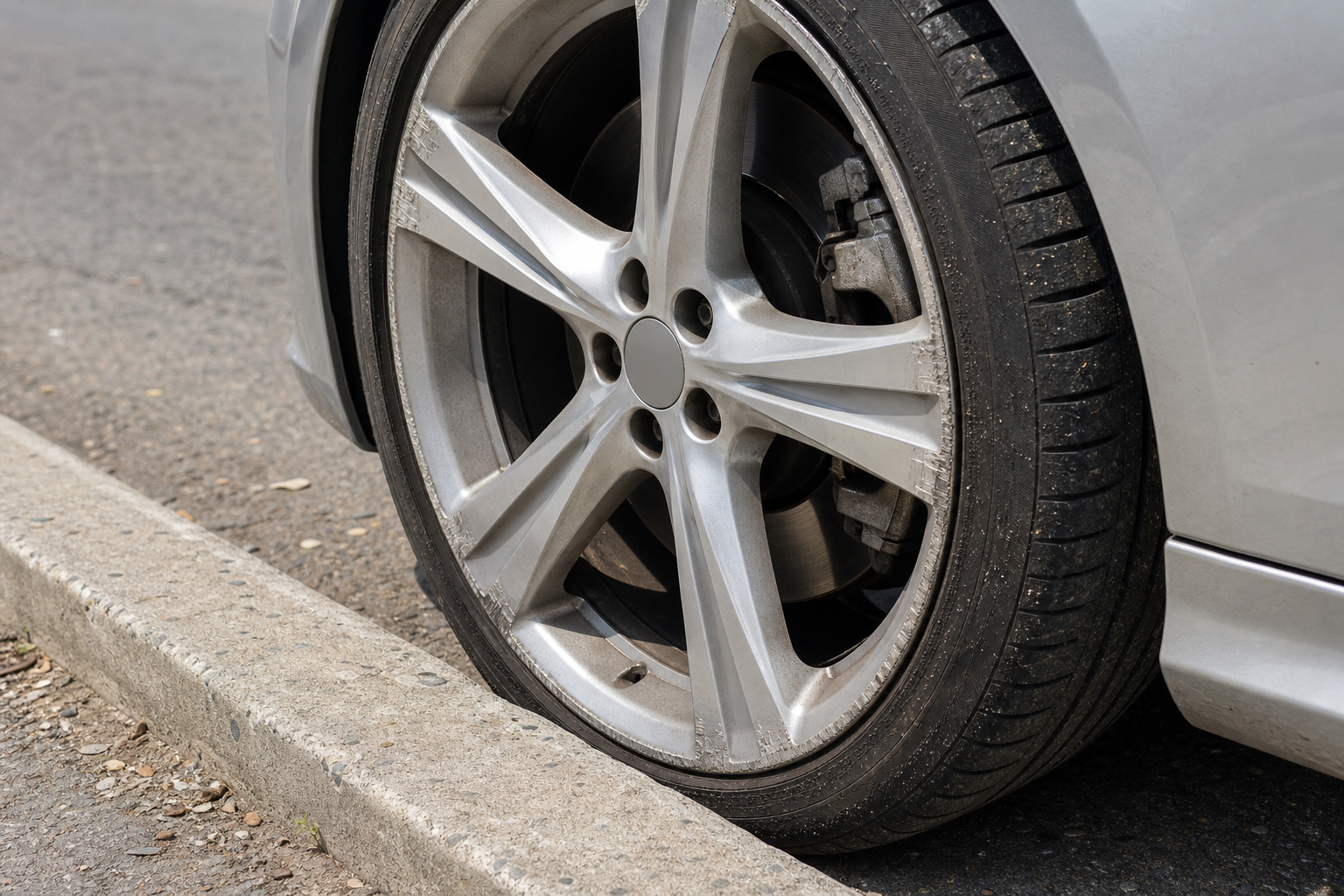
The Rim-Meets-Curb Moment
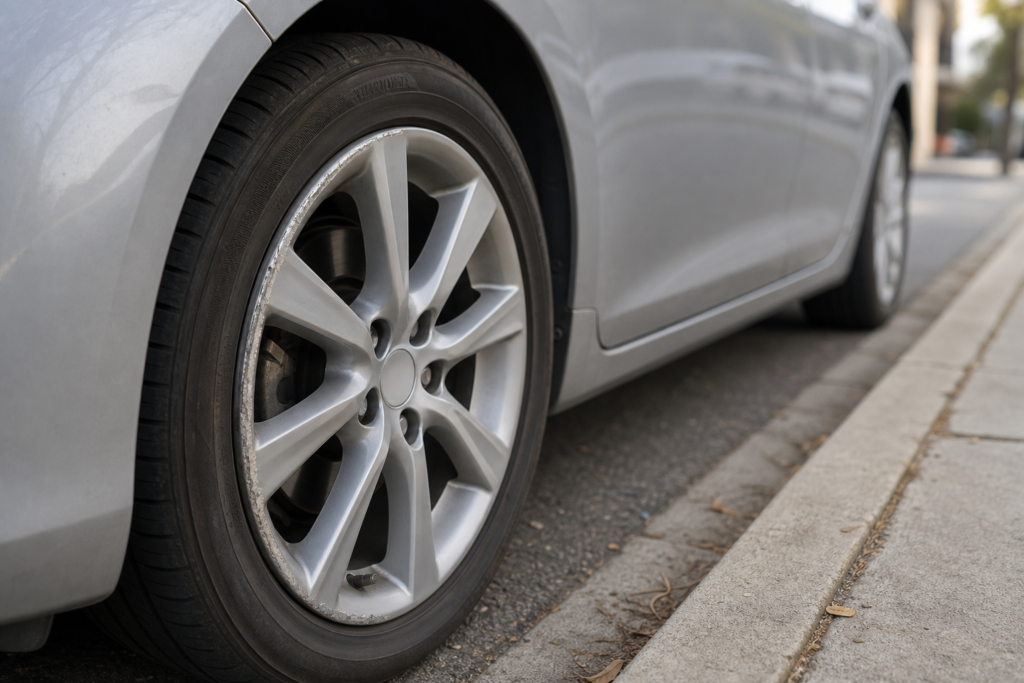
You’re easing into a parallel spot on a narrow street, steering right, inching backward. The tire sidewall passes within a fraction of an inch of the concrete curb edge, and then you hear it. A short, grating scrape. The outer lip of your wheel rim has contacted the curb before the rubber could absorb or deflect anything. That single moment of rim-on-concrete contact is how curb rash happens, and it takes less than a second.
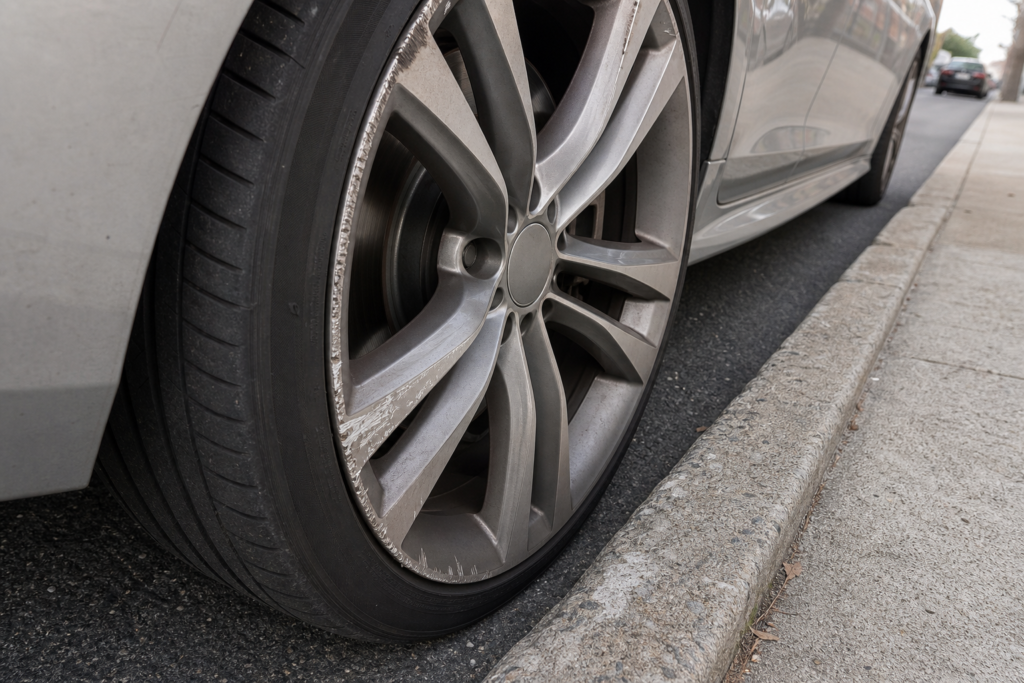
The sequence is remarkably consistent. As the vehicle moves laterally toward a curb, sidewalk edge, or parking block, the approach angle narrows until the outermost point of the rim, the lip or flange, becomes the first solid surface to meet the concrete. The tire sidewall, which sits slightly inboard of the rim’s widest point on many modern setups, never gets the chance to act as a buffer. Concrete is highly abrasive. Even at walking speed, the contact concentrates force along a tiny strip of the rim edge, and the curb acts like coarse sandpaper dragged across the finish.
That’s why the resulting mark often looks worse than the contact felt. A gentle brush might barely register through the steering wheel, but it’s enough to strip clearcoat, score the underlying metal, and leave a visible scuff several inches long. This is fundamentally why rims get scratched on curbs: a hard, rough surface meets a softer metal edge under concentrated lateral load, and the geometry of the wheel puts the most exposed point right where the curb waits.
Modern Wheel-and-Tire Vulnerability
A generation ago, most passenger cars wore taller sidewall tires that extended well past the rim lip. That extra rubber acted as a cushion, contacting the curb first and sparing the wheel. Today’s trend toward low-profile tires has reversed that protection. With less sidewall height between the road and the rim edge, the wheel’s outer lip sits closer to, or even flush with, the tire’s widest point. Curb rash and low-profile tires go hand in hand because there’s simply less rubber standing between alloy and concrete.
Wide wheels and flush or near-flush fitment compound the exposure. When the wheel face sits close to the fender line, it also sits closer to any curb the vehicle approaches. Enthusiast and factory sport packages often pair both traits, wide, large-diameter wheels with thin sidewalls, creating the maximum possible vulnerability.
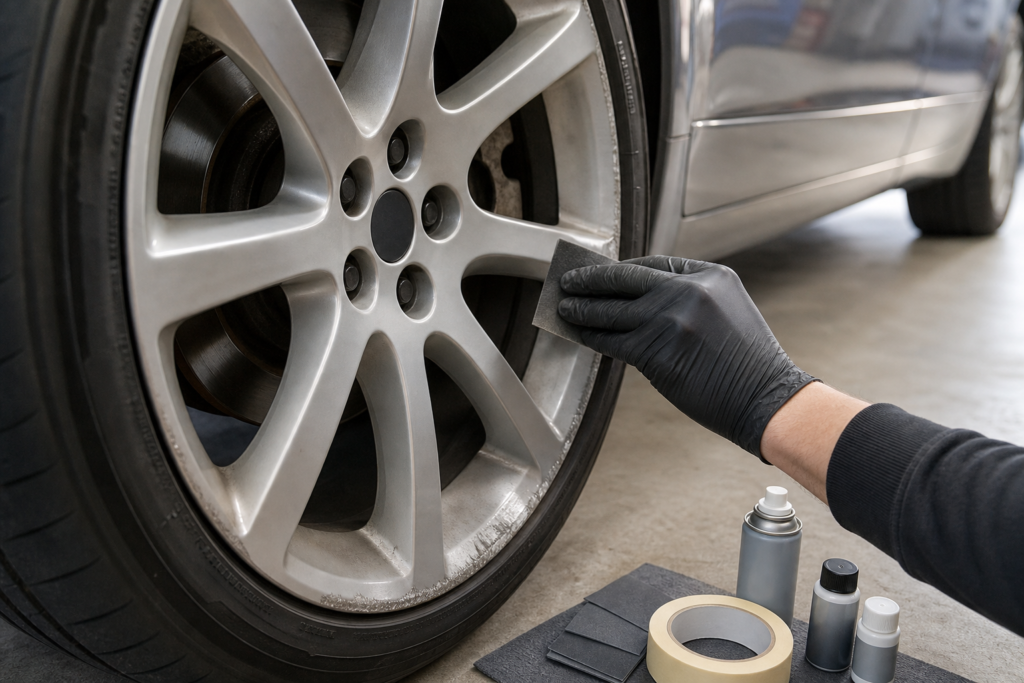
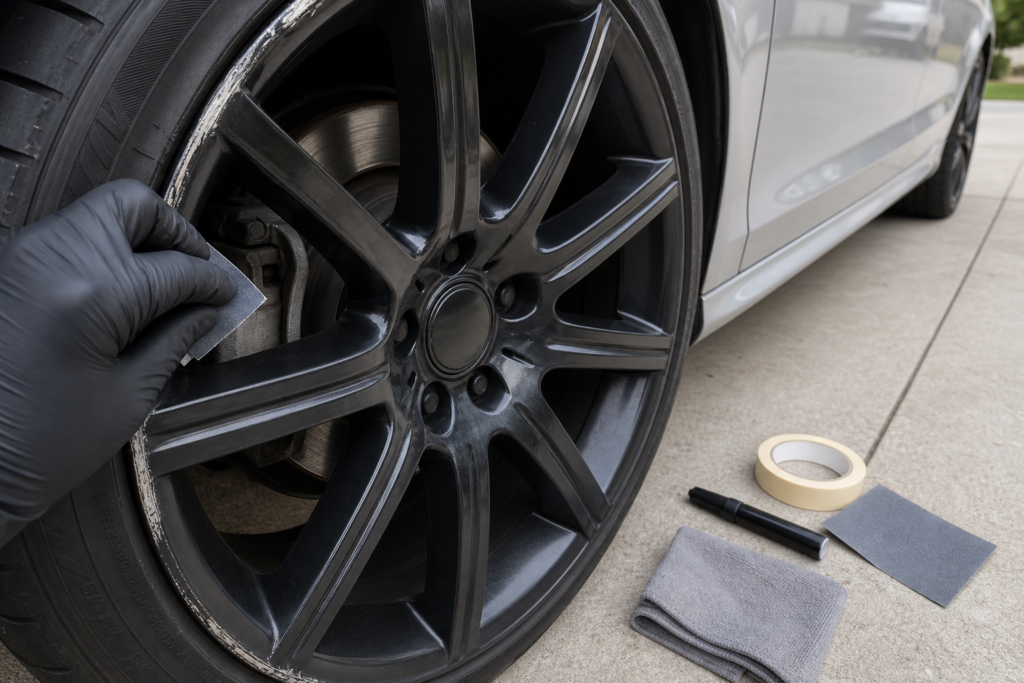
Material matters too. Curb rash on alloy wheels is especially common because aluminum alloys, while lighter and more attractive than steel, are softer and more prone to gouging. Many alloy wheels also carry clearcoat, paint, or machined finishes that chip or flake on impact. Once that protective layer breaks, the exposed aluminum begins to oxidize, turning the cosmetic scratch into an ongoing corrosion issue. Chrome-clad and polished finishes can show damage even more visibly, though the underlying failure mode is the same: abrasion removes the barrier, and the environment does the rest.
Most Common Curb Rash Scenarios
Parallel Parking. This is the single most common setting for curb rash. The driver focuses on the gap between the bumper and the car behind, while the right-side wheels track a path the driver can’t see well from the seat. Misjudging distance by even an inch or two, especially on the final backward arc toward the curb, puts the rear wheel’s rim lip directly against the concrete edge. Curb rash from parallel parking tends to hit the rear passenger-side wheel hardest, because the rear axle follows a tighter arc than the front during the turning maneuver.
Right Turns at Corners. At a tight right-hand turn, the front wheels may clear the curb comfortably while the rear wheels track inward on a shorter radius. This is basic turning geometry: the rear axle doesn’t steer, so it cuts the corner. Drivers who gauge clearance by the front wheel’s position often don’t realize the rear wheel is several inches closer to the curb. Curb rash from turning right is especially common at intersections with raised curbs and tight radii, where even a modest speed carries the rear wheel into contact.
Tight Spaces and Obstacles. Garage pillars, narrow parking stalls, multi-story ramp walls, drive-thru lanes, car-wash guide rails, and low parking blocks all present hard, abrasive edges at exactly the height of a wheel rim. In tight spaces, the driver is managing multiple obstacles at once, and the right-side wheels sit in the hardest zone to judge from the driver’s seat. Seating position and mirror setup play an overlooked role, since the driver sits on the left and the right-side wheel path is the farthest from direct view. Seat height, forward-back position, and mirror aim all change how well a driver can see the curb edge relative to the right-side wheels.
Repeated Contact Compounds Damage
A single light scrape might leave a mark no wider than a pencil line. Left alone, it’s cosmetic. But most curb rash doesn’t happen once, it accumulates. The same wheel hits the same kind of curb in the same kind of parking scenario, and each contact removes a little more material.
The progression follows a predictable path. First, the clearcoat or paint breaks. Then the bare aluminum beneath is exposed. Aluminum oxidizes when it contacts moisture and air, forming a dull, chalky white layer that spreads outward from the original scratch. Road salt, brake dust, and grime accelerate that process. What started as a scuff becomes a rough, corroded patch that’s harder and more expensive to restore than the original scratch would have been.
Curb rash on alloy wheels can eventually reach the tire bead area, the flat sealing surface where the tire meets the rim. If that surface develops burrs, nicks, or enough corrosion, the tire’s seal can weaken, leading to slow air loss. This isn’t common from a single light contact, but it’s a realistic outcome after repeated hits to the same wheel.
Beyond the rim itself, a hard enough impact can damage the tire sidewall, causing cuts, bulges, or weakened plies that aren’t always visible without close inspection. Vibration at highway speed or a persistent pull to one side after a curb strike can signal bent rim geometry. If you’ve heard or felt a significant scrape, inspecting both the wheel and the tire is worth the few minutes it takes. Look for sharp edges on the rim lip, sidewall scuffing or bubbling, and any change in tire pressure over the following days.
Habits That Reduce Curb Rash
Knowing how to avoid curb rash starts with accepting that the problem is geometric, not a reflection of skill. Small, deliberate adjustments cover most of the risk. Approach curbs at a shallower angle rather than turning sharply into them. The steeper the angle between the wheel and the curb face, the more likely the rim lip will make contact before the tire. When parallel parking, stop your rearward arc a few inches earlier than feels necessary, the gap that looks too far from the driver’s seat is usually just right at the curb.
Use fixed reference points. Many drivers develop a reliable sense of where the right-side wheels track by noting where the curb line appears relative to a dashboard feature or mirror edge. Adjusting the right-side mirror to angle slightly downward while parking gives a direct view of the rear wheel’s proximity to the curb, a habit common among commercial drivers for good reason.
Slow down more than instinct suggests. Curb rash almost always happens at low speed, but low doesn’t mean slow enough. The slower the maneuver, the more time the driver has to hear or feel an initial brush and stop before the scrape deepens. Finally, avoid riding the curb, rolling along parallel to it with the wheel just barely clearing, since one small steering input or a slight road-surface irregularity can close that gap instantly.
The Key Mental Model
Curb rash is a geometry and exposure problem: a hard curb edge, a soft alloy rim, and an approach angle that lets the two meet before the tire intervenes. It’s not about being a bad driver, it’s about the physics of a wheel’s most exposed point sitting millimeters from a surface that acts like sandpaper. Adjust the angle, widen the margin, and slow down a fraction more, and most curb rash never happens.