Trailer Wrap Pricing in OC

Covers real price ranges for wrapping cargo trailers in Orange County, including material choices for OC sun exposure, installation variables, and how to compare shop quotes.

The 24/7 Advertising Effect

A fully wrapped cargo trailer inching through the 405/55 interchange during Friday rush hour has its bold graphics facing thousands of windshields for twenty minutes straight. Or the same trailer parked outside a job site in Irvine all morning, doing nothing but collecting eyeballs. That’s the context behind every question about trailer wrap pricing in Orange County, and the reason quotes here vary more than people expect.

A wrapped trailer is a marketing machine that works 24/7. It advertises while you drive to a job, while you’re parked at a client’s house, and while it sits in your lot overnight facing the street. Contractors, landscapers, event rental companies, mobile detailers, delivery operators, across OC, the use cases overlap in one way: the trailer is already going places. The wrap just decides whether anyone remembers seeing it.

That framing matters because it shapes how you should evaluate cost. You’re not buying a sticker. You’re buying years of passive visibility on some of the most congested freeways in the country, in a market where outdoor advertising rates reflect that density.

Real Price Ranges and Variables

How much does a trailer wrap cost? There’s no single number, but there is a realistic band. For a small enclosed cargo trailer, partial coverage with basic graphics typically falls at the lower end of the spectrum and scales up with size and complexity. A full wrap on a larger enclosed trailer, say a 16- to 24-foot unit with complete graphic coverage on all visible panels, costs meaningfully more, and very large or complex jobs push higher still.

That range is wide on purpose because several variables compress or stretch it. Trailer size is the obvious one: more square footage means more material and more labor hours. Coverage level matters almost as much. A partial wrap, logo, phone number, and website on two or three panels, costs meaningfully less than wrapping every visible surface including the tongue box and fenders.

Design complexity is the variable people underestimate. A simple one- or two-color layout with text and a logo is fast to produce and straightforward to install. Full photographic imagery, gradients, intricate patterns, or designs that need to align across doors, seams, and corrugations add design time and installation precision. That precision costs money.

The trailer wrap cost also shifts depending on whether the shop is designing from scratch or working from a client-supplied file. Some shops include design in the quote; others bill it separately. Know which you’re getting before you compare numbers. For a sense of how these same variables play out in a different market, looking at trailer wrap pricing boston shows similar cost drivers but with regional material and labor differences.

Materials and Installation for OC Climate

Choosing a trailer vinyl wrap in Orange County is partly a climate decision. OC’s UV exposure is aggressive year-round, and the difference between a trailer parked daily in inland Anaheim or Santa Ana heat versus one garaged near the coast in Costa Mesa or Newport is real. Higher-grade cast vinyl with UV-resistant laminate holds color and adhesion longer under these conditions. Cheaper calendered vinyl can shrink, crack, or fade faster, especially on a trailer baking in a commercial lot with no shade.

Laminate type matters too. A matte or gloss overlaminate protects the printed layer from UV, abrasion, and salt air, a factor for any trailer regularly running coastal routes. Skipping laminate saves money upfront but shortens the wrap’s usable life, which changes the math.

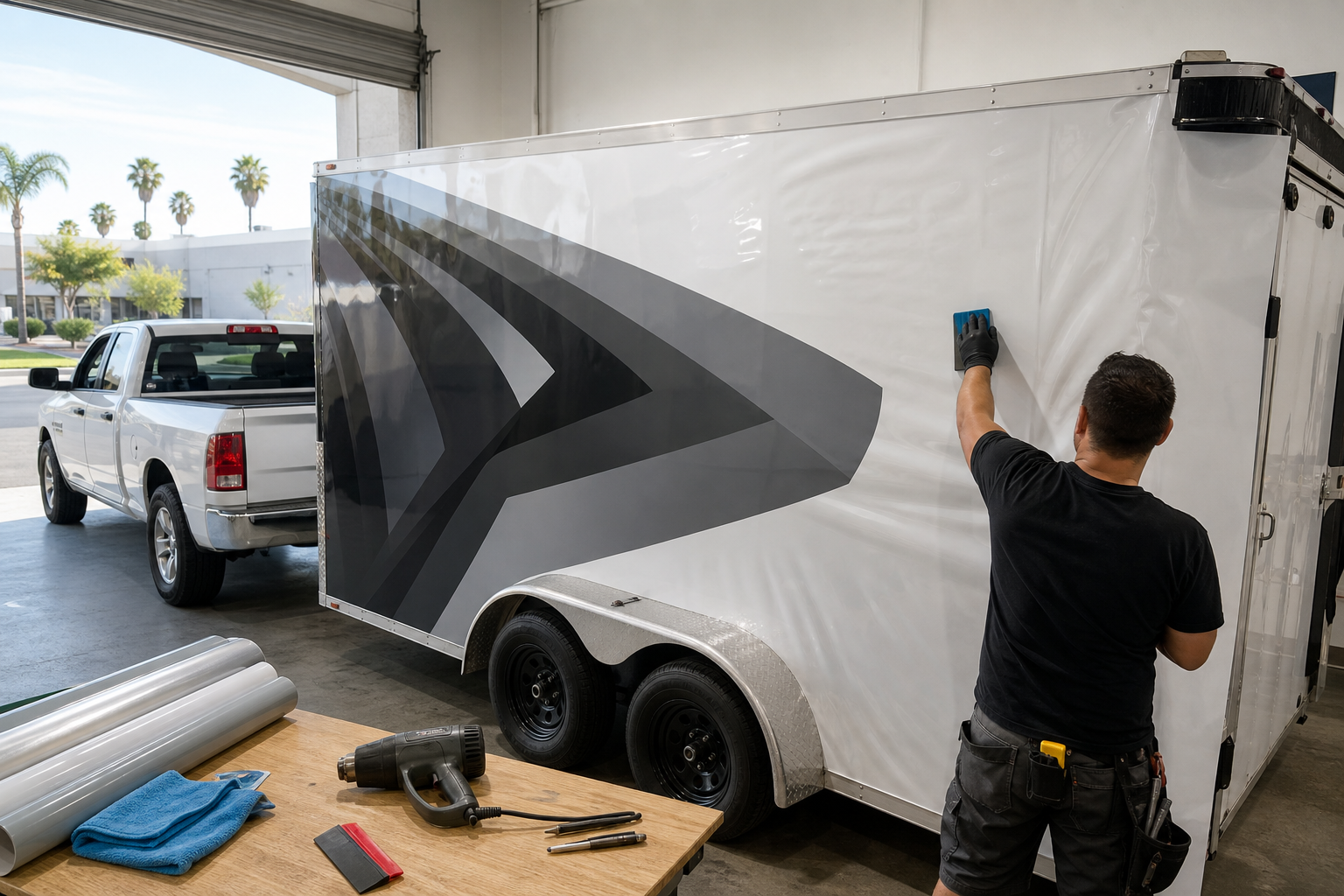
Installation is the other major cost driver, and trailers are not simple surfaces. Rivets, corrugations, recessed panels, door handles, latches, hinges, each requires careful cutting, tucking, and heat-forming. A clean trailer wrap installation in Orange County takes skilled labor and hours. If the trailer has an old wrap that needs removal, or surface damage that needs prep, expect that to add to the bill. These aren’t hidden costs if the shop is transparent, but they will inflate the final number beyond a basic per-square-foot estimate.

Lifespan and Compounding Visibility Payoff

A quality full wrap on a trailer in Southern California typically lasts several years before showing meaningful degradation, assuming proper material selection and installation. Premium cast vinyl with laminate, well installed and reasonably maintained, can hold up considerably longer in some cases, though OC sun and road conditions introduce variability.

Reframe the cost over that lifespan and the numbers shift. Take the total wrap cost, divide by the number of days you expect usable life, and you get a cost-per-day visibility figure. For most commercial trailer wraps in Orange County, that daily number is remarkably low. Compare that to monthly digital ad spend, print advertising, or even a single billboard lease along a major OC corridor, and the economics are straightforward.

Worth noting: trailer wraps and van or box truck wraps share some pricing logic, but trailers often offer more flat, uninterrupted surface area per dollar. Box truck wrap pricing tends to run higher partly because of more complex surfaces, roll-up doors, cab-to-box transitions, wheel wells. A trailer, by contrast, is mostly flat panels, which can mean more visible graphic area for the same spend. The tradeoff is that trailers don’t always move independently, so their route flexibility depends on your tow vehicle schedule.

Reading OC Wrap Quotes Right

When you’re comparing trailer wrap quotes in Orange County, the goal is apples-to-apples, and most quotes aren’t structured identically. Start by identifying what’s included. A complete quote should break out design, material (vinyl type and laminate), surface prep, installation labor, and warranty terms. If any of those are missing or bundled into a single line, ask for the breakdown.

Warranty terms vary. Some shops warranty the material; some warranty the installation; some warranty both. Know which you’re getting and for how long. A lower quote with no installation warranty may cost more in the long run if an edge lifts or a panel peels within the first year.

“Trailer wrap near me” searches will surface shops across OC, but pricing can vary by sub-region and shop workload. A busy shop in a high-rent area may quote higher overhead into the job. A shop in a lower-cost part of the county might quote less but have a longer lead time. Neither is automatically better, what matters is the specifics of your job.

Think in scenarios. If you’re a landscaper running a small 6×12 enclosed trailer and you want logo, number, and website on two sides, you’re looking at a partial wrap with simple graphics, lower end of the range. If you’re an event rental company with a 20-foot trailer and you want full photographic coverage on every panel including the rear doors, you’re in full-wrap territory with complex design and more installation hours. Match your expectations to the right tier before you start calling for quotes, and you’ll waste less of everyone’s time.

When Premium Wrap Spend Pays Off

Premium materials and meticulous installation cost more. Whether that premium is justified depends on your trailer, your routes, and your timeline.

If your trailer sits in direct sun most of the day, runs coastal and inland routes through OC’s full climate range, and you plan to keep it wrapped for several years, paying more for cast vinyl and quality laminate is rational. The per-day cost difference between a wrap that lasts a shorter period and one that lasts significantly longer is meaningful, and a faded, peeling wrap sends a worse message than no wrap at all.

If you’re wrapping a trailer for a short-term project, a seasonal business, or a vehicle you might sell within a year or two, a simpler partial wrap with mid-grade materials can deliver strong visibility without overcommitting. The key is matching your investment to your expected use window.

There is no universal right answer on trailer wrap pricing, only the answer that fits your math, your market, and your miles. Know what you’re buying, know what it costs per day of visibility, and the decision makes itself.

Trailer Wrap Pricing in OC

The 24/7 Advertising Effect

A fully wrapped cargo trailer inching through the 405/55 interchange during Friday rush hour has its bold graphics facing thousands of windshields for twenty minutes straight. Or the same trailer parked outside a job site in Irvine all morning, doing nothing but collecting eyeballs. That's the context behind every question about trailer wrap pricing in Orange County, and the reason quotes here vary more than people expect.

A wrapped trailer is a marketing machine that works 24/7. It advertises while you drive to a job, while you're parked at a client's house, and while it sits in your lot overnight facing the street. Contractors, landscapers, event rental companies, mobile detailers, delivery operators, across OC, the use cases overlap in one way: the trailer is already going places. The wrap just decides whether anyone remembers seeing it.

That framing matters because it shapes how you should evaluate cost. You're not buying a sticker. You're buying years of passive visibility on some of the most congested freeways in the country, in a market where outdoor advertising rates reflect that density.

Real Price Ranges and Variables

How much does a trailer wrap cost? There's no single number, but there is a realistic band. For a small enclosed cargo trailer, partial coverage with basic graphics typically falls at the lower end of the spectrum and scales up with size and complexity. A full wrap on a larger enclosed trailer, say a 16- to 24-foot unit with complete graphic coverage on all visible panels, costs meaningfully more, and very large or complex jobs push higher still.

That range is wide on purpose because several variables compress or stretch it. Trailer size is the obvious one: more square footage means more material and more labor hours. Coverage level matters almost as much. A partial wrap, logo, phone number, and website on two or three panels, costs meaningfully less than wrapping every visible surface including the tongue box and fenders.

Design complexity is the variable people underestimate. A simple one- or two-color layout with text and a logo is fast to produce and straightforward to install. Full photographic imagery, gradients, intricate patterns, or designs that need to align across doors, seams, and corrugations add design time and installation precision. That precision costs money.

The trailer wrap cost also shifts depending on whether the shop is designing from scratch or working from a client-supplied file. Some shops include design in the quote; others bill it separately. Know which you're getting before you compare numbers. For a sense of how these same variables play out in a different market, looking at trailer wrap pricing boston shows similar cost drivers but with regional material and labor differences.

Choosing a trailer vinyl wrap in Orange County is partly a climate decision. OC's UV exposure is aggressive year-round, and the difference between a trailer parked daily in inland Anaheim or Santa Ana heat versus one garaged near the coast in Costa Mesa or Newport is real. Higher-grade cast vinyl with UV-resistant laminate holds color and adhesion longer under these conditions. Cheaper calendered vinyl can shrink, crack, or fade faster, especially on a trailer baking in a commercial lot with no shade.

Laminate type matters too. A matte or gloss overlaminate protects the printed layer from UV, abrasion, and salt air, a factor for any trailer regularly running coastal routes. Skipping laminate saves money upfront but shortens the wrap's usable life, which changes the math.

Installation is the other major cost driver, and trailers are not simple surfaces. Rivets, corrugations, recessed panels, door handles, latches, hinges, each requires careful cutting, tucking, and heat-forming. A clean trailer wrap installation in Orange County takes skilled labor and hours. If the trailer has an old wrap that needs removal, or surface damage that needs prep, expect that to add to the bill. These aren't hidden costs if the shop is transparent, but they will inflate the final number beyond a basic per-square-foot estimate.

Lifespan and Compounding Visibility Payoff

A quality full wrap on a trailer in Southern California typically lasts several years before showing meaningful degradation, assuming proper material selection and installation. Premium cast vinyl with laminate, well installed and reasonably maintained, can hold up considerably longer in some cases, though OC sun and road conditions introduce variability.

Reframe the cost over that lifespan and the numbers shift. Take the total wrap cost, divide by the number of days you expect usable life, and you get a cost-per-day visibility figure. For most commercial trailer wraps in Orange County, that daily number is remarkably low. Compare that to monthly digital ad spend, print advertising, or even a single billboard lease along a major OC corridor, and the economics are straightforward.

Worth noting: trailer wraps and van or box truck wraps share some pricing logic, but trailers often offer more flat, uninterrupted surface area per dollar. Box truck wrap pricing tends to run higher partly because of more complex surfaces, roll-up doors, cab-to-box transitions, wheel wells. A trailer, by contrast, is mostly flat panels, which can mean more visible graphic area for the same spend. The tradeoff is that trailers don't always move independently, so their route flexibility depends on your tow vehicle schedule.

Reading OC Wrap Quotes Right

When you're comparing trailer wrap quotes in Orange County, the goal is apples-to-apples, and most quotes aren't structured identically. Start by identifying what's included. A complete quote should break out design, material (vinyl type and laminate), surface prep, installation labor, and warranty terms. If any of those are missing or bundled into a single line, ask for the breakdown.

Warranty terms vary. Some shops warranty the material; some warranty the installation; some warranty both. Know which you're getting and for how long. A lower quote with no installation warranty may cost more in the long run if an edge lifts or a panel peels within the first year.

"Trailer wrap near me" searches will surface shops across OC, but pricing can vary by sub-region and shop workload. A busy shop in a high-rent area may quote higher overhead into the job. A shop in a lower-cost part of the county might quote less but have a longer lead time. Neither is automatically better, what matters is the specifics of your job.

Think in scenarios. If you're a landscaper running a small 6x12 enclosed trailer and you want logo, number, and website on two sides, you're looking at a partial wrap with simple graphics, lower end of the range. If you're an event rental company with a 20-foot trailer and you want full photographic coverage on every panel including the rear doors, you're in full-wrap territory with complex design and more installation hours. Match your expectations to the right tier before you start calling for quotes, and you'll waste less of everyone's time.

When Premium Wrap Spend Pays Off

Premium materials and meticulous installation cost more. Whether that premium is justified depends on your trailer, your routes, and your timeline.

If your trailer sits in direct sun most of the day, runs coastal and inland routes through OC's full climate range, and you plan to keep it wrapped for several years, paying more for cast vinyl and quality laminate is rational. The per-day cost difference between a wrap that lasts a shorter period and one that lasts significantly longer is meaningful, and a faded, peeling wrap sends a worse message than no wrap at all.

If you're wrapping a trailer for a short-term project, a seasonal business, or a vehicle you might sell within a year or two, a simpler partial wrap with mid-grade materials can deliver strong visibility without overcommitting. The key is matching your investment to your expected use window.

There is no universal right answer on trailer wrap pricing, only the answer that fits your math, your market, and your miles. Know what you're buying, know what it costs per day of visibility, and the decision makes itself.
Trailer Wrap Questions for OC Cargo Trailers

Does the location of a trailer in Orange County affect which vinyl material holds up best?

A trailer parked daily in inland Anaheim or Santa Ana faces more intense heat exposure than one garaged near the coast in Costa Mesa or Newport, and that difference matters for material selection. Higher-grade cast vinyl with UV-resistant laminate is better suited to aggressive OC sun because cheaper calendered vinyl can shrink, crack, or fade faster when left in an unshaded commercial lot. Coastal routes add salt air exposure, which is another reason laminate is relevant beyond just UV protection.

What makes installing a wrap on a cargo trailer more labor-intensive than wrapping a flat panel?

Cargo trailer surfaces include rivets, corrugations, recessed panels, door handles, latches, hinges, and seams, each of which requires careful cutting, tucking, and heat-forming to achieve a clean result. A thorough installation takes substantial hours even before accounting for complicating factors. If an old wrap needs removal or the surface has damage requiring prep work, the labor scope increases further.

How does a partial trailer wrap differ from a full wrap in terms of what surfaces get covered?

A partial wrap applies graphics such as a logo, phone number, and website to two or three panels, leaving the rest of the trailer's surface unwrapped. A full wrap covers every visible surface, which can include the tongue box, fenders, rear doors, and all side panels. The difference in coverage directly affects both material usage and installation hours.

What should a complete trailer wrap quote from an Orange County shop include?

A transparent quote typically itemizes design, vinyl type and laminate, surface preparation, installation labor, and warranty terms. Quotes presented as a single bundled number can make it harder to compare materials and labor scope across shops. Warranty terms vary and may cover materials, installation, or both for different durations, so limited coverage can increase risk if an edge lifts or a panel peels early.

How does design complexity change the scope of a trailer wrap project?

Simple one- or two-color layouts with text and a logo are straightforward to produce and install. Full photographic imagery, gradients, or intricate patterns that must align across doors, seams, and corrugations demand extra design time and greater installation precision. Whether the shop creates the design from scratch or works from a client-supplied file also affects the scope, since some shops include design in the base work while others bill it separately.

How does wrapping a cargo trailer compare to wrapping a box truck in terms of usable graphic surface?

Trailers often supply more flat, uninterrupted surface area than box trucks, which tend to involve more complex surfaces such as roll-up doors, cab-to-box transitions, and wheel wells. The largely flat panels on a cargo trailer can yield more visible graphic area. The tradeoff is that a trailer does not move independently, so its route exposure depends entirely on the tow vehicle's schedule.

When does it make practical sense to use mid-grade materials on a trailer wrap instead of premium cast vinyl?

For a short-term project, a seasonal business, or a trailer that may be sold within a year or two, a simpler partial wrap with mid-grade materials can provide visibility without the commitment that premium materials are designed to support. The rationale for premium cast vinyl and meticulous installation grows when the trailer will stay wrapped for several years, runs both coastal and inland OC routes, and sits in direct sun most of the day. The useful match is between the expected use window and the investment level, not a single universal answer.

What visibility does a wrapped cargo trailer get compared to a stationary advertisement?

A wrapped trailer generates exposure during towing on congested freeways, while parked at job sites or client locations, and while sitting overnight in a lot facing the street. That combination produces continuous passive visibility across multiple contexts without requiring additional placement decisions. The article frames this as years of recurring impressions rather than a one-time static placement, and notes that outdoor advertising density on major OC corridors is already high.

Related News

Curb Rash on Rims

Covers what curb damage does to alloy, black, and chrome wheel finishes, DIY and professional repair options, cost factors, and prevention habits.

Read More

Curb Rash Repair Costs

Breaks down wheel refinishing prices by damage severity, finish type, and provider quality, with notes on Tesla and large-diameter EV wheels that run higher.

Read More

Fixing Curb Rash Realistically

Covers how to assess curb rash severity, when sanding and filler work on painted alloys, and why chrome or diamond-cut finishes require professional shop repair.

Read More

Bumper Curb Rash Explained

Covers the four levels of curb damage on plastic bumper covers, DIY versus professional repair paths, cost factors, and how ownership or rental status changes the right response.

Read More

Curb Rash Repair Options

Compares mobile technicians, alloy wheel shops, powder-coating facilities, and dealership options for fixing scraped rims based on finish type and damage depth.

Read More

Curb Rash Costs and Fixes

Covers how to assess wheel scrapes for cosmetic versus structural damage, compares DIY and professional repair across finish types, and outlines prevention habits.

Read More