Introduction
Whether you drive a Tesla down the MassPike, park in a Back Bay garage, or navigate Fenway game-day chaos, getting your windows tinted in Boston is about more than looks. It is about staying legal at your annual RMV inspection, handling brutal winters and humid summers, and protecting your vehicle investment long term. This guide covers everything you need to know.
- Part 1: Navigating Massachusetts Window Tint Laws
- Part 2: Why Boston’s Climate Makes Window Tinting Worth Every Penny
- Part 3: Film Types Compared Which Is Right for Your Boston Commute?
- Part 4: Pricing, Logistics & Finding the Right Boston Tint Shop
- Summary
Part 1: Navigating Massachusetts Window Tint Laws
For Boston drivers, the annual RMV safety inspection is the ultimate reality check on window tint legality. Massachusetts enforces some of the stricter tinting standards in New England, and failing your inspection means delays, removal costs, and re-inspection fees. Understanding the law before you tint is the smartest move you can make.
The 35% VLT Rule What It Actually Means
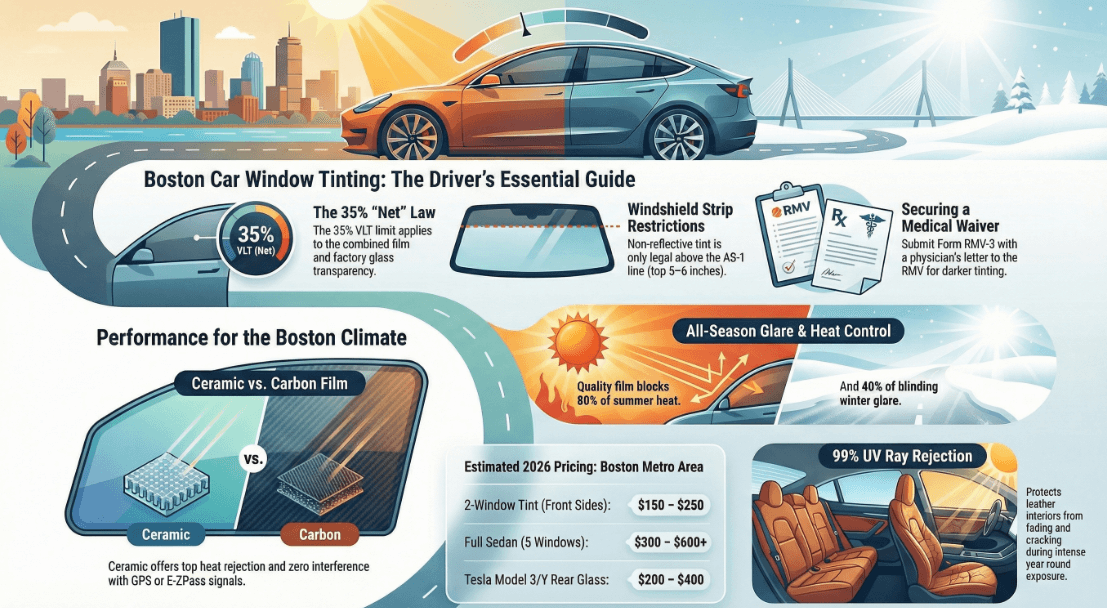
The most important number in Massachusetts tint law is 35%. All side windows, both front and rear, and the rear window must allow a minimum of 35% Visible Light Transmission (VLT). VLT measures the percentage of visible light that passes through the glass.
To visualize this: standard factory clear glass typically allows 70% to 90% VLT. A 35% VLT tint is a noticeable, medium-shade tint. It provides real privacy and heat rejection while still allowing a clear view from outside at daylight. Anything darker than 35% VLT on side or rear windows is illegal for passenger vehicles in Massachusetts.
Pro Tip: Hold your phone camera up to the window after tinting and take a photo. At 35% VLT, you should be clearly visible sitting in the car during daylight. If you can barely be made out, the tint is likely too dark.
The “Net” Law The Rule Most Drivers Miss
Here is where most Boston car owners get into trouble: Massachusetts law applies the 35% VLT limit to the combined, net result of your film and your factory glass, not just the film alone.
Factory automotive glass is not perfectly clear. It typically transmits about 70% to 80% of visible light on its own. If your factory glass is at 75% VLT and you apply a 50% VLT film, the combined result drops to approximately 37.5%, barely legal. Apply a 45% VLT film to that same glass, and you land at roughly 33.75%, which is now illegal even though the film itself would be sold as “45%” tint.
What to do: Always ask your tint shop to measure your existing factory glass VLT before selecting a film. A reputable Boston shop will do this with a tint meter, the same tool your inspection station uses.
The Windshield Strip What’s Legal at the Top
Massachusetts law allows a non-reflective tint strip along the top of the windshield, up to the manufacturer’s AS-1 line, typically 5 to 6 inches from the top of the windshield. This strip must be non-reflective and cannot extend into the driver’s primary vision area. It is a popular option for reducing sun glare during those blinding winter mornings on I-93 without violating the law.
No tint is allowed below the AS-1 line on windshields, and reflective or mirrored films are prohibited on any window in Massachusetts.
Medical Waiver Guide Darker Tint for Health Conditions
Massachusetts does provide a path for drivers with documented medical conditions that require reduced light exposure, such as photophobia (light sensitivity), lupus, albinism, xeroderma pigmentosum, or similar conditions, to apply for a Tinted Glass Waiver through the Massachusetts RMV.
How to Apply for a Massachusetts Tinted Glass Waiver
- Obtain a letter from your licensed physician clearly diagnosing your condition and stating the medical necessity for reduced visible light transmission.
- Complete Form RMV-3 (Tinted Glass Waiver Application), available on the Massachusetts RMV website or at any RMV Service Center.
- Submit the completed form and physician’s letter to your local RMV Service Center or by mail.
- If approved, you will receive a waiver certificate that must be kept in your vehicle at all times and presented during inspections.
- Waivers are issued per vehicle and must be renewed; they do not transfer if you sell the car.
Important: Even with a medical waiver, law enforcement may still pull you over. Always keep your waiver certificate easily accessible in the glove box.
Failed Your Inspection? Illegal Tint Removal Services
If you bought a used vehicle, moved to Massachusetts from another state, or simply had tint applied that does not meet the 35% standard, a failed inspection does not have to be a major headache. Most professional tint shops in the Boston metro area offer tint removal services ranging from $50 to $200, depending on the number of windows and the condition of the existing film.
Older or cheaper dyed films are typically the easiest and most affordable to remove. High-quality ceramic or carbon films, while longer-lasting, can require more labor to extract cleanly without leaving adhesive residue. Once removed, you can either drive with clear glass to pass your re-inspection or immediately have a legal 35% or higher VLT film applied in the same visit.
Part 2: Why Boston’s Climate Makes Window Tinting Worth Every Penny
Boston does not do seasons halfway. From January blizzards to July heat waves soaked in harbor humidity, your car takes a beating year round, and so do you while sitting in it. Quality window tinting addresses real, specific challenges that Boston drivers face in every season.
Winter Glare Reduction The MassPike’s Hidden Hazard
Most people think of window tinting as a summer luxury. Boston drivers know better. One of the most dangerous driving conditions on the MassPike, Route 1, and the Expressway is the low winter sun reflecting off fresh snow and ice, a blinding “white-out” glare effect that no pair of sunglasses fully defeats.
Quality window tint, particularly ceramic films, reduces visible glare by 20% to 40% while still allowing the legal minimum light transmission. This is not just a comfort upgrade; it is a genuine safety improvement for winter commuters navigating the South Shore or heading through the Sumner Tunnel at the wrong time of day.
Summer Heat Rejection Surviving Humid Boston Julys
Boston summers are deceptively brutal. The combination of high humidity, urban heat island effect, and direct sun can push the interior temperature of a parked car to 150°F or higher. Premium ceramic window films block up to 80% of infrared (IR) heat, the part of sunlight that actually heats your interior, while remaining optically clear.
This translates to a cooler car after parking, faster cooling when you do run the AC, and real fuel savings for those driving gas-powered vehicles. For EV owners, particularly Tesla drivers who are common in the Cambridge, Brookline, and Somerville areas, less thermal load on the cabin means better range efficiency in stop-and-go city driving.
Real-world estimate: A ceramic-tinted car parked on a Cambridge street in July can be 30°F to 40°F cooler inside compared to an untinted vehicle, before you even start the air conditioning.
Interior Preservation UV Damage Is a Year-Round Problem
Many Boston drivers assume UV protection is only relevant in summer. In fact, UV radiation penetrates clouds and reflects intensely off snow in winter, making UV exposure on leather seats, wood trim, and dashboards surprisingly high in January and February. Window tint blocks up to 99% of UV rays, dramatically slowing the fading and cracking of leather, vinyl, and plastic trim surfaces.
If you are leasing a vehicle and facing potential wear charges, or if you own a luxury vehicle whose interior is part of its resale value, UV-blocking film pays for itself in preserved condition alone. High-quality ceramic film typically carries a lifetime warranty against delamination, bubbling, and fading.
Shatter Resistance Safety & Security Film for Urban Parking
Boston’s density creates unavoidable parking realities, South End garages, Fenway street spots, and North End narrow streets all carry a risk that suburban driving does not: smash-and-grab theft. Standard automotive glass, when struck with sufficient force, shatters into the vehicle, granting immediate access to whoever swings the blow.
Safety and Security window films, available in both tinted and clear formulations, are designed to hold shattered glass in place on the film, significantly increasing the time and effort required to breach a window. A would-be thief who expects a single swing to open a window often moves on when the glass holds. These films meet ANSI Z97.1 safety standards and are frequently installed on commercial and fleet vehicles in the Boston area for exactly this reason.
Part 3: Film Types Compared Which Is Right for Your Boston Commute?
Not all window tint is created equal, and in Boston’s specific climate and legal environment, the choice of film type matters significantly. Here is a straightforward comparison of the four main categories available at local shops:
- Film Type: Ceramic
Best For: High-end EVs (Tesla/Lucid/Rivian)
Boston Performance: Best; blocks up to 80% IR heat, crystal-clear optics
Signal Safe? ✅ Yes; no GPS/cell interference - Film Type: Carbon
Best For: Daily Commuters
Boston Performance: Good; matte finish, will not fade or turn purple
Signal Safe? ✅ Yes - Film Type: Dyed
Best For: Budget-conscious drivers
Boston Performance: Fair; aesthetics and basic privacy only
Signal Safe? ✅ Yes - Film Type: PPF + Tint
Best For: New Car Owners
Boston Performance: Total protection: paint and glass combo package
Signal Safe? ✅ Yes
Ceramic Film The Boston Premium Standard
Ceramic film is the top-tier choice for Boston drivers who want maximum performance and zero legal risk. Unlike older metalized films, ceramic films contain no metal particles, meaning they do not interfere with GPS, Bluetooth, cellular signals, or toll transponders like the E-ZPass and FastLane units that Boston commuters rely on daily. Ceramic films block up to 80% of infrared heat, reject 99% of UV rays, and maintain their VLT rating indefinitely without fading or turning purple.
For Tesla Model 3 and Model Y owners, a rapidly growing segment of Boston’s vehicle population, ceramic film is almost universally recommended. The large panoramic rear glass on these vehicles is both a heat management challenge and a complex installation job, and ceramic film addresses both with the best possible performance-to-legal-compliance ratio.
Carbon Film The Smart Choice for Daily Commuters
Carbon film occupies the sweet spot between cost and performance for most Boston daily drivers. It rejects more heat than dyed film, carries a matte finish that resists fading without the metallic sheen that older films developed, and holds its VLT rating reliably. Carbon film will not turn that ugly purplish-brown that many Boston drivers with older tinted vehicles have noticed on cheap dyed installs from years past.
Dyed Film Entry-Level Privacy Without Performance
Dyed film is the most affordable option and is entirely adequate if your primary goal is privacy and aesthetics on a tight budget. However, it provides minimal heat rejection, fades over time, particularly in Boston’s intense winter UV environment, and offers no protection against UV damage or heat. For long-term value, most Boston shops recommend stepping up to carbon at minimum.
Paint Protection Film (PPF) + Tint Combo For New Car Owners
If you have just taken delivery of a new vehicle, particularly a high-end model, the PPF-plus-tint combination package is the definitive new car protection setup. PPF (clear urethane film) is applied to painted surfaces, particularly the front bumper, hood, mirrors, and door edges, to protect against road debris, salt spray, and scrapes from Boston’s tight parking situations. Paired with a tint package, this two-visit, or in some shops one-visit, service provides complete vehicle protection inside and out.
Part 4: Pricing, Logistics & Finding the Right Boston Tint Shop
Getting an accurate quote for window tinting in Boston requires understanding what drives pricing, film type, vehicle size, glass complexity, and shop reputation all factor in. Here are realistic 2026 estimates for the Boston metro area:
- Service: 2-Window Tint (Front Sides)
Estimated Price (2026): $150 to $250
Notes: Most common for legal compliance - Service: Full Sedan (5 Windows)
Estimated Price (2026): $300 to $600+
Notes: Varies by film type and glass complexity - Service: Full SUV / Van
Estimated Price (2026): $450 to $800+
Notes: Larger surface area, extended install time - Service: Tesla Model 3/Y Rear Glass
Estimated Price (2026): $200 to $400 (rear only)
Notes: One-piece install; specialist required - Service: Illegal Tint Removal
Estimated Price (2026): $50 to $200
Notes: Pre-inspection fix service
Tesla-Specific Tinting in Boston Why It Costs More
Tesla vehicles, particularly the Model 3, Model Y, and Cybertruck, present unique installation challenges that most standard tint shops are not equipped to handle well. The Model 3 and Y rear glass is a single, large, compound-curve piece that requires precision single-piece film cutting and installation. An inexperienced installer who attempts to seam the film will leave a visible horizontal line across the rear glass that looks amateur and reduces optical clarity.
Seek out a Boston-area shop that specifically lists Tesla installation experience, uses a computerized film-cutting plotter, not hand-cut patterns, and offers a warranty on delamination and bubbling. Expect to pay a premium; $200 to $400 for the rear glass alone is common; but the result, when done correctly, is nearly invisible.
Same-Day Service What to Look For
Most Boston tint shops complete a standard sedan or SUV tint job in 2 to 4 hours. For commuters who cannot leave their car for a full day, same-day service is a genuine selling point. Look for shops located near MBTA Green or Red Line stops in Somerville, Cambridge, or the South End; drop your car, ride the T to your office, and pick up your completed vehicle on the way home.
Some forward-thinking Boston shops now offer Wi-Fi lounges, coffee, and workspace setups specifically designed for remote workers who want to stay on-site during the install. If this matters to you, ask when booking.
Shop tip: Schedule your tint appointment mid-week if possible. Saturday slots fill up fast, particularly in spring as drivers prepare for summer, and rushed weekend installs are where quality suffers most.
Mobile Tinting vs. Climate-Controlled Shop The Boston Verdict
Mobile tinting services have grown in popularity in cities like Boston where parking and logistics make shop visits inconvenient. However, Boston’s specific environment creates conditions that make shop-based installation significantly superior for quality results.
Window film installation requires dust-free, temperature-stable air. Boston’s streets, particularly in summer construction season, carry significant airborne particulate matter. Wind gusts off the harbor create near-impossible conditions for handling large film panels outdoors. Even a single trapped dust particle under a film creates a permanent bubble that can only be fixed by removing and reinstalling the film. Climate-controlled shop environments eliminate these variables entirely.
If a mobile installer’s pricing seems significantly lower than shops, factor in the elevated risk of imperfect installation requiring a redo, which almost always costs more in the long run. Reserve mobile services for situations where shop access is genuinely impossible, and ensure the installer uses an enclosed van or portable shelter to simulate controlled conditions.
Questions to Ask Before Booking Any Boston Tint Shop
- Do you measure my factory glass VLT before selecting film to ensure the net result is 35% or higher?
- What film brands do you carry and can you show me the manufacturer’s warranty documentation?
- Do you have experience with Tesla or other EV panoramic glass installations?
- Is your installation environment climate-controlled and dust-managed?
- Do you provide a written receipt specifying the film brand, model, and VLT applied to each window?
- What is your warranty coverage and process if I develop bubbling or delamination?
Bottom Line for Boston Drivers
Window tinting in Boston is not just a cosmetic upgrade; it is a practical investment that pays dividends across every season, keeps you legal at your annual RMV inspection, and protects both your vehicle and the people inside it. Choose a reputable shop, insist on ceramic or carbon film for lasting performance, get your factory glass VLT measured first, and you will be the driver who actually enjoys Boston’s roads, year round.
Updated for 2026 • Massachusetts RMV Compliant Guidance
Summary
If you want tint that looks great and still passes Massachusetts inspection, plan around the 35% VLT requirement and remember the net law depends on both your factory glass and the film you choose. In Boston’s climate, ceramic and carbon films deliver the best all-season payoff through glare reduction, heat rejection, and UV protection. Pick a shop that measures your glass, documents the exact film and VLT installed, and can handle complex glass like Tesla rear panels in a clean, climate-controlled environment.
Conclusion: Boston window tinting is at its best when it is done with legality, climate, and long-term durability in mind. If you treat tint as protection rather than decoration, you will get a cooler cabin, safer visibility, and fewer headaches at inspection time.