Introduction
Your food truck is a 10,000-pound billboard on wheels. Before a single customer tastes your food, they’ve already judged your brand, in roughly three seconds, from across a crowded festival field or a busy downtown corner. That first impression is made entirely by your wrap.
A well-executed food truck wrap doesn’t just look good. It tells your story, signals your cuisine, converts hungry passersby into paying customers, and generates tens of thousands of advertising impressions every single day. A bad one does the opposite, or worse, renders you invisible.
In this guide, we’ve broken the world of food truck wraps into four chapters that matter most: creative inspiration, marketing strategy, technical execution, and cold business math. Whether you’re wrapping your first truck or refreshing an outdated look for 2026, this is the only resource you’ll need.
- Design & Branding Concepts
- Strategic Layout & Marketing
- Technical Specs & Maintenance
- Cost, ROI & Regulation
- Summary
Design & Branding Concepts
Stand Out at Every Festival, Corner & Curb
Great wrap design is part art direction, part psychology. These are the six most powerful concepts working in 2026, each one engineered to stop foot traffic cold.
- Appetite-Triggering Macro Photography
Nothing sells food like food. The single most effective visual choice you can make is large-format macro photography of your signature dish, melting cheese stretching from a burger, steam rising from a freshly pressed taco, glossy glaze catching sunlight on a donut. When printed at wrap scale, these hyper-real images trigger a visceral hunger response before the customer has consciously registered your brand. For best results, commission a professional food photographer and supply files at a minimum of 300 DPI at print size. Avoid stock imagery, authenticity matters, and experienced customers can spot it instantly.
- Minimalist “Modern Industrial” Aesthetic
The dominant trend in upscale street food branding for 2026 is clean, blocky geometry paired with muted palettes, matte charcoal, warm off-whites, stone gray, and dusty sage. This look communicates “gourmet” rather than “fast food” and photographs beautifully for social media. Choose a bold, geometric sans-serif typeface with tight tracking. Resist the temptation to fill every inch of your truck; intentional white space signals confidence and sophistication. This aesthetic works especially well for fusion concepts, craft beverage trucks, and high-end dessert vendors.
- Cultural & Heritage Themes
The most memorable food truck brands are rooted in a genuine cultural story. If your cuisine has a heritage, lean into it visually. Mexican concepts can draw on Talavera tile patterns, Oaxacan textile geometry, or the rich iconography of Día de los Muertos. Greek trucks can use Santorini blues, broken-column motifs, and Mediterranean mosaic borders. Vietnamese, Ethiopian, Korean, and South Asian cuisines all have extraordinarily rich visual vocabularies waiting to be translated into wrap art. When done with care and authenticity, this approach creates immediate recognition, emotional connection, and word-of-mouth power that generic designs simply cannot achieve.
- Mascot & Character Branding
A hand-drawn illustrated character, a grinning taco with sunglasses, a mustachioed chef bear, a cartoon shrimp on a surfboard, does several things simultaneously: it gives your brand a memorable face, creates instant approachability for families and children, and produces an endlessly versatile asset that works equally well on the truck, merchandise, packaging, and social media. Invest in a professional illustrator rather than using clip art or AI-generated images, which tend to look generic. The character should feel distinctly yours. Once established, your mascot becomes the backbone of a cohesive brand identity that customers recognize from a block away.
- 3D Lettering & Roof Toppers
At busy festivals where dozens of trucks compete for attention, vertical visibility is everything. 3D fabricated elements mounted to the roof, an oversized version of your logo in foam or aluminum, a giant prop food item, backlit channel letters, extend your brand identity above the roofline and can be spotted from hundreds of feet away. While these require a fabrication budget beyond the wrap itself, the ROI at high-foot-traffic events is exceptional. At minimum, consider extending your wrap design concept onto the roof surface, so aerial photos from event drones and drone-style social content also showcase your branding.
- The “Glow” Factor: Reflective & LED Elements
Food trucks that operate at night markets, after-hours events, or late-night spots have an enormous opportunity that most owners ignore: reflective vinyl and integrated lighting. 3M and Avery Dennison both manufacture specialty reflective films that catch vehicle headlights and venue lighting dramatically, making your truck pop against dark backgrounds. For a more dramatic effect, work with your wrap designer to plan zones where LED light strips can be mounted behind translucent sections of the wrap, creating a backlit glow effect. This is especially powerful for logos, taglines, and panel borders. A truck that glows at night is a truck that photographs itself, and gets shared.
Pro Tip: Before finalizing your design, print a scaled test panel (at least 24″×36″) and view it from 10, 25, and 50 feet away. What looks balanced on screen often needs significant adjustment at physical scale. Distance legibility should always take priority over close-up detail.
Strategic Layout & Marketing
Turn Your Wrap Into a Sales Machine
A beautiful truck that doesn’t convert customers is a missed opportunity. These five strategies treat your wrap as the sales tool it truly is.
- The 3-Second Rule Layout
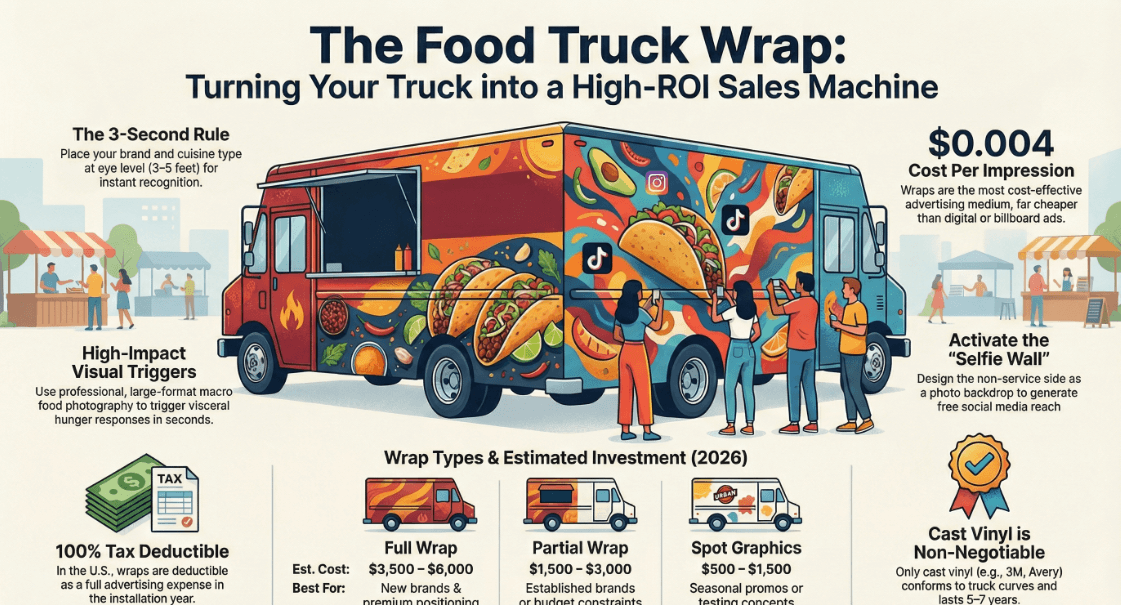
Research into outdoor advertising consistently shows that a moving audience decides within three seconds whether to stop and investigate. Your wrap layout must respect this ruthlessly. Place your two most critical pieces of information, what you serve and your brand name, at eye level (roughly 3 to 5 feet from the ground) on your service side. Use your largest, boldest typeface. Everything else, origin story, social handles, secondary items, can live at lower priority positions. If someone can’t read your food category and brand name in three seconds from 20 feet away, your layout is working against you. Test this by photographing your truck from that exact distance and squinting at the image.
- Digital Integration with QR Codes
QR codes have become universally understood and widely used since 2020. A large, high-contrast QR code placed near the ordering window or prominently on the rear of the truck can link to your live menu, weekly schedule, loyalty program, or social media follow page. Make the surrounding design explicitly invite the scan with a clear call-to-action like “SCAN TO SEE THIS WEEK’S MENU” in bold type. Ensure the landing page is mobile-optimized and loads in under two seconds, a slow-loading destination defeats the purpose entirely. Rotate QR code destinations seasonally without reprinting the wrap by using a QR code management service like QR Tiger or Beaconstac.
- Social Media “Selfie Wall” Design
The non-service side of your truck is underutilized real estate. Instead of simply mirroring the service side design, treat it as a curated photo backdrop, a “selfie wall” designed specifically to generate user-created content for social media. Use high-contrast, photogenic elements: bold color-blocking, your mascot character in a fun pose, a punchy branded hashtag at head height, or a playful illustrated frame that customers can stand inside. When a guest posts a photo at your truck and tags your brand, that’s free reach to their entire network. A single well-designed selfie wall can generate hundreds of tagged social posts per event, organic marketing worth thousands of dollars.
- Visual Hierarchy for In-Line Menu Panels
Long lines are your enemy, not because they indicate unpopularity, but because undecided customers at the front slow everything down. Integrating a “Signature Items” panel directly into the wrap design, visible from at least 15 feet back in the queue, allows customers to pre-decide while they wait. Feature your three or four most popular items with names, a one-line description, and a price. Pair each with a compelling food photo. Position this panel so it’s at comfortable reading height for someone standing 8 to 10 feet away. This simple addition measurably reduces average transaction time and increases the likelihood customers order a featured (and often higher-margin) item.
- Call-to-Action Prominence on the Rear
Every driver who sits in traffic behind your truck is a captive audience for 30 seconds to several minutes. The rear of your truck is premium advertising space that most operators waste. Use it for your strongest business development CTA: “BOOK US FOR YOUR NEXT EVENT” in massive type, followed by your website URL or phone number. Include your catering or event booking email address as well. This single change has been cited by food truck operators as their single most effective source of corporate catering leads, a revenue stream that can dwarf daily service income. Ensure the text is legible from at least 50 feet in daylight.
“Your wrap is the only advertisement you’re paying for anyway, it might as well work 24 hours a day, seven days a week, from every angle.”
Technical Specs & Maintenance
The Practical Details That Make or Break Your Wrap
Choosing the wrong material or skipping proper surface prep can turn a $5,000 investment into a peeling disaster within 18 months. Here’s what installers and manufacturers actually recommend.
- Cast vs. Calendered Vinyl: Why It Matters
There are two fundamental categories of wrap vinyl: cast and calendered. Calendered vinyl is less expensive but stiffens over time and cannot conform reliably to complex curves, rivets, recessed panels, or corrugated surfaces, all of which are common on food truck bodies. For a vehicle wrap that will be driven daily and exposed to temperature extremes, cast vinyl is non-negotiable. Industry standards point to 3M Series 1080, Avery Dennison Supreme Wrapping Film, or ORAFOL ORAGUARD as the benchmark products. Cast film stretches without cracking, conforms to compound curves, and maintains dimensional stability for 5 to 7 years under proper care. The cost difference over the life of the wrap is negligible.
- Heat & Grease Resistance
The area around your exhaust vents, cooking windows, and any external surfaces near heat-generating equipment requires specialized high-temperature laminates. Standard vinyl laminates begin to yellow, bubble, and peel when exposed to consistent heat above 140°F, a threshold easily exceeded near exhaust stacks and generator vents. Specify heat-resistant overlaminate films in these zones; 3M and Hexis both manufacture options rated for elevated temperature exposure. Additionally, all surfaces near cooking openings should be cleaned with a degreaser before installation, and the installer should use primer on any bare metal or previously painted surfaces to maximize adhesion. Skipping this step is the leading cause of premature wrap failure in the food service environment.
- Window Perforations: One-Way Vision Film
Covering windows with solid vinyl creates a dark, claustrophobic environment for staff and introduces safety concerns. The correct solution is perforated “one-way vision” film, a microperforated vinyl that appears as a solid printed graphic from outside, while staff inside have a clear (if slightly dimmed) view outward. The standard perforation ratio is 50/50 (50% vinyl, 50% open holes), which maintains graphic impact while preserving adequate light transmission. This film must be installed with care to ensure the perforations align cleanly with no air pockets. Your wrap designer should account for the optical density reduction in the design, colors printed on perforated film appear approximately 10 to 15% lighter at viewing distance than on solid material.
- Bleed, Templates & Irregular Dimensions
Food trucks are not standard vehicles. They come in dozens of body configurations, step vans, box trucks, custom trailers, converted buses, each with unique panel dimensions, rivet placements, door seams, and equipment openings. A professional wrap shop will measure your truck on-site and build a precise digital template before any print production begins. When supplying design files, ensure all critical elements stay at least 2 to 3 inches from any seam, rivet, or cut line. Maintain a 5 to 10 inch bleed beyond the intended print boundary to account for installation positioning tolerances. Request a pre-print proof overlaid on the truck template before approving final files, this step catches design errors that are extremely expensive to correct after printing.
- UV Protection & Seasonal Care
The sun-facing side of your truck will accumulate UV exposure significantly faster than the shaded side, causing color fade, chalking, and delamination over time if not protected. Premium cast vinyl films include UV inhibitors in the base film, but a high-quality UV-resistant overlaminate adds a critical additional layer of protection, particularly important in Southern and Southwestern markets where UV index is high year-round. For winter operations, vinyl becomes less pliable in temperatures below 40°F; avoid pressure washing with high heat in cold conditions, as thermal shock can stress film adhesion. An annual inspection by your wrap installer, including a check of all edges and seams, will catch issues early and dramatically extend the life of your investment.
Technical Checklist
- Request a flat truck template from your installer before design begins
- Specify cast vinyl (3M, Avery Dennison, or ORAFOL), not calendered
- Use heat-resistant laminate near all exhaust zones and cooking surfaces
- Design with a minimum 5-inch bleed on all edges
- Specify perforated one-way film for all window areas
- Apply UV-resistant overlaminate as standard, not optional in sunny climates
- Schedule an annual edge-and-seam inspection to extend wrap life
Cost, ROI & Regulation
The Business Case for a Great Wrap
For a food truck operator, every dollar matters. Here’s how to frame your wrap investment as the highest-performing marketing spend in your budget.
Key Performance Snapshot
- 70K Daily impressions from a single food truck wrap in urban areas
- $0.004 Cost per impression, far below typical digital advertising CPM
- 5 to 7 Years of effective lifespan for a properly installed cast vinyl wrap
Investment Breakdown: What to Expect in 2026
- Full Wrap 100% of exterior surfaces, $3,500 to $6,000, best for new brands, total rebrands, premium positioning
- Partial Wrap 50 to 75% of exterior, $1,500 to $3,000, best for established brands, budget constraints, accent branding
- Spot Graphics key panels only, $500 to $1,500, best for seasonal promotions, start-ups testing concepts
- Design & Template Fees N/A, $500 to $1,500, included with most full-service installers
- Removal (when upgrading) full truck, $300 to $600, budget for this from day one
- Advertising Value & CPM Comparison
The advertising industry measures reach in Cost Per Thousand Impressions (CPM). A food truck operating in a moderately busy urban environment generates between 30,000 and 70,000 daily visual impressions, from pedestrians, drivers, and event attendees who see the truck. Amortized over a five-year wrap lifespan, even a $5,000 full wrap delivers impressions at a CPM well under $1. Compare this to Instagram advertising ($6 to $10 CPM), Google Display ($1 to $3 CPM), or outdoor billboards ($2 to $8 CPM in secondary markets). The food truck wrap is not just branding, it is, by any mathematical measure, the most cost-effective advertising medium available to a small food business.
- Tax Deductibility as Advertising Expense
In the United States, a food truck wrap qualifies as a 100% deductible business advertising expense under IRS guidelines, not a capital improvement. This means you deduct the full cost in the year of installation rather than depreciating it over years. The distinction matters: a $5,000 wrap in the 25% tax bracket effectively costs you $3,750 out of pocket. Always retain your invoice and document the advertising purpose. Consult your tax professional to confirm treatment in your jurisdiction, but this deductibility has been a consistent position for vehicle advertising wraps and is well-established in U.S. tax practice.
- Local Compliance Requirements
Before finalizing your design, verify every jurisdiction you operate in for the following requirements. Health department permits and inspection certificates must be visible and unobstructed, in many states, covering them with vinyl is an automatic violation. Your VIN number and DOT registration markings must remain accessible or be reproduced in the wrap design. Safety lighting, reflective markings, and turn signals cannot be covered. Some municipalities also regulate the placement of commercial graphics on vehicles operating in public right-of-way. Your wrap installer should be familiar with local requirements, but the responsibility ultimately rests with the truck owner. Budget time for a compliance review before printing.
- The Removable Vinyl Strategy for Resale
If you plan to upgrade or replace your truck within two to three years, a common trajectory for growing operators, specify removable-grade cast vinyl (sometimes called “repositionable” or “air-egress” film) during installation. These films use a modified adhesive that releases cleanly from the truck surface without leaving residue or damaging paint, provided the vehicle’s surface was properly prepared before installation. A clean, residue-free truck commands a significantly higher resale value than one with adhesive ghost marks and paint damage. The cost difference between removable and permanent vinyl grades is minimal, typically $200 to $400 on a full wrap, and it pays for itself many times over at resale.
ROI Snapshot: A Real-World Example
Consider a full wrap at $5,000, tax-deducted to an effective cost of $3,750, over 5 years = $750/year. Operating 250 days per year in a medium-traffic urban area at 40,000 daily impressions = 10 million impressions annually. That’s $0.075 per thousand impressions, a fraction of any digital advertising channel. If the wrap generates even one new catering booking per month at $2,000 average, the wrap pays for itself entirely within the first 2 to 3 months of operation.
Summary
A food truck wrap is your most visible marketing asset, and in 2026 the best wraps combine strong design, conversion-focused layout, and durable materials. If you prioritize distance legibility, intentional branding, cast vinyl, and smart marketing placements like QR codes and rear-facing calls-to-action, your wrap becomes a dependable sales tool, not just decoration.
Conclusion: A great food truck wrap is one of the few marketing investments that works every day you operate, in every location you park, and from every angle. Treat it like a core part of your business strategy, and it will pay you back in visibility, customer trust, and revenue for years.